
The peer review process serves as the foundation of academic integrity, ensuring that scholarly work meets rigorous standards before publication. Through systematic evaluation by experts in the field, this quality control mechanism filters research contributions and maintains the credibility of academic literature. When examining a specific peer review example, we can observe how reviewers assess methodology, analyze findings, and provide constructive feedback that strengthens research outcomes.
This critical evaluation process involves multiple stages, from initial manuscript submission to final publication decisions. Reviewers examine everything from experimental design and data analysis to literature citations and theoretical frameworks. Their detailed comments and recommendations guide authors toward improvements that enhance both scientific validity and clarity of presentation.
What is Peer Review?
Peer review is a quality control process used in academic and scientific publishing where experts in a specific field evaluate research work before it gets published. Here’s how it works:
The Basic Process: When researchers submit a manuscript to a journal, the editor sends it to independent experts (peers) in the same field. These reviewers assess the work’s quality, methodology, originality, and significance without knowing the authors’ identities in many cases.
What Reviewers Evaluate:
- Research methodology and experimental design
- Data analysis and interpretation
- Literature review completeness
- Clarity of writing and presentation
- Significance of findings
- Ethical considerations
Types of Decisions: Reviewers typically recommend one of several outcomes: accept as-is, accept with minor revisions, major revisions required, or reject. The editor makes the final decision based on these recommendations.
Why Peer Review Matters
Quality Assurance and Error Detection
Peer review serves as academia’s primary quality control mechanism. Expert reviewers scrutinize every aspect of research, from experimental design to statistical analysis, catching methodological flaws that authors might overlook. This process identifies calculation errors, logical inconsistencies, and problematic interpretations before they reach the public. Without this safeguard, unreliable findings could spread through the academic community, potentially misleading future research and policy decisions.
Reviewers bring fresh perspectives and specialized knowledge that help identify blind spots in research. They may spot confounding variables the authors missed, suggest alternative explanations for results, or point out gaps in the literature review. This collaborative refinement process significantly improves the final quality of published work.
Maintaining Scientific Integrity
The peer review system upholds the fundamental principles of scientific inquiry by ensuring research meets established standards. It creates a barrier against fraudulent data, plagiarism, and unethical research practices. Reviewers verify that proper protocols were followed, ethical guidelines were observed, and citations are accurate and complete.
This gatekeeping function protects the credibility of scientific journals and maintains public trust in academic institutions. When people read peer-reviewed research, they can have greater confidence that the work has been thoroughly vetted by knowledgeable experts who have no vested interest in the outcomes.
Advancing Knowledge Through Constructive Criticism
Peer review transforms research from isolated individual efforts into collaborative endeavors that benefit the entire scientific community. Reviewers often suggest additional experiments, recommend relevant literature, or propose alternative interpretations that strengthen the work’s contribution to knowledge.
The feedback process frequently leads to significant improvements in research design, analysis methods, and presentation clarity. Authors learn from experienced researchers in their field, gaining insights that enhance not only the current manuscript but also their future research capabilities. This mentorship aspect of peer review helps maintain and elevate academic standards across generations of scholars.
Filtering and Prioritizing Research
With thousands of studies conducted annually in any given field, peer review helps prioritize the most significant and reliable contributions. Journals use reviewer assessments to decide which research deserves publication in limited space, ensuring that the most impactful and methodologically sound work receives attention.
This filtering process helps researchers and practitioners focus on high-quality studies rather than wade through potentially unreliable information. It creates a hierarchy of credibility that guides funding decisions, policy development, and future research directions.
Building Academic Reputation and Career Development
The peer review process establishes a merit-based system where research quality determines publication success and career advancement. This creates incentives for researchers to maintain high standards and pursue meaningful questions rather than simply producing large quantities of work.
For early-career researchers, navigating the peer review process provides essential training in academic communication and research methodology. Learning to address reviewer comments professionally and incorporate feedback constructively develops critical skills for long-term academic success.
Public Policy and Practical Applications
Many government agencies, healthcare organizations, and policy makers rely specifically on peer-reviewed research when making important decisions that affect public welfare. The peer review stamp of approval signals that findings have been rigorously evaluated and can be trusted as a basis for action.
In fields like medicine, environmental science, and public health, peer-reviewed research directly influences treatment protocols, regulatory decisions, and safety guidelines. The quality control provided by peer review becomes a matter of public safety and effective governance.
Global Collaboration and Knowledge Sharing
Peer review facilitates international collaboration by establishing common standards that transcend geographic and cultural boundaries. Researchers worldwide can engage with and build upon each other’s work with confidence, knowing that peer-reviewed publications meet universally recognized quality criteria.
This standardization enables the global scientific community to function as a cohesive enterprise, where discoveries in one country can immediately inform and advance research elsewhere. The peer review system creates a shared language of academic rigor that enables effective international cooperation.
Continuous Improvement of Research Methods
The peer review process drives innovation in research methodology by subjecting new approaches to expert scrutiny. Reviewers evaluate novel techniques, statistical methods, and experimental designs, helping to establish best practices and identify promising new directions.
This ongoing evaluation and refinement of research methods ensures that scientific inquiry continues to evolve and improve. Fields advance not just through new discoveries, but through the development of better ways to conduct reliable research.
Addressing Limitations and Evolving Practices
While peer review remains essential, the academic community continues working to address its limitations. Initiatives like open peer review, post-publication review, and alternative metrics are being developed to make the process more transparent, efficient, and comprehensive.
These evolutionary improvements demonstrate that the importance of peer review lies not in its current form being perfect, but in its fundamental role as a mechanism for maintaining and improving research quality. As academic communication continues to evolve, peer review adapts while preserving its core mission of ensuring scholarly integrity.
Structure of a Peer Review Example
Overview of Peer Review Components
A comprehensive peer review example typically contains several distinct sections that work together to provide thorough feedback on a submitted manuscript. Understanding this structure helps both authors and aspiring reviewers navigate the evaluation process effectively.
1. Reviewer Header Information
Basic Details:
- Manuscript title and ID number
- Journal name
- Review submission date
- Reviewer identification (often anonymous)
- Recommendation summary (accept, revise, or reject)
Confidentiality Statement: Most reviews begin with a reminder about the confidential nature of the review process and ethical obligations.
2. Overall Assessment Summary
General Impression: The reviewer provides a brief overview of their overall assessment, typically 2-3 sentences summarizing the manuscript’s strengths and main areas for improvement.
Significance Statement: A concise evaluation of the work’s contribution to the field, including:
- Novelty of findings
- Relevance to current research
- Potential impact on the discipline
- Appropriateness for the target journal
3. Major Comments Section
Methodological Evaluation:
- Research design appropriateness
- Sample size and selection criteria
- Data collection procedures
- Statistical analysis methods
- Control group considerations
- Experimental protocols
Content Analysis:
- Literature review completeness and accuracy
- Theoretical framework strength
- Results interpretation validity
- Discussion of limitations
- Conclusions supported by data
Structural Assessment:
- Logical flow of arguments
- Organization of sections
- Clarity of presentation
- Abstract accuracy
- Title appropriateness
4. Specific Technical Comments
Line-by-Line Feedback: Reviewers often provide detailed comments organized by manuscript section:
Abstract Comments:
- Accuracy of summary
- Key findings representation
- Word count adherence
- Keywords appropriateness
Introduction Comments:
- Background information sufficiency
- Research gap identification
- Hypothesis clarity
- Objective statement precision
Methods Comments:
- Procedure replicability
- Equipment specifications
- Ethical approval documentation
- Statistical power considerations
Results Comments:
- Data presentation clarity
- Figure and table quality
- Statistical reporting accuracy
- Missing analyses identification
Discussion Comments:
- Interpretation accuracy
- Limitation acknowledgment
- Future research suggestions
- Practical implications discussion
References Comments:
- Citation accuracy
- Source credibility
- Completeness of relevant literature
- Formatting consistency
5. Minor Comments and Editorial Suggestions
Language and Style:
- Grammar and syntax corrections
- Clarity improvements
- Terminology consistency
- Writing flow enhancement
Formatting Issues:
- Citation style compliance
- Figure caption accuracy
- Table formatting
- Reference list organization
Technical Corrections:
- Spelling errors
- Numerical accuracy
- Unit consistency
- Abbreviation definitions
6. Confidential Comments to Editor
Separate Section for Editorial Team: Many reviews include a confidential section visible only to editors, containing:
Publication Recommendation:
- Detailed justification for accept/revise/reject decision
- Priority level for publication
- Comparison with similar published work
- Journal fit assessment
Process Concerns:
- Ethical considerations
- Potential conflicts of interest
- Reviewer expertise limitations
- Time constraints affecting review quality
7. Constructive Feedback Framework
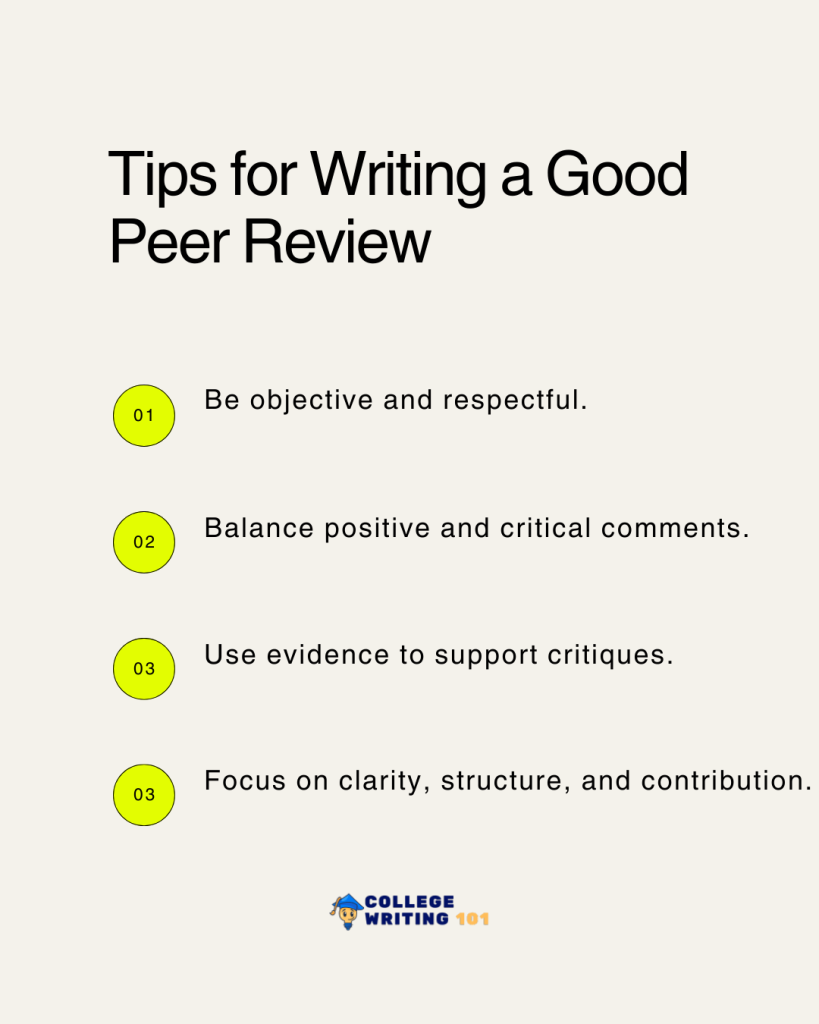
Positive Reinforcement: Effective reviews balance criticism with recognition of strengths:
- Acknowledge innovative aspects
- Highlight well-executed components
- Recognize clear writing sections
- Praise appropriate methodology choices
Improvement Suggestions: Rather than simply identifying problems, quality reviews provide:
- Specific recommendations for addressing issues
- Alternative approaches for consideration
- Additional resources or references
- Step-by-step improvement guidance
8. Review Tone and Professional Standards
Professional Communication:
- Respectful language throughout
- Constructive rather than destructive criticism
- Objective evaluation focus
- Supportive improvement orientation
Evidence-Based Feedback:
- Citations supporting reviewer claims
- Specific examples from the manuscript
- Clear rationale for recommendations
- Transparent reasoning process
9. Recommendation Categories Explained
Accept:
- Minor revisions only
- Strong contribution to field
- Methodologically sound
- Well-written and organized
Major Revisions:
- Significant improvements needed
- Potential for strong contribution
- Methodological concerns addressable
- Substantial rewriting required
Minor Revisions:
- Small improvements needed
- Generally strong manuscript
- Easily addressable issues
- Quick turnaround expected
Reject:
- Fundamental methodological flaws
- Insufficient contribution
- Poor fit for journal
- Unaddressable major problems
10. Best Practices in Review Structure
Comprehensive Coverage:
- Address all manuscript components
- Balance detail with clarity
- Prioritize most critical issues
- Provide actionable feedback
Time Management:
- Allocate appropriate time for thorough review
- Meet deadline commitments
- Request extensions when necessary
- Maintain consistent quality standards
Continuous Improvement:
- Learn from editor feedback on reviews
- Observe reviewing styles of others
- Participate in reviewer training programs
- Stay updated on field-specific standards
Peer Review Example
Manuscript ID: JEDU-2024-0387
Journal: Journal of Educational Psychology
Manuscript Title: “The Impact of Mindfulness-Based Interventions on Academic Performance and Stress Levels Among College Students: A Randomized Controlled Trial”
Reviewer: Anonymous
Review Date: March 15, 2024
Recommendation: Major Revisions Required
Overall Assessment
This manuscript presents a randomized controlled trial examining the effects of mindfulness-based interventions on academic performance and stress levels in college students. The research addresses an important and timely question given the increasing mental health challenges facing university populations. The study demonstrates solid methodological design with appropriate randomization and control procedures. However, several significant issues require attention before publication, including incomplete statistical reporting, limited discussion of practical implications, and insufficient consideration of potential confounding variables.
The work makes a meaningful contribution to the literature on mindfulness in educational settings, but the current presentation does not fully capitalize on the strength of the data collected.
Major Comments
Methodological Concerns
Sample Size and Power Analysis
While the authors report recruiting 240 participants, the power analysis section (page 8) lacks sufficient detail. Please provide:
- Effect size assumptions used in power calculations
- Alpha level and desired power
- Justification for the chosen effect size
- Post-hoc power analysis given the actual effect sizes observed
Randomization Procedure
The randomization method needs clearer explanation. The manuscript states participants were “randomly assigned” but provides no details about:
- Randomization sequence generation method
- Allocation concealment procedures
- Stratification variables (if any)
- Who conducted the randomization
Control Group Design
The waitlist control design raises concerns about expectancy effects. Consider discussing:
- Why an active control condition was not used
- Potential bias from participants knowing their group assignment
- How this limitation affects interpretation of results
Statistical Analysis Issues
Missing Data Handling
The manuscript mentions 23 participants dropped out but provides insufficient information about:
- Reasons for dropout by group
- Missing data patterns
- Imputation methods used
- Sensitivity analyses for missing data assumptions
Multiple Testing Corrections
With multiple outcome measures, the absence of correction for multiple comparisons is problematic. Please address:
- Bonferroni or other appropriate corrections
- Primary versus secondary outcome designation
- Justification if no corrections applied
Effect Size Reporting
While p-values are reported, effect sizes are inconsistently presented. Please include:
- Cohen’s d for all group comparisons
- Confidence intervals for effect sizes
- Clinical or practical significance discussion
Results Presentation
Figure 2 Clarity
The time-series plot is difficult to interpret due to:
- Overlapping confidence intervals that are hard to distinguish
- Small font sizes for axis labels
- Missing error bars for some time points
Table 3 Formatting
The correlation matrix contains several formatting issues:
- Inconsistent decimal places
- Missing significance indicators
- Unclear variable abbreviations
Specific Comments by Section
Abstract
- Line 23: “Significant improvements” should specify the magnitude (effect size)
- Line 31: The conclusion overstates findings given the limitations discussed
- Consider adding confidence intervals to the abstract results
Introduction
Strengths:
- Comprehensive literature review covering both mindfulness and academic performance research
- Clear rationale for studying college populations
- Well-articulated research gaps
Areas for Improvement:
- Page 4, paragraph 2: The transition between mindfulness mechanisms and academic outcomes needs strengthening
- Consider adding more recent meta-analyses (2022-2023 publications)
- The theoretical framework could benefit from a visual model
Methods
Participants Section:
- Recruitment methods need more detail – were incentives provided?
- Demographic table should include socioeconomic indicators
- Exclusion criteria for psychiatric medications seems overly broad
Intervention Description: The mindfulness protocol description is excellent and appears replicable. Minor suggestions:
- Include instructor qualifications and training
- Specify homework compliance monitoring procedures
- Add information about session attendance requirements
Measures:
- Perceived Stress Scale reliability in this sample should be reported
- Academic performance operationalization needs justification – why GPA over other measures?
- Consider adding qualitative measures for intervention acceptability
Results
Baseline Characteristics: Table 1 effectively demonstrates successful randomization, though effect sizes for any differences should be included.
Primary Outcomes: The ANOVA results are clearly presented, but please add:
- Assumption testing results (normality, homogeneity of variance)
- Effect size interpretations using established benchmarks
- Post-hoc pairwise comparisons with appropriate corrections
Secondary Analyses: The mediation analysis is interesting but needs:
- Bootstrap confidence intervals
- Stronger theoretical justification
- Discussion of temporal precedence issues
Discussion
Strengths:
- Honest acknowledgment of study limitations
- Good connection to previous literature
- Practical implications discussed
Areas Needing Development:
- Mechanism discussion could be expanded – why might mindfulness specifically help academic performance?
- Limited consideration of individual differences in intervention response
- Future research directions could be more specific and actionable
- Clinical significance discussion is missing
Minor Comments and Editorial Suggestions
Language and Style
- Page 6, line 234: “Participants were asked to complete” – awkward phrasing, suggest revision
- Page 12, line 456: Missing space between sentences
- Throughout: Consider using active voice more consistently
- Several instances of unclear pronoun references (e.g., page 9, line 287)
Technical Issues
- References 23 and 47 appear to be duplicates
- Figure 1 caption doesn’t match the figure content
- Inconsistent abbreviation usage (sometimes spelled out, sometimes abbreviated)
- Page numbers missing from pages 15-17
APA Format Compliance
- Several in-text citations missing page numbers for direct quotes
- Reference list needs consistency in doi formatting
- Table titles should be above tables, not below
- Some headings don’t follow APA 7th edition style
Recommendations for Revision
Essential Changes (Must Address)
- Conduct and report appropriate multiple testing corrections
- Provide complete power analysis details
- Address missing data handling more thoroughly
- Include effect sizes with confidence intervals throughout
- Improve figures and tables for clarity
- Expand discussion of practical significance
Highly Recommended Changes
- Add active control group rationale or limitation discussion
- Include more recent literature (2022-2023)
- Provide theoretical model figure
- Expand mechanism discussion
- Address individual differences in treatment response
- Improve intervention fidelity reporting
Suggested Enhancements
- Add qualitative feedback from participants
- Include cost-effectiveness considerations
- Discuss implementation challenges
- Provide more specific future research directions
- Consider cultural considerations in mindfulness practice
Confidential Comments to Editor
This manuscript addresses an important research question with generally sound methodology. The randomized controlled trial design is appropriate, and the sample size is adequate for detecting meaningful effects. The writing is generally clear, though some sections need revision for clarity and precision.
The main concerns center on statistical rigor and complete reporting rather than fundamental methodological flaws. The authors appear responsive to feedback based on their previous publications, and I believe the necessary revisions are well within their capabilities.
I recommend major revisions with re-review to ensure statistical issues are adequately addressed. The work has potential for solid contribution to the field once these issues are resolved.
Timeline Recommendation: Given the extent of revisions needed, particularly statistical re-analyses, I suggest allowing 8-10 weeks for revision.
Reviewer Availability: I am available to review the revised manuscript and would be interested in seeing how the authors address the statistical concerns raised.
Overall Recommendation: Major Revisions
This study has the potential to make a valuable contribution to our understanding of mindfulness interventions in academic settings. The research question is important, the methodology is generally sound, and the findings could inform educational practice and policy. However, the manuscript requires substantial revision to meet publication standards, particularly regarding statistical rigor and comprehensive reporting of results.
I encourage the authors to address these concerns thoroughly, as doing so will significantly strengthen their contribution to the literature. The work demonstrates good scholarship and addresses a practically important question – with appropriate revisions, it should make a solid addition to the journal.
Word Count: 1,247 words
Review Completion Time: 4.5 hours
Expertise Match: High (mindfulness interventions, educational psychology, RCT methodology)
FAQs
What are the most common types of peer review?
Single-blind, double-blind, and open peer review.
What is peer review in simple words?
It is when experts check someone’s work to make sure it is accurate, clear, and reliable before it is published.
What are the five types of peer status?
Popular, rejected, neglected, controversial, and average.