
Moral principles serve as the compass that guides human behavior, shaping our decisions and interactions in countless ways throughout our daily lives. These fundamental beliefs about right and wrong manifest differently across cultures, religions, and individual perspectives, yet they share common threads that unite humanity’s quest for ethical living.
Understanding morals through concrete examples helps illuminate how abstract principles translate into real-world actions. From simple acts of honesty in personal relationships to complex decisions about justice in professional settings, moral examples reveal the practical application of our deepest values. They demonstrate how concepts like integrity, compassion, fairness, and respect play out in situations ranging from everyday encounters to life-changing moments.
By examining specific moral examples, we can better comprehend how ethical frameworks influence behavior and decision-making. These examples not only clarify what it means to act morally but also highlight the ongoing challenges we face when competing values conflict, helping us develop stronger ethical reasoning skills for navigating life’s complex moral landscape.
What Are Morals?
Morals are the fundamental principles and beliefs that distinguish between right and wrong, serving as the ethical foundation for human behavior and decision-making. These deeply held convictions about what constitutes proper conduct guide individuals and societies in determining acceptable actions and behaviors.
Morals represent a system of values that helps people navigate complex situations by providing a framework for ethical judgment. They encompass concepts such as honesty, justice, compassion, respect, and responsibility, which collectively shape our understanding of virtuous behavior. Unlike laws, which are externally imposed, morals emerge from internal conviction and personal conscience.
Morals develop through various influences including family upbringing, cultural traditions, religious teachings, personal experiences, and philosophical reflection. They serve as an internal compass, helping individuals make choices that align with their sense of what is ethically sound. While moral principles can vary between different cultures and belief systems, they universally address fundamental questions about how humans should treat one another and what constitutes a life well-lived, forming the backbone of civilized society.
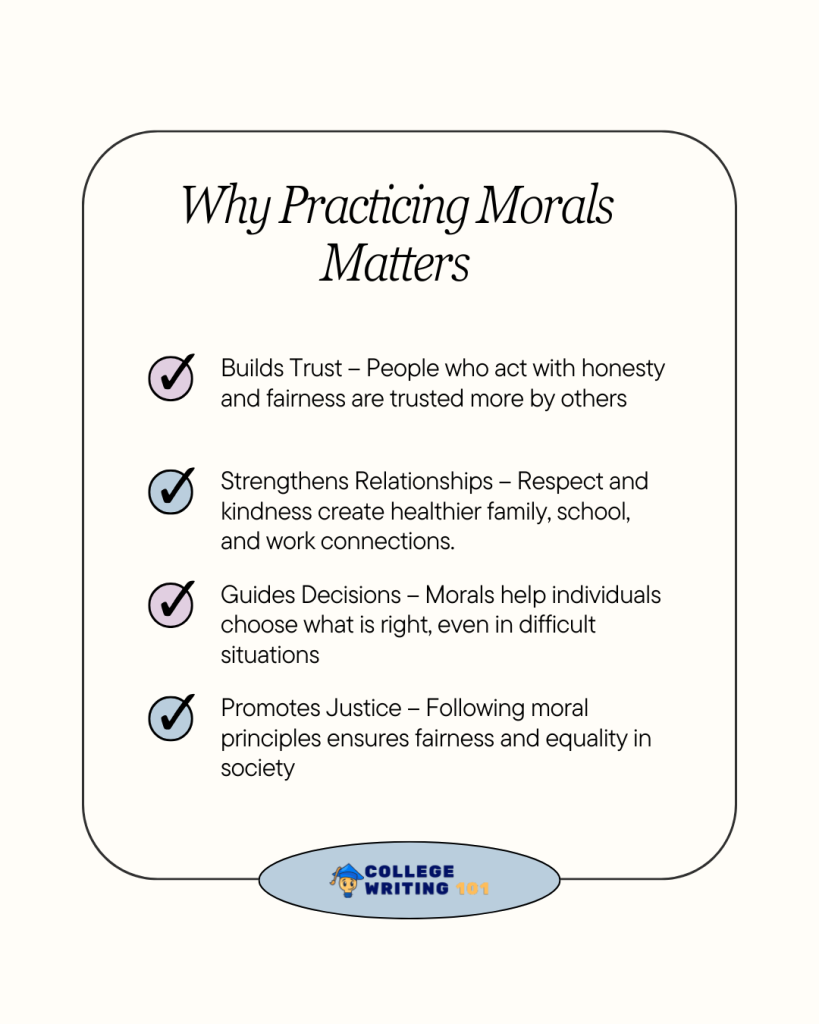
Common Examples of Morals
Honesty and Truthfulness
One of the most fundamental moral principles involves commitment to truth and transparency. This manifests in telling the truth even when it’s difficult or uncomfortable, such as admitting mistakes to supervisors, being forthright about qualifications during job applications, or confessing wrongdoing to friends or family members. Honesty extends to avoiding deception in business dealings, providing accurate information in academic work, and maintaining transparency in personal relationships. This moral principle also encompasses avoiding lies of omission, where important information is deliberately withheld.
Respect for Others
Treating all individuals with dignity and consideration represents another cornerstone of moral behavior. This includes listening to others without interruption, acknowledging different viewpoints even when disagreeing, and avoiding discriminatory language or actions based on race, gender, religion, or other characteristics. Respect manifests in simple gestures like saying “please” and “thank you,” holding doors for others, and giving people privacy when requested. It also involves respecting others’ property, time, and personal boundaries.
Compassion and Empathy
Acting with kindness and understanding toward others, especially during their times of need, demonstrates moral character. This includes helping elderly neighbors with groceries, volunteering at homeless shelters, donating to charitable causes, or simply offering emotional support to friends facing difficulties. Compassion extends to showing patience with those who are learning or struggling, forgiving others for their mistakes, and treating animals humanely.
Justice and Fairness
Moral behavior involves treating people equitably and standing up for what is right. Examples include reporting witnessed wrongdoing, ensuring equal opportunities regardless of personal preferences, dividing resources fairly among team members, and supporting those who face discrimination. This principle also involves accepting consequences for one’s actions and avoiding favoritism in positions of authority.
Responsibility and Accountability
Taking ownership of one’s actions and their consequences demonstrates moral maturity. This includes fulfilling commitments and promises, completing assigned tasks thoroughly, acknowledging errors without making excuses, and making amends when harm has been caused. Responsibility also encompasses caring for dependents, maintaining personal property, and contributing positively to community welfare.
Gratitude and Appreciation
Recognizing and acknowledging the contributions of others reflects moral awareness. This manifests in expressing thanks for assistance received, acknowledging others’ achievements, showing appreciation for gifts or kindness, and recognizing the efforts of service workers. Gratitude extends to environmental stewardship, appreciating natural resources and working to preserve them for future generations.
Loyalty and Commitment
Maintaining faithfulness in relationships and obligations demonstrates moral integrity. Examples include supporting friends during challenging times, remaining committed to family members, honoring marriage vows, keeping confidences shared in trust, and maintaining professional obligations even when circumstances become difficult. Loyalty also involves dedication to principles and values rather than abandoning them for personal gain.
Courage and Integrity
Acting according to one’s moral convictions, especially when facing pressure or opposition, exemplifies moral courage. This includes speaking up against bullying, reporting unethical behavior in workplace settings, defending those who cannot defend themselves, and maintaining personal standards despite peer pressure. Moral courage also involves admitting ignorance rather than pretending to know something, and choosing difficult but right actions over easy but wrong ones.
Humility and Modesty
Recognizing personal limitations and avoiding arrogance demonstrates moral wisdom. This manifests in accepting constructive criticism gracefully, acknowledging when others know more about a subject, sharing credit for successes with team members, and avoiding boastfulness about achievements. Humility also involves learning from mistakes without becoming defensive and treating all people with equal respect regardless of their social status.
Generosity and Service
Contributing to others’ welfare without expecting reward reflects moral generosity. Examples include sharing resources with those in need, volunteering time for community projects, mentoring younger individuals, offering assistance without being asked, and putting others’ needs before personal convenience when appropriate. Generosity extends beyond material giving to include sharing knowledge, skills, and emotional support.
Morals in Daily Life
Morals at Home: The Foundation of Character
The home environment provides our earliest and most formative experiences with moral decision-making. Within families, we learn fundamental principles that often carry forward throughout our lives.
Sharing and fairness represent core values that children encounter daily. When siblings divide the last piece of cake equally, or when family members take turns choosing what to watch on television, they practice distributive justice. These moments teach us that considering others’ needs alongside our own creates harmony and demonstrates respect for family members.
Obedience to parents involves more than simple rule-following. It encompasses understanding the wisdom behind guidance, recognizing authority structures, and learning to balance personal desires with family expectations. When teenagers follow curfew rules or complete household chores without being reminded, they demonstrate respect for parental authority while developing personal responsibility.
Honesty within the family builds the foundation for all relationships. Admitting mistakes, such as breaking a household item or forgetting an important task, requires courage but strengthens family bonds. When family members speak truthfully about their feelings, needs, and experiences, they create an environment of trust and emotional safety.
Morals at School: Building Community Values
Educational environments extend moral learning beyond the family unit, introducing concepts of fairness, cooperation, and personal integrity within a diverse community setting.
Academic honesty forms a cornerstone of educational ethics. Students face numerous opportunities to compromise their integrity through cheating on tests, plagiarizing assignments, or allowing others to copy their work. Choosing to complete work independently, citing sources properly, and refusing to participate in academic dishonesty demonstrates respect for learning, fairness to classmates, and personal integrity. These choices prepare students for professional environments where similar ethical challenges will arise.
Helping classmates reflects the principle of mutual support within communities. This might involve tutoring a struggling peer, including isolated students in group activities, or standing up against bullying behavior. When students choose collaboration over competition, they contribute to a positive learning environment that benefits everyone.
Respect for diversity in schools teaches students to value differences in background, ability, and perspective. This includes defending classmates against discrimination, participating respectfully in cultural exchanges, and recognizing that different viewpoints can enrich discussions and learning experiences.
Morals at Work: Professional Integrity and Responsibility
Workplace ethics extend beyond following company policies to encompass broader principles of fairness, honesty, and accountability that affect colleagues, customers, and society at large.
Professional integrity manifests in numerous daily decisions. This includes accurately reporting work hours, giving credit to team members for their contributions, and admitting mistakes rather than covering them up. When employees choose to be transparent about project challenges or resource needs, they enable better decision-making throughout the organization.
Accountability involves taking responsibility for both successes and failures. This means following through on commitments, meeting deadlines, and accepting consequences for decisions. When managers acknowledge their role in project shortcomings rather than blaming subordinates, they model leadership integrity and create environments where others feel safe to report problems early.
Respect for colleagues encompasses treating all team members with dignity regardless of their position, background, or personal characteristics. This includes listening to different perspectives during meetings, avoiding gossip or discriminatory language, and supporting colleagues’ professional development opportunities.
Customer and stakeholder responsibility requires balancing profit motives with ethical treatment of those affected by business decisions. This might involve being honest about product limitations, prioritizing safety over cost savings, or considering environmental impacts when making operational decisions.
Morals in Society: Civic Responsibility and Social Cohesion
Societal morals encompass our responsibilities as citizens and community members, extending our ethical considerations to include people we may never meet directly but whose lives our actions can impact.
Legal compliance represents more than avoiding punishment; it reflects respect for the social contracts that enable communities to function peacefully. Following traffic laws protects not only ourselves but also other drivers and pedestrians. Paying taxes honestly supports public services that benefit everyone, from schools to infrastructure to emergency services.
Respect for diversity in broader society requires actively working to understand and value differences in culture, religion, socioeconomic status, and personal identity. This includes challenging our own biases, supporting inclusive policies, and speaking out against discrimination when we witness it.
Environmental responsibility reflects our moral obligation to future generations and global communities. Making choices about consumption, transportation, and waste disposal with consideration for environmental impact demonstrates recognition that our actions have consequences beyond our immediate circumstances.
Community involvement shows commitment to collective well-being. This might involve volunteering for local organizations, participating in civic processes like voting or community meetings, or simply being a good neighbor by maintaining property, reducing noise, and offering help during emergencies.
Economic fairness in our role as consumers and community members includes supporting businesses that treat workers fairly, being honest in our own economic dealings, and considering the broader impact of our spending choices on local communities and global supply chains.
The interconnected nature of these moral contexts means that ethical development in one area strengthens our ability to act morally in others. A person who learns honesty and accountability at home is better prepared to demonstrate professional integrity at work. Someone who practices respect and fairness at school develops skills for being a contributing member of diverse communities throughout life.
Cultural and Religious Perspectives
Moral principles, while sharing universal human concerns, manifest differently across various cultural traditions and religious belief systems throughout the world. These diverse perspectives enrich our understanding of ethical behavior while highlighting both the common threads that unite humanity and the unique approaches different societies have developed for addressing moral questions.
Western Cultural Perspectives
Western moral philosophy has been significantly influenced by Greek philosophical traditions, Judeo-Christian values, and Enlightenment thinking. Individual rights, personal autonomy, and rational decision-making form core components of Western ethical frameworks. The emphasis on individual responsibility means that moral choices are often viewed through the lens of personal conscience and individual accountability.
In many Western societies, moral decision-making prioritizes fairness, equality, and justice as universal principles. The concept of human rights, including freedom of expression, religious liberty, and equal treatment under law, reflects Western moral priorities. These cultures often emphasize the importance of questioning authority, critical thinking, and making independent moral judgments based on reasoned analysis rather than traditional customs alone.
Western business ethics typically focus on contractual obligations, competitive fairness, and transparent dealings. Professional conduct emphasizes merit-based advancement, clear policies, and individual achievement. Family relationships often balance individual fulfillment with family responsibilities, allowing for greater personal choice in career, marriage, and lifestyle decisions.
Eastern Cultural Perspectives
Eastern moral traditions, particularly those influenced by Confucian, Buddhist, and Hindu philosophies, often emphasize collective harmony, respect for authority, and social interconnectedness. These cultures typically prioritize group welfare over individual desires, viewing moral behavior through the lens of how actions affect family, community, and society as a whole.
Confucian ethics emphasize filial piety, respect for elders, and maintaining social hierarchy as foundations of moral society. The concept of “face” or social reputation plays a significant role in moral decision-making, as actions that bring honor or shame affect not only individuals but their entire family and community networks. Educational achievement, professional success, and maintaining family harmony are often viewed as moral obligations rather than personal choices.
Buddhist moral perspectives center on the concepts of karma, compassion, and the alleviation of suffering. The principle of ahimsa (non-violence) extends beyond avoiding physical harm to encompassing emotional and spiritual well-being of all sentient beings. Buddhist ethics emphasize mindful living, detachment from material desires, and cultivating wisdom through meditation and self-reflection.
Hindu moral philosophy incorporates the concept of dharma, which represents righteous living according to one’s position in life and society. This includes fulfilling duties to family, community, and spiritual development while progressing through different life stages with appropriate moral focus at each phase.
Islamic Moral Framework
Islamic ethics are grounded in the Quran and the teachings of Prophet Muhammad, emphasizing submission to Allah’s will and following divine guidance in all aspects of life. The concept of tawhid (unity of God) provides the foundation for moral decision-making, with all actions evaluated in terms of their alignment with Islamic principles and their consequences in both this life and the afterlife.
Islamic morality emphasizes justice (adl), compassion (rahma), and social responsibility. The Five Pillars of Islam provide structured moral obligations including charity (zakat), which mandates sharing wealth with those in need. Business ethics in Islamic tradition prohibit interest-based transactions (riba) and emphasize fair dealing, honesty in trade, and fulfilling contractual obligations.
Family relationships in Islamic culture prioritize respect for parents, care for extended family members, and maintaining strong community bonds. Gender roles are often clearly defined, with specific moral obligations and rights assigned to men and women within family and social structures.
African Traditional Perspectives
African traditional moral systems, while diverse across the continent, often share common emphasis on ubuntu – the interconnectedness of all people and the belief that “I am because we are.” This philosophy prioritizes community welfare, collective decision-making, and shared responsibility for maintaining social harmony.
Traditional African ethics emphasize respect for ancestors, elders, and traditional wisdom. Moral education occurs through storytelling, proverbs, and community rituals that transmit cultural values across generations. The extended family system creates networks of mutual obligation and support that influence individual moral choices.
Conflict resolution in traditional African societies often focuses on restoration rather than punishment, seeking to heal relationships and reintegrate offenders into the community rather than simply imposing penalties. This restorative approach to justice reflects deeper moral values about human dignity and the possibility of redemption.
Indigenous Perspectives Worldwide
Indigenous cultures across different continents often share similar moral frameworks that emphasize harmony with nature, respect for traditional knowledge, and collective decision-making processes. These perspectives typically view humans as stewards of the earth rather than its owners, creating moral obligations to preserve natural resources for future generations.
Many indigenous moral systems incorporate spiritual dimensions into daily ethical decisions, recognizing the interconnectedness of physical and spiritual worlds. Elders play crucial roles in moral guidance, serving as keepers of traditional wisdom and arbiters of ethical disputes within communities.
Traditional indigenous justice systems often emphasize healing and community restoration rather than individual punishment, reflecting moral values that prioritize maintaining social cohesion and collective well-being over individual rights or retribution.
Jewish Ethical Traditions
Jewish moral philosophy centers on the concept of mitzvot (commandments) and the pursuit of tikkun olam (repairing the world). Jewish ethics emphasize education, social justice, and the sanctity of human life as fundamental moral principles. The tradition of rabbinical discussion and interpretation creates ongoing dialogue about moral questions rather than fixed dogmatic answers.
Jewish business ethics emphasize honesty in trade, fair treatment of workers, and charitable giving. The concept of tzedakah goes beyond voluntary charity to represent obligatory acts of justice and righteousness toward those in need.
Hindu Moral Philosophy
Hindu ethics incorporate complex concepts of dharma, karma, and moksha (liberation) into comprehensive moral frameworks that address individual duty, social responsibility, and spiritual development. The caste system, while controversial in modern contexts, historically provided structured moral obligations and responsibilities for different social groups.
Hindu moral teaching emphasizes ahimsa (non-violence), truthfulness (satya), and self-discipline (brahmacharya) as universal principles while recognizing that specific moral obligations may vary according to individual circumstances, life stage, and social position.
Contemporary Global Synthesis
Modern globalization has created opportunities for cross-cultural moral dialogue and synthesis. International human rights frameworks attempt to establish universal moral standards while respecting cultural diversity. Global challenges like environmental protection, economic inequality, and technological ethics require collaborative moral approaches that draw from multiple cultural traditions.
Many contemporary moral philosophers and religious leaders work to identify common ground between different cultural and religious perspectives while respecting the unique contributions each tradition offers. This synthesis approach recognizes that moral wisdom exists across cultures and that global challenges require collaborative ethical responses.
The study of diverse cultural and religious perspectives on morality reveals both the universal human need for ethical guidance and the creative ways different societies have addressed moral questions. Understanding these diverse approaches enriches personal moral development and promotes more effective cross-cultural cooperation in addressing shared human challenges. Rather than viewing different moral systems as competing ideologies, recognizing them as complementary approaches to human flourishing can contribute to more comprehensive and inclusive ethical understanding.
FAQs
What are morals in simple words?
Morals are the basic rules or principles that help people decide what is right or wrong in their behavior. They guide how we treat others and how we live in society.
How are morals different from ethics?
Morals are personal beliefs about right and wrong, while ethics are rules or guidelines often created by groups, professions, or society to maintain fairness and order.
Why are morals important in everyday life?
Morals shape our decisions, improve relationships, and help create a safe and fair community. Without morals, trust and cooperation between people would be difficult.