
Thematic essays explore a central idea or theme, weaving connections across texts, events, or concepts to reveal deeper insights. This approach encourages critical thinking, urging writers to analyze how a single theme shapes meaning in various contexts. By examining patterns and relationships, a thematic essay uncovers universal truths or perspectives that resonate across time and cultures. Whether addressing love, power, identity, or justice, the essay form demands a clear focus, supported by evidence from diverse sources like literature, history, or personal experience.
What is a Thematic Essay?
A thematic essay is a type of analytical writing that examines and explores a specific theme or central idea across one or more subjects, texts, or contexts. Rather than focusing on chronological events or simple description, this essay format requires writers to identify patterns, connections, and deeper meanings related to a particular theme.
Key Characteristics:
Purpose: To analyze how a theme develops, appears, or influences across different sources or situations. The theme serves as the organizing principle for the entire essay.
Structure: Typically follows a traditional essay format with an introduction that presents the theme and thesis, body paragraphs that provide evidence and analysis, and a conclusion that synthesizes findings.
Focus: Centers on abstract concepts such as power, identity, justice, love, conflict, freedom, or social change rather than concrete events or surface-level details.
Analysis Required: Writers must interpret evidence, make connections between different examples, and explain the broader significance of how the theme manifests.
Common Applications:
- Literature classes (analyzing themes across multiple works)
- History courses (examining recurring patterns or concepts across time periods)
- Social studies (exploring themes like democracy, human rights, or cultural change)
- Philosophy (investigating concepts like morality, truth, or existence)
Key Components of a Thematic Essay
1. Clear Theme Identification and Definition
The essay must establish a specific, well-defined theme that serves as the central organizing principle. This involves:
- Selecting an appropriate theme: Choose concepts that are abstract yet concrete enough for analysis (power, identity, redemption, social justice, human nature)
- Defining the theme clearly: Provide a working definition early in the essay to establish parameters
- Ensuring scope appropriateness: The theme should be broad enough to support multiple examples but narrow enough to allow for deep analysis
- Establishing relevance: Demonstrate why this particular theme matters in the chosen contexts
2. Comprehensive Thesis Statement
A sophisticated thesis goes beyond simple theme identification to present a complex argument:
- Specific claim: State exactly how the theme functions or what patterns it reveals
- Arguable position: Present a viewpoint that requires evidence and can be challenged
- Roadmap function: Indicate the main points or approaches the essay will take
- Scope indication: Clearly define what sources, time periods, or contexts will be examined
- Example: “Throughout Shakespeare’s tragedies, the theme of ambition consistently destroys characters by isolating them from their moral foundations, their relationships, and ultimately their true selves.”
3. Diverse and Strategic Supporting Examples
Effective thematic essays require carefully selected evidence that demonstrates breadth and depth:
- Source variety: Draw from multiple texts, historical periods, cultural contexts, or disciplines
- Relevance criteria: Each example must clearly connect to and illuminate the chosen theme
- Balance consideration: Avoid over-relying on one source while neglecting others
- Quality over quantity: Select examples that offer rich material for analysis rather than superficial connections
- Cultural and temporal range: When appropriate, include examples from different time periods or cultures to show universality
4. Detailed Analytical Body Paragraphs
Each body paragraph should function as a mini-essay focused on one aspect of the theme:
- Topic sentence: Clearly state how this paragraph advances the overall thesis
- Context establishment: Provide necessary background for the examples being discussed
- Specific textual evidence: Include direct quotes, specific scenes, or detailed examples
- Deep analysis: Explain not just what happens, but how and why it relates to the theme
- Multiple layers: Consider literal, symbolic, and thematic meanings
- Comparative elements: When relevant, show how this example relates to others in the essay
- Paragraph unity: Ensure all sentences contribute to the paragraph’s central point about the theme
5. Sophisticated Transitional Connections
Smooth, meaningful transitions create coherence and show relationships between ideas:
- Logical progression: Each paragraph should build upon previous analysis
- Explicit connections: Use transitional phrases that specifically relate to the theme (“Similarly, this pattern of…” or “In contrast to this manifestation…”)
- Bridging concepts: Connect different examples by showing how they represent different aspects of the same theme
- Anticipatory elements: Prepare readers for shifts in focus or perspective
- Cohesive devices: Use repeated key terms and concepts to maintain thematic focus throughout
6. Multi-Layered Interpretive Analysis
The essay must demonstrate sophisticated critical thinking through:
- Cause and effect relationships: Explain how themes influence characters, events, or outcomes
- Pattern recognition: Identify recurring elements and explain their significance
- Symbolic interpretation: Analyze how themes appear through symbols, imagery, or metaphors
- Cultural context: Consider how historical, social, or cultural factors influence thematic presentation
- Multiple perspectives: Acknowledge complexity and avoid oversimplification
- Implications exploration: Discuss what the thematic analysis reveals about human nature, society, or universal truths
- Critical evaluation: Assess the effectiveness or impact of how themes are presented
7. Synthesizing and Forward-Looking Conclusion
The conclusion should demonstrate the essay’s broader significance:
- Thesis reinforcement: Restate the main argument with new authority gained through analysis
- Synthesis of evidence: Show how all examples work together to support the central claim
- Broader implications: Discuss what the thematic analysis reveals about literature, history, or human experience
- Universal relevance: Explain why this theme continues to matter in contemporary contexts
- Scholarly contribution: Suggest how this analysis adds to understanding of the theme or sources
- Avoiding repetition: Present familiar ideas in new ways that reflect the journey of analysis
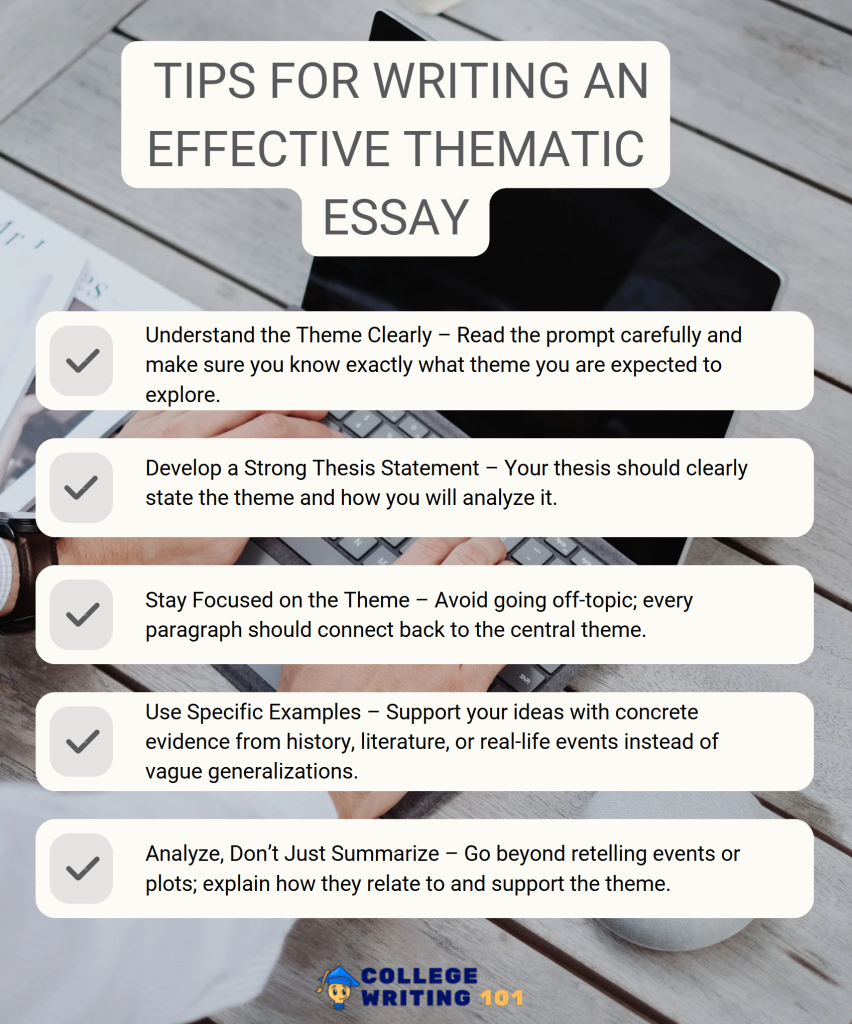
Steps to Writing a Thematic Essay
1. Understand the Theme or Prompt
Before you begin, carefully read the essay prompt or instructions. A thematic essay usually revolves around a central idea (theme), such as justice, freedom, identity, conflict, or change. Make sure you clearly understand what the theme is asking you to analyze. Misinterpreting the theme is one of the most common mistakes students make.
2. Choose or Identify the Theme
If the theme is provided, focus on understanding it fully. If you have to choose one, pick a theme that:
- Interests you
- Has enough examples or evidence you can draw from
- Is broad enough for discussion but narrow enough to stay focused
For example, if the theme is “conflict”, you might narrow it to “how conflict shapes character development in literature” or “how political conflicts influence historical change.”
3. Brainstorm and Gather Evidence
Start by listing examples, facts, or literary devices related to the theme.
- In literature: Think about characters, plot events, and symbols that connect to the theme.
- In history: Consider important events, people, or movements that illustrate the theme.
- In social studies: Focus on issues, debates, and societal patterns.
This brainstorming step will give you a pool of evidence to use later in your essay.
4. Develop a Strong Thesis Statement
Your thesis is the backbone of the thematic essay. It should clearly state the theme and your position or interpretation. A good thesis is specific and arguable.
Example:
- Weak thesis: “Conflict is important in history.”
- Strong thesis: “Conflict has been a driving force in shaping nations, as seen in the American Revolution and the Civil Rights Movement, both of which transformed ideas of freedom and equality.”
5. Outline the Essay Structure
Organizing your thoughts will help your essay flow logically. A standard thematic essay includes:
- Introduction: Introduce the theme and present your thesis.
- Body Paragraphs: Each paragraph should focus on one main point or example that supports your thesis. Provide analysis, not just description.
- Conclusion: Summarize the main points and restate the significance of the theme.
6. Write the Draft
- Introduction: Start with a hook (quote, question, or general statement about the theme), then present your thesis.
- Body paragraphs: Use topic sentences to introduce each idea. Support your points with examples, evidence, or quotations. Explain how they connect to the theme.
- Conclusion: Wrap up by reinforcing the importance of the theme and what the reader should take away from your essay.
7. Revise and Proofread
Revision is crucial. Check for:
- Clarity: Is your thesis clear? Do your paragraphs connect logically?
- Focus: Did you stay on the theme throughout the essay?
- Evidence: Do your examples strongly support your thesis?
- Language: Is your tone academic and free from errors?
Proofread for grammar, punctuation, and spelling mistakes. Reading your essay aloud can help catch awkward phrasing or unclear sentences.
Examples of Thematic Essays
Conflict as a Force for Change
Introduction
Conflict has always been a central force in shaping societies and historical events. Whether political, social, or cultural, conflicts often bring about transformation that redefines people’s lives and values. Throughout history, conflict has not only destroyed but also created opportunities for progress. Two examples that demonstrate this theme are the American Revolution and the Civil Rights Movement in the United States. Both show how struggles for justice and freedom led to significant changes in society.
Body Paragraph 1: The American Revolution
The American Revolution (1775–1783) is a prime example of conflict driving change. The colonies’ conflict with Britain arose from issues such as taxation without representation, restrictions on trade, and a growing sense of independence among colonists. Although the war was violent and costly, it resulted in the creation of a new nation built on democratic ideals. The Revolution gave rise to the Declaration of Independence, a document that emphasized liberty, equality, and the natural rights of individuals. While not all groups immediately benefited—enslaved people and women continued to face oppression—the Revolution laid the foundation for future movements seeking broader equality. This conflict reshaped political structures and established the United States as a nation committed, at least in principle, to democratic governance.
Body Paragraph 2: The Civil Rights Movement
Almost two centuries later, another conflict challenged the United States to live up to its democratic ideals. The Civil Rights Movement of the 1950s and 1960s was a direct struggle against racial segregation and systemic discrimination. Leaders such as Martin Luther King Jr. used nonviolent protest and civil disobedience to confront unjust laws and practices. The conflict between activists and segregationists created social tension, but it also led to historic changes. Landmark legislation such as the Civil Rights Act of 1964 and the Voting Rights Act of 1965 dismantled legal segregation and expanded political rights for African Americans. In this way, the conflict pushed American society toward greater inclusivity and justice.
Body Paragraph 3: Connecting the Examples
Although separated by time and context, both the American Revolution and the Civil Rights Movement demonstrate how conflict leads to change. The Revolution transformed colonies into an independent nation, while the Civil Rights Movement pushed that nation closer to fulfilling its original promises of freedom and equality. In both cases, conflict was not simply destructive—it served as a catalyst for progress.
Conclusion
Conflict, though often painful and divisive, has been a powerful driver of transformation in history. The American Revolution and the Civil Rights Movement reveal how struggles can spark change, reshape institutions, and expand opportunities for future generations. While conflict is rarely desirable, its outcomes often define the trajectory of societies. Ultimately, history shows that conflict, when harnessed toward justice, can become a force for meaningful and lasting change.
Example 2: Power and Corruption in Animal Farm
Introduction
Literature often explores themes that mirror the realities of human society. George Orwell’s novella Animal Farm is a powerful allegory that examines how power can lead to corruption. Orwell demonstrates that when individuals or groups gain unchecked authority, they often abuse it for personal gain, betraying the very ideals they once fought to uphold. The theme of power and corruption is central to Animal Farm, and it is illustrated through the rise of the pigs, the manipulation of language, and the suffering of the other animals.
Body Paragraph 1: The Rise of the Pigs
At the beginning of the novel, the animals unite under Old Major’s vision of equality and freedom. They overthrow their human oppressor, Mr. Jones, believing that all animals will now live as equals. However, the pigs quickly take leadership positions, claiming to be the most intelligent. Napoleon, in particular, consolidates power by driving out his rival Snowball and establishing himself as the farm’s sole leader. This shift in power demonstrates how initial revolutionary ideals can be corrupted when authority becomes concentrated in the hands of a few. Instead of equality, the farm falls under a new dictatorship.
Body Paragraph 2: The Manipulation of Language
Orwell shows that power is not maintained by force alone but also through manipulation. The pigs, especially Squealer, use propaganda and deceit to control the thoughts of the other animals. The commandments of Animalism are gradually altered to suit the pigs’ desires—for example, “All animals are equal” eventually becomes “All animals are equal, but some animals are more equal than others.” By twisting language and rewriting history, the pigs keep the animals obedient and confused. This highlights the dangerous role of propaganda in sustaining corrupt leadership.
Body Paragraph 3: The Suffering of the Animals
As the pigs grow more powerful, the other animals suffer the consequences. They work harder, receive less food, and live in worse conditions than they did under Mr. Jones. Meanwhile, the pigs indulge in luxuries and privileges, such as drinking alcohol and sleeping in beds. The betrayal of Boxer, the hardworking horse, is the clearest example of this corruption. Despite his loyalty and strength, he is sold to a glue factory when he is no longer useful. The animals’ suffering underscores Orwell’s message that unchecked power results in exploitation and oppression.
Conclusion
Through Animal Farm, George Orwell illustrates the theme of power and corruption with striking clarity. The pigs’ rise to dominance, their manipulation of language, and the suffering of the other animals reveal how revolutions can fail when leaders prioritize power over justice. Orwell’s message remains relevant today: without accountability, power inevitably corrupts, and the ideals of equality and fairness are often sacrificed. By exposing this truth, Animal Farm warns readers of the dangers of blindly trusting authority and forgetting the principles of freedom and equality.
FAQs
How many paragraphs is a thematic essay?
A thematic essay usually has five paragraphs, but it can be longer depending on the assignment. The standard structure is:
Introduction (1 paragraph) – introduces the theme and thesis statement
Body paragraphs (3 paragraphs or more) – each one develops an example or idea related to the theme
Conclusion (1 paragraph) – summarizes the main points and restates the significance of the theme
So, the minimum is often 5 paragraphs, but teachers may expect 6–8 if you are covering multiple examples in depth.
What is the thematic way of writing?
The thematic way of writing means organizing an essay around a central theme or idea rather than just retelling events or describing a story. In this method:
You identify a theme (e.g., conflict, power, freedom, identity).
You build your thesis statement around how that theme is shown in literature, history, or society.
Each body paragraph provides examples, evidence, and analysis that connect back to the theme.
The essay stays focused on proving or exploring the theme, not just summarizing content.
In short, the thematic way of writing = choosing a theme → analyzing it → supporting it with evidence.
What are the 4 main types of essays?
Expository Essay – Explains a topic with facts, evidence, and examples (e.g., explaining climate change causes).
Narrative Essay – Tells a story, often personal, with a clear beginning, middle, and end (e.g., an experience that taught you a lesson).
Descriptive Essay – Focuses on describing a person, place, object, or event in detail using sensory language (e.g., describing your hometown).
Persuasive/Argumentative Essay – Convincingly argues a point of view using evidence, logic, and counterarguments (e.g., arguing for renewable energy).