
Secondary research is a common method used in academic, business, and professional studies. It involves using existing information that has already been collected by others instead of gathering new data. This type of research saves time, reduces costs, and helps researchers build strong arguments using trusted sources. Secondary research examples can include books, journal articles, government reports, websites, surveys, and published statistics.
Students often use secondary research when writing essays, literature reviews, and reports. Businesses also rely on it to study markets, understand trends, and analyze competitors. Knowing how to use secondary research correctly is an important skill because it helps improve the quality and accuracy of any project. By reviewing clear examples of secondary research, readers can learn how to choose reliable sources, organize information, and support their ideas with evidence.
Types of Secondary Research
1. Published Academic Sources
These include textbooks, scholarly journals, research papers, and conference articles. They are widely used in schools and universities because they are written by experts and reviewed before publication. Students often use these sources for essays, literature reviews, and research projects.
2. Government and Public Records
Government reports, census data, policy documents, and statistical records are strong sources of factual information. They are useful for studies related to population, economics, education, and public health.
3. Commercial and Industry Reports
Market research reports, company financial statements, and industry analyses fall under this type. Businesses use these sources to study market trends, customer behavior, and competitors.
4. Online and Digital Sources
Websites, online databases, blogs, news articles, and digital archives are easy to access and widely used. However, it is important to check the credibility of these sources before using them.
5. Internal Organizational Data
Organizations often use past reports, sales records, and internal surveys as secondary data. This helps in planning, evaluation, and decision-making without collecting new data.
Secondary Research Examples in Different Fields
Business & Marketing
A company launching a new product might analyze industry reports from Nielsen or Mintel to understand market size, review competitors’ annual reports and financial statements, examine consumer trend data from trade associations, and study social media sentiment analysis from existing platforms. This helps them position their product without conducting expensive primary research first.
Healthcare & Medicine
Medical researchers routinely conduct literature reviews of clinical trials published in journals like The Lancet or JAMA, analyze patient data from electronic health records, examine disease prevalence statistics from the WHO or CDC, and review drug efficacy studies from pharmaceutical databases. A hospital might use this data to decide which treatment protocols to adopt.
Education
An education policy researcher might analyze standardized test score data from the Department of Education, review existing studies on teaching methods from academic journals, examine enrollment and graduation statistics, and compare international education data from OECD reports. This informs decisions about curriculum changes or resource allocation.
Social Sciences
A sociologist studying income inequality would use census data and labor statistics, review previous surveys and demographic studies, analyze historical records and archival documents, and examine government policy reports. They might combine decades of census data to identify long-term trends.
Environmental Science
Climate researchers extensively use existing temperature records from weather stations, satellite imagery and remote sensing data, historical ecological studies, and pollution monitoring reports from environmental agencies. Rather than collecting new measurements, they often analyze patterns in decades of existing climate data.
Law & Policy
Legal researchers rely on case law databases like Westlaw or LexisNexis, legislative records and congressional reports, court statistics and crime data from the FBI, and policy analysis from think tanks. A lawyer preparing a case would review relevant precedents rather than generating new legal arguments from scratch.
Real Estate
A real estate developer uses property transaction records and pricing databases like Zillow, demographic data about neighborhood populations, economic indicators like employment rates, and zoning regulations and urban planning documents to assess whether a location is viable for development.
Advantages of Using Secondary Research
Cost-Effective
Secondary research is significantly cheaper than primary research. Much of the data is freely available through government databases, academic libraries, and online sources. Even paid reports are typically less expensive than conducting surveys, focus groups, or experiments yourself. This makes it accessible for organizations with limited budgets.
Time-Saving
Data already exists and is readily available, allowing you to gather information in days or weeks rather than months. You can quickly access years of accumulated data without waiting for responses or conducting lengthy studies. This speed is crucial when you need insights for time-sensitive decisions.
Large Sample Sizes
Secondary sources often provide access to extensive datasets that would be impossible to collect independently. Government census data covers entire populations, while industry reports may aggregate information from thousands of respondents. This breadth gives you more statistically robust findings and broader perspective.
Historical Perspective
Secondary research allows you to examine trends over time by accessing historical records, archived studies, and longitudinal data. You can understand how markets have evolved, how social attitudes have shifted, or how scientific understanding has developed without having witnessed these changes firsthand.
Serves as Foundation
It provides context and background before investing in primary research. You can identify what’s already known, spot gaps in existing knowledge, refine your research questions, and avoid duplicating previous work. This groundwork makes any subsequent primary research more focused and valuable.
Credibility and Reliability
Data from reputable sources like government agencies, peer-reviewed journals, and established research institutions comes with built-in credibility. The information has often undergone rigorous review processes and quality controls that individual researchers might not be able to replicate.
Multiple Perspectives
You can easily compare findings across different studies, regions, or time periods. This triangulation of sources helps validate conclusions and provides a more comprehensive understanding than relying on a single data source.
Limitations of Secondary Research
May Not Fit Your Specific Needs
Secondary data was collected for someone else’s purpose, which may differ from yours. The variables measured, the questions asked, or the population studied might not align perfectly with your research objectives. You’re constrained by what others chose to investigate rather than designing research around your exact requirements.
Potential for Outdated Information
Data can become obsolete quickly, especially in fast-moving fields like technology, fashion, or current events. A market analysis from three years ago may no longer reflect current consumer preferences. Economic data from before major events like the pandemic may have limited relevance to today’s conditions.
Quality and Accuracy Concerns
You have no control over how the original data was collected. The methodology may have been flawed, samples might have been biased, or errors could have occurred during data collection. Without access to the original research process, it’s difficult to assess reliability. Some sources may lack transparency about their methods entirely.
Lack of Control Over Variables
You cannot customize how data was categorized, measured, or analyzed. If a study groups ages differently than you need, or defines “urban” differently than your target market, you’re stuck with those definitions. This inflexibility can limit the depth of your analysis.
Incomplete or Missing Data
Secondary sources rarely provide all the information you need. Key details may be omitted, certain demographics might not be represented, or specific questions you have may remain unanswered. Published reports often summarize findings without providing the raw data you might want to analyze differently.
Potential Bias
Data may reflect the biases, assumptions, or agendas of those who collected it. A study funded by an industry group might present findings favorably to that industry. Academic researchers may have theoretical perspectives that shape their interpretation. Even government data can reflect political priorities in what gets measured and reported.
Accessibility Issues
Some valuable secondary sources require expensive subscriptions or are locked behind paywalls. Proprietary market research can cost thousands of dollars. Academic journals may not be freely available. Language barriers can also limit access to international sources.
Lack of Context
Published findings may not include important contextual information about circumstances during data collection, limitations that were encountered, or nuances in the results. This missing context can lead to misinterpretation or inappropriate application of the data.
Credibility Varies Widely
Not all secondary sources are equally trustworthy. Information from unknown websites, biased publications, or non-peer-reviewed sources may be unreliable. Evaluating source credibility requires skill and effort, and even then, quality can be difficult to assess.
Aggregation Challenges
When combining data from multiple secondary sources, you may encounter inconsistencies in definitions, measurement methods, or time periods that make integration difficult or impossible. This can limit your ability to build comprehensive analyses.
Secondary Research vs Primary Research
| Feature | Primary Research | Secondary Research |
|---|---|---|
| Data Source | Collected firsthand by the researcher. | Collected by others, then used by the researcher. |
| Purpose | To address a specific, current problem. | To understand the broader context or existing knowledge. |
| Process | Time-consuming, systematic, and involved. | Relatively quick and straightforward. |
| Cost | High (design, execution, analysis). | Low to minimal (often just access fees). |
| Time Frame | Long (weeks to months). | Short (hours to days). |
| Data Relevance | Highly specific and targeted. | May be general and not perfectly aligned. |
| Data Freshness | Current and original. | Can be outdated. |
| Researcher Control | Full control over design and collection. | No control; must trust the original source’s methods. |
When to Use Secondary Research
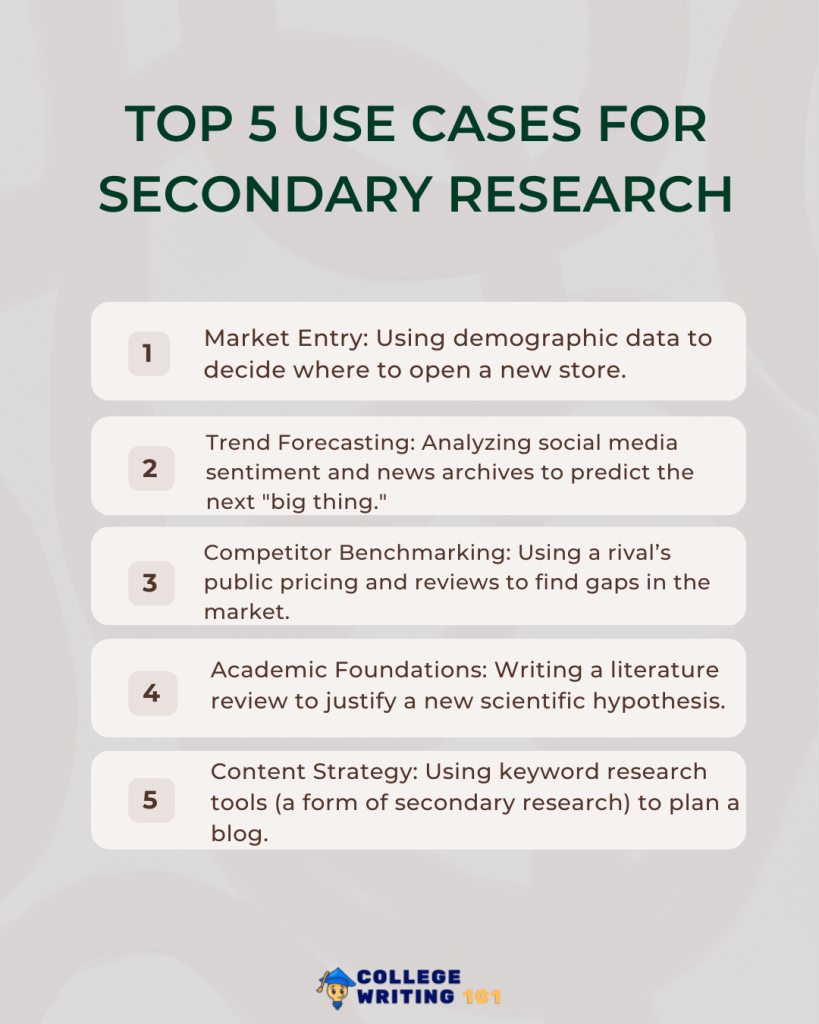
At the Beginning of Any Research Project
Secondary research should almost always be your starting point. Before investing time and money in primary research, you need to understand what’s already known about your topic. This prevents you from reinventing the wheel and helps you identify genuine knowledge gaps worth exploring.
When You Need Background Information
If you’re entering a new market, exploring an unfamiliar industry, or studying a topic you’re not deeply familiar with, secondary research provides essential context. It helps you understand terminology, key players, historical developments, and current trends without starting from scratch.
For Feasibility Studies
When evaluating whether a business idea, research project, or initiative is viable, secondary research offers quick insights into market size, competition, regulatory environment, and demographic factors. This preliminary assessment helps you decide whether to proceed before committing significant resources.
When Resources Are Limited
If you have budget or time constraints, secondary research provides maximum value with minimal investment. Small businesses, startups, students, and nonprofit organizations can access substantial information without the costs associated with surveys, focus groups, or experiments.
For Trend Analysis and Forecasting
Understanding historical patterns requires longitudinal data that already exists. Whether you’re analyzing economic cycles, consumer behavior shifts, climate change, or technological adoption rates, secondary sources provide the historical perspective necessary for spotting trends and making projections.
When You Need Large-Scale Data
If your research questions require broad population data, national statistics, or industry-wide information, secondary sources are often your only practical option. Replicating census-level data or comprehensive market reports would be prohibitively expensive for most researchers.
For Competitive Intelligence
Understanding your competitors doesn’t require direct access to their operations. Annual reports, news articles, industry analyses, patent filings, and market share data provide substantial competitive insights through publicly available secondary sources.
When Studying Sensitive Topics
Some subjects are difficult to research directly because people may not respond honestly or may be uncomfortable discussing certain issues. Secondary research on topics like illegal activities, stigmatized behaviors, or private matters can provide insights through anonymized aggregate data or previously conducted confidential studies.
For Academic Literature Reviews
Academic research always requires reviewing existing scholarly work. You need to demonstrate knowledge of your field, position your work within existing debates, and show how your research contributes something new. This is exclusively secondary research territory.
When Validating or Contextualizing Findings
If you’ve conducted primary research, secondary sources help you interpret your results by comparing them with established findings, industry benchmarks, or theoretical frameworks. This validation adds credibility and depth to your analysis.
For Ongoing Market Monitoring
Businesses that need to stay current with industry developments, regulatory changes, or competitive movements benefit from regularly consulting trade publications, government updates, industry reports, and news sources rather than constantly conducting new primary research.
When Primary Research Isn’t Practical
Some situations simply don’t allow for primary data collection. Historical events can’t be re-studied, certain populations may be inaccessible, or ethical considerations may prevent direct research. Secondary sources become your only viable option.
Before Designing Primary Research
Even when you know you’ll need primary research, secondary research should come first. It helps you refine your research questions, design better surveys or experiments, avoid methodological pitfalls others encountered, and ensure your primary research addresses actual knowledge gaps.
When Quick Decisions Are Required
Business decisions often can’t wait months for primary research completion. Secondary research provides rapid insights that enable timely decision-making, even if the information isn’t perfectly tailored to your specific situation.
How to Find Reliable Secondary Research Sources
1. Use Academic Databases
Academic databases contain peer-reviewed and well-researched sources. These are ideal for essays and research papers.
Examples:
2. Check Government and Official Websites
Government websites provide accurate statistics, reports, and policy documents.
Examples:
3. Use Reputable Organizations and Institutions
Universities, research institutes, and global organizations publish reliable studies.
Examples:
4. Review Author and Publication Details
Check the author’s background, publication date, and references used.
5. Cross-Check Information
Compare facts across multiple trusted sources to confirm accuracy.
FAQs
Is a literature review an example of secondary research?
Yes, a literature review is a common example of secondary research because it analyzes existing studies, articles, and academic papers.
Is using websites considered secondary research?
Yes, using reliable websites such as government sites, academic databases, or research organizations is considered secondary research.
What are examples of secondary research in business?
Examples include using market research reports, financial statements, industry analysis reports, and competitor data.