A chemistry lab report is an important part of science learning. It shows how an experiment was done, what data was collected, and what the results mean. Many students struggle with lab reports because they are not sure about the correct format or what information to include in each section. An example of a chemistry lab report can help make this process much clearer.
By looking at a well-written example, students can understand how to write a strong title, clear objective, detailed procedure, and accurate results. It also shows how to organize data, use proper scientific language, and explain findings in a logical way. Whether you are in high school or college, knowing how to write a chemistry lab report is a key skill.
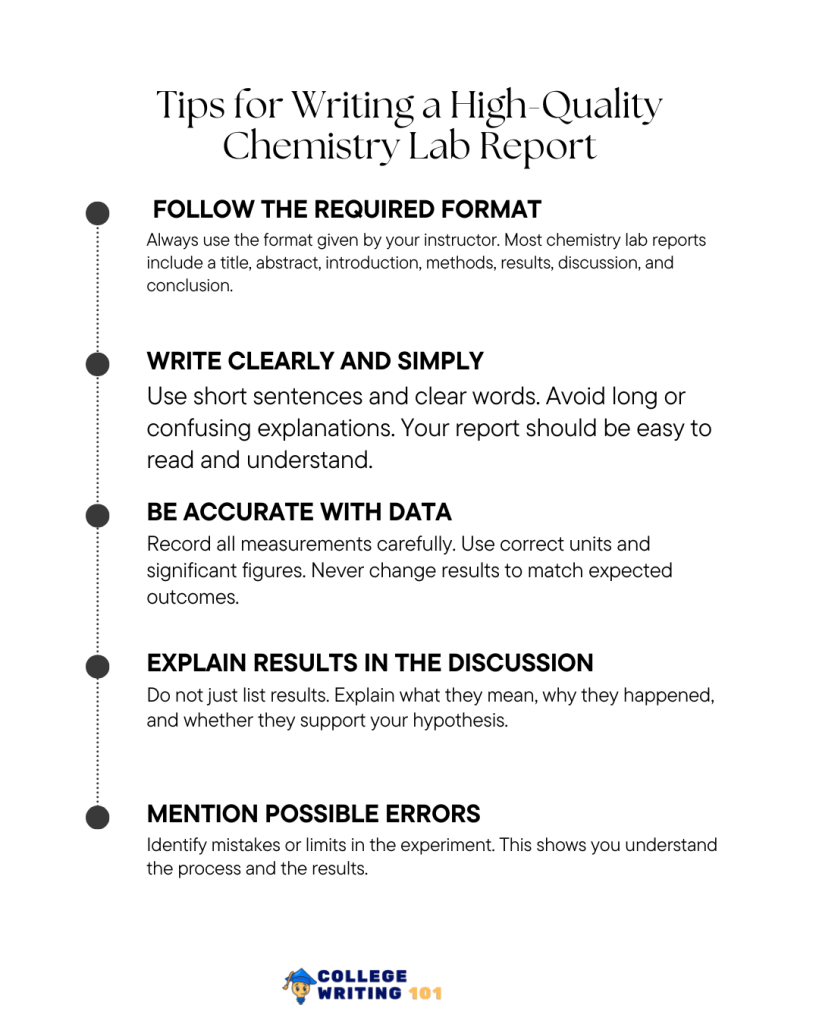
Standard Format of a Chemistry Lab Report
Title The experiment’s name and your identifying information (name, date, lab section).
Introduction This section provides context for the experiment. You explain the scientific principles or theories being investigated, state the purpose of the experiment, and often include your hypothesis. It answers why you’re doing this experiment and what you expect to learn.
Materials and Methods Here you list the equipment and chemicals used, then describe the procedure in enough detail that someone else could replicate your experiment. This is usually written in past tense and passive voice, though some instructors prefer active voice.
Results This is where you present your data objectively without interpretation. Include raw data, calculations, tables, graphs, and observations. Be thorough and organized, clearly labeling all figures and tables.
Discussion/Analysis This section interprets your results. You explain what the data means, compare your results to expected values or literature values, calculate percent error if applicable, discuss sources of error, and explain whether your hypothesis was supported. This is where you demonstrate your understanding of the chemistry involved.
Conclusion A brief summary of your key findings and their significance. You restate whether your hypothesis was supported and might suggest improvements or future experiments.
References Any sources you cited, formatted according to your instructor’s preferred citation style.
Full Example of a Chemistry Lab Report
Determination of the Molar Mass of an Unknown Volatile Liquid Using the Dumas Method
Student Name: Hannah Wayne
Lab Partner: Michael Kyeon
Course: CHEM 101, Section 3
Date Performed: October 15, 2025
Date Submitted: October 22, 2025
Instructor: Dr. Patricia Williams
Introduction
The molar mass of a substance is a fundamental property that helps identify unknown compounds and verify the purity of known substances. The Dumas method is a classic technique for determining the molar mass of volatile liquids by vaporizing a small sample in a container of known volume at a known temperature and pressure, then using the ideal gas law to calculate molar mass.
According to the ideal gas law, PV = nRT, where P is pressure, V is volume, n is the number of moles, R is the gas constant, and T is temperature. By rearranging this equation and using the relationship n = m/M (where m is mass and M is molar mass), we can derive: M = mRT/PV. This allows us to calculate molar mass from measurable quantities.
Purpose: To determine the molar mass of an unknown volatile liquid using the Dumas method and identify the liquid by comparing the experimental molar mass to known values.
Hypothesis: The unknown liquid will have a molar mass that corresponds to a common organic solvent, likely in the range of 50-100 g/mol based on its volatility and physical appearance.
Materials and Methods
Materials:
- Unknown volatile liquid (sample #7)
- 125 mL Erlenmeyer flask with aluminum foil cap
- Boiling water bath with thermometer
- Analytical balance (±0.0001 g precision)
- Barometer
- Pin or needle
- Tongs
- Paper towels
Procedure:
A clean, dry 125 mL Erlenmeyer flask was obtained and weighed to the nearest 0.0001 g. Approximately 3-4 mL of the unknown liquid was added to the flask. A small piece of aluminum foil was placed over the mouth of the flask and secured with a rubber band, and a small pinhole was made in the center of the foil using a pin.
A water bath was prepared and heated to boiling (approximately 100°C). The flask was carefully placed in the boiling water bath using tongs, ensuring that the water level was above the liquid level in the flask but below the foil cap. The flask was maintained in the boiling water bath for approximately 10 minutes, allowing all the liquid to vaporize. Complete vaporization was confirmed when no visible liquid remained and condensation ceased around the pinhole.
After complete vaporization, the flask was carefully removed from the water bath using tongs and allowed to cool to room temperature for 15 minutes. As the vapor cooled and condensed, atmospheric pressure pushed air back into the flask through the pinhole.
The flask with the condensed liquid and foil cap was weighed. The atmospheric pressure was recorded from the laboratory barometer, and the water bath temperature was recorded. The volume of the flask was determined by filling it completely with water, then pouring the water into a graduated cylinder.
This procedure was repeated two additional times to obtain triplicate measurements.
Results
Table 1: Experimental Data and Measurements
| Measurement | Trial 1 | Trial 2 | Trial 3 |
|---|---|---|---|
| Mass of empty flask + foil (g) | 88.3472 | 88.3475 | 88.3470 |
| Mass of flask + foil + condensed liquid (g) | 88.5654 | 88.5625 | 88.5648 |
| Mass of condensed vapor (g) | 0.2182 | 0.2150 | 0.2178 |
| Temperature of boiling water (°C) | 99.2 | 99.5 | 99.3 |
| Temperature (K) | 372.4 | 372.7 | 372.5 |
| Atmospheric pressure (mmHg) | 758.3 | 758.3 | 758.3 |
| Atmospheric pressure (atm) | 0.9978 | 0.9978 | 0.9978 |
| Volume of flask (L) | 0.1273 | 0.1273 | 0.1273 |
Calculations:
Using the equation M = mRT/PV, where:
- M = molar mass (g/mol)
- m = mass of vapor (g)
- R = 0.08206 L·atm/(mol·K)
- T = temperature (K)
- P = pressure (atm)
- V = volume (L)
Trial 1:
M = (0.2182 g × 0.08206 L·atm/(mol·K) × 372.4 K) / (0.9978 atm × 0.1273 L)
M = 6.667 / 0.1270 = 52.5 g/mol
Trial 2:
M = (0.2150 g × 0.08206 L·atm/(mol·K) × 372.7 K) / (0.9978 atm × 0.1273 L)
M = 6.576 / 0.1270 = 51.8 g/mol
Trial 3:
M = (0.2178 g × 0.08206 L·atm/(mol·K) × 372.5 K) / (0.9978 atm × 0.1273 L)
M = 6.656 / 0.1270 = 52.4 g/mol
Average molar mass: (52.5 + 51.8 + 52.4) / 3 = 52.2 g/mol
Standard deviation: 0.38 g/mol
The theoretical molar mass of methanol (CH₃OH) is 32.04 g/mol.
The theoretical molar mass of acetone (C₃H₆O) is 58.08 g/mol.
Percent error (using acetone as the likely identity):
% error = |52.2 – 58.08| / 58.08 × 100% = 10.1%
Discussion
The experimental molar mass of the unknown volatile liquid was determined to be 52.2 ± 0.4 g/mol. This value is closest to the theoretical molar mass of acetone (58.08 g/mol), suggesting that the unknown liquid is likely acetone. The percent error of 10.1% is moderately high but within acceptable limits for this technique.
The consistency among the three trials (standard deviation of 0.38 g/mol) indicates good precision in the experimental technique. However, the molar mass is systematically lower than the theoretical value for acetone, suggesting the presence of systematic error rather than random error.
Sources of Error:
Several factors may have contributed to the lower-than-expected molar mass. First, incomplete vaporization of the liquid would result in excess mass remaining in the flask, leading to a calculated molar mass that is too high. However, our result is too low, so this is unlikely to be the primary issue.
More likely, some vapor may have escaped from the flask before the pinhole was made or through too-large a pinhole, resulting in less condensed liquid being weighed and thus a lower calculated molar mass. Additionally, if the flask was not allowed to cool completely to room temperature before weighing, thermal expansion could affect the measurement.
Air displacement may also introduce error. The ideal gas law assumes the flask contained only vapor at the boiling point, but in reality, some air may have remained or re-entered during vaporization. The Dumas method also assumes ideal gas behavior, which may not be perfectly accurate for all organic vapors, particularly at temperatures near their boiling points where intermolecular forces become significant.
Atmospheric pressure variations during the experiment, though minor, could also contribute to error if the pressure changed between the time of vaporization and when it was recorded.
Despite these sources of error, the experimental molar mass of 52.2 g/mol is much closer to acetone (58.08 g/mol) than to other common volatile liquids such as methanol (32.04 g/mol), ethanol (46.07 g/mol), or hexane (86.18 g/mol), providing reasonable confidence in the identification.
Conclusion
Using the Dumas method, the molar mass of an unknown volatile liquid was experimentally determined to be 52.2 ± 0.4 g/mol. Based on comparison with known molar masses of common volatile liquids, the unknown sample is identified as acetone (theoretical molar mass = 58.08 g/mol), with a percent error of 10.1%.
The experiment successfully demonstrated the application of the ideal gas law to determine molar mass. The moderate percent error suggests that while the technique is useful for identifying unknown substances, careful attention must be paid to experimental details such as ensuring complete vaporization, minimizing vapor loss, and allowing complete cooling before measurements.
Future improvements could include using a water-jacketed condenser to prevent premature vapor escape, taking multiple temperature readings throughout the heating process, and conducting additional trials to further assess precision.
References
- Silberberg, M. S., & Amateis, P. (2021). Chemistry: The Molecular Nature of Matter and Change (9th ed.). McGraw-Hill Education.
- Tro, N. J. (2020). Chemistry: A Molecular Approach (5th ed.). Pearson.
- Laboratory Manual for CHEM 101. (2025). Department of Chemistry, University Name.
Common Mistakes in Chemistry Lab Reports
Data and Calculations
Incorrect significant figures – This is extremely common. Students either use too many or too few sig figs, or inconsistently apply the rules. Remember that your answer can’t be more precise than your least precise measurement.
Missing units – Leaving units off measurements and calculations makes your data meaningless. Always include appropriate units (g, mL, °C, mol/L, etc.).
No sample calculations – Many students just present final answers without showing how they got there. Include at least one complete sample calculation so readers can follow your work.
Recording data incorrectly – Writing down measurements that exceed the precision of your equipment (like reporting 25.4738°C from a thermometer marked in 1° increments) or forgetting to record important measurements during the lab.
Calculation errors – Simple math mistakes, using wrong formulas, or plugging values into equations incorrectly. Always double-check your work.
Results Section
Interpreting data in the results section – The results section should present data objectively. Save explanations, conclusions, and interpretations for the discussion section.
Poor data presentation – Tables without titles or labels, graphs without axes labels, figures referred to but not actually included, or data presented in a disorganized way that’s hard to follow.
Missing error analysis – Failing to calculate percent error, standard deviation, or discuss precision and accuracy of measurements.
Discussion Section
Listing errors without explanation – Simply stating “human error” or “calculation error” without explaining what specifically went wrong and how it affected results.
Not connecting results to theory – Failing to explain what the data means in terms of the chemical principles being studied. Your discussion should show you understand the chemistry, not just the math.
Ignoring unexpected results – If your results don’t match expected values, explain why rather than ignoring the discrepancy or just saying “it was wrong.”
Vague error sources – Saying errors were due to “contamination” or “measurement error” without specificity. Better: “The sample may have been contaminated with water from the previous rinse, which would increase the mass and lead to…”
Writing and Format
Using first person excessively – While some instructors allow it, traditional lab reports use passive voice: “The solution was heated” rather than “I heated the solution.” Check your instructor’s preference.
Wrong verb tense – Methods should be past tense (what you did), but introduction and known principles should be present tense (what is true).
Too informal or too verbose – Lab reports should be clear and concise, not conversational. Avoid phrases like “we got” or “the experiment worked pretty well.”
Plagiarism from lab manual – Copying procedure descriptions word-for-word from the lab manual. You need to describe what you actually did in your own words.
No paragraph structure – Writing walls of text without organizing ideas into logical paragraphs with clear topic sentences.
Introduction Section
Missing hypothesis – Forgetting to state what you expected to find or why.
No connection to theory – Jumping straight into what you did without explaining the relevant chemistry principles or why the experiment matters.
Too much irrelevant background – Including the entire history of chemistry when you only need a few relevant principles.
Conclusion Section
Just repeating results – The conclusion should synthesize findings and their significance, not just restate numbers from the results section.
No mention of hypothesis – Forgetting to explicitly state whether your hypothesis was supported or not.
Introducing new information – Bringing up data or ideas not discussed earlier in the report.
Other Common Issues
Not following instructions – Every instructor has specific requirements for format, sections, citation style, etc. Read the rubric carefully.
Submitting without proofreading – Typos, grammar errors, and formatting inconsistencies make your report look careless.
Late completion – Waiting too long after the lab to write the report, so you forget important observations or details.
Missing references – Not citing sources when you use outside information, or using incorrect citation format.
FAQs
Can ChatGPT write a lab report?
It can create a sample report, explain each section, and help improve clarity. However, students should always check their school’s rules on AI use and review the final work carefully.
How to write a brief lab report?
To write a brief lab report, keep each section short and clear. State the aim, summarize the method, present key results, and explain what they mean in a few sentences.
What AI can write a lab report?
AI tools like ChatGPT, Jasper, and Grammarly AI can help write or edit lab reports.