
Research participation should be a collaborative partnership between investigators and volunteers, yet mounting evidence suggests that participants are increasingly experiencing burnout from the demands of modern studies. Participant fatigue represents a growing challenge that threatens the quality and validity of research across disciplines, from clinical trials to social science investigations.
This phenomenon manifests in various ways: declining response rates, incomplete data collection, higher dropout rates, and reduced engagement quality. As research becomes more complex and time-intensive, participants often find themselves overwhelmed by lengthy surveys, repeated assessments, and demanding protocols. The consequences extend beyond individual studies, potentially compromising the generalizability of findings and the advancement of knowledge.
Understanding the causes and consequences of participant fatigue is crucial for researchers who want to maintain ethical standards while producing reliable results. By examining this issue, we can develop strategies to create more sustainable research practices that respect participants’ time and energy while still achieving rigorous scientific objectives.
Causes of Participant Fatigue
Time Burden and Study Duration
One of the primary drivers of participant fatigue is the sheer time commitment required by many research studies. Lengthy questionnaires that take hours to complete, extended interview sessions, and studies spanning months or years can exhaust participants’ willingness to engage fully. When participants feel their time is not valued or efficiently used, motivation declines rapidly.
Survey Length and Complexity
Modern research instruments often contain hundreds of questions, many with complex response scales or confusing wording. Participants may struggle to maintain concentration and provide thoughtful responses as surveys drag on. The cognitive load increases when questions require deep reflection or recall of specific memories, leading to mental exhaustion.
Repetitive Assessment Protocols
Studies involving repeated measurements—such as daily diary entries, weekly surveys, or monthly follow-ups—can create a sense of monotony. Participants may feel trapped in an endless cycle of similar questions, leading to decreased attention and perfunctory responses. This repetition can make the research feel like a chore rather than a meaningful contribution.
Poor Communication and Unclear Expectations
When researchers fail to clearly communicate study requirements, timelines, and expectations at the outset, participants may feel blindsided by demands they didn’t anticipate. Inadequate updates about study progress or changes to protocols can leave participants feeling uninformed and undervalued.
Lack of Perceived Value or Relevance
Participants become fatigued when they cannot see how their contribution relates to meaningful outcomes. Studies that seem disconnected from real-world applications or personal relevance fail to maintain participant engagement. Without understanding the study’s purpose or potential impact, motivation wanes.
Inadequate Compensation and Recognition
While monetary compensation isn’t always necessary or appropriate, participants who invest significant time and effort without adequate acknowledgment may experience fatigue. This includes not only financial compensation but also recognition of their contribution through feedback about results or study outcomes.
Technology-Related Challenges
Digital platforms and online surveys can create barriers for participants who are less comfortable with technology. Technical difficulties, poor user interface design, or platform incompatibilities can frustrate participants and contribute to fatigue, particularly among older adults or those with limited digital literacy.
Over-Research in Specific Populations
Certain groups—such as healthcare workers, students, or individuals with specific conditions—may be approached by multiple researchers simultaneously. This over-solicitation can lead to research fatigue at the population level, where potential participants become resistant to any new study requests.
Emotional and Psychological Demands
Studies addressing sensitive topics like trauma, mental health, or personal relationships can be emotionally draining. Participants may experience fatigue not just from the time investment but from the psychological effort required to engage with difficult subject matter repeatedly.
Administrative Burden
Complex consent processes, frequent scheduling changes, multiple forms to complete, and bureaucratic requirements can exhaust participants before the actual research begins. When administrative tasks overshadow the research activities themselves, participants may question their continued involvement.
Lack of Flexibility in Study Design
Rigid protocols that don’t accommodate participants’ schedules, preferences, or circumstances can contribute to fatigue. Studies that cannot adapt to participants’ changing life situations or that impose inflexible requirements may drive away otherwise willing contributors.
Cultural and Individual Factors
Different cultural backgrounds, personal values, and individual circumstances influence how participants experience research demands. What feels manageable to one person may be overwhelming to another, and researchers who don’t account for this diversity may inadvertently create fatigue among certain participant subgroups.
Consequences of Participant Fatigue
Data Quality Degradation
When participants become fatigued, the quality of their responses deteriorates significantly. They may provide superficial answers, select response options randomly, or engage in satisficing behavior—choosing the first acceptable answer rather than the optimal one. This leads to measurement error and reduces the reliability and validity of research findings.
Increased Attrition Rates
Fatigued participants are more likely to withdraw from studies prematurely, leading to high dropout rates. This attrition creates smaller sample sizes than originally planned and may introduce selection bias if certain types of participants are more likely to leave. Longitudinal studies are particularly vulnerable to this issue.
Response Set Bias and Careless Responding
Tired participants often develop response patterns that don’t reflect their true attitudes or experiences. They may consistently choose middle options on rating scales, agree with all statements regardless of content, or provide contradictory responses within the same survey. These patterns contaminate datasets with meaningless or misleading information.
Reduced External Validity
When participant fatigue leads to systematic dropout or poor-quality responses from certain demographic groups, the remaining sample may no longer represent the target population. This threatens the generalizability of research findings and limits their applicability to real-world contexts.
Compromised Statistical Power
Higher dropout rates and noisy data from fatigued participants reduce statistical power, making it harder to detect true effects. Researchers may fail to identify significant relationships that actually exist, leading to Type II errors and missed opportunities for scientific advancement.
Ethical Concerns and Participant Welfare
Participant fatigue raises ethical questions about research burden and respect for persons. When studies become so demanding that they cause stress or interfere with participants’ well-being, researchers may violate the principle of minimizing harm. This can damage the trust between research communities and the public.
Increased Recruitment Difficulties
Word-of-mouth about overly burdensome studies can spread within communities, making it harder to recruit new participants. Populations that have been over-researched may develop resistance to participating in any studies, creating challenges for future research in those areas.
Economic Costs and Resource Waste
Participant fatigue leads to inefficient use of research resources. Money spent on recruiting participants who later drop out or provide poor-quality data represents wasted investment. Additional costs arise from extending recruitment periods, collecting larger initial samples to account for attrition, or repeating studies due to compromised data quality.
Delayed Scientific Progress
Poor data quality and failed studies due to participant fatigue slow the pace of scientific discovery. When research must be repeated or findings cannot be replicated due to data quality issues, the advancement of knowledge in important areas is hindered.
Damage to Researcher-Participant Relationships
Negative experiences with overly demanding studies can sour participants’ attitudes toward research in general. This erosion of goodwill makes it harder for all researchers to build the trust and cooperation necessary for successful studies, affecting the entire research enterprise.
Publication and Replication Issues
Studies plagued by participant fatigue may produce findings that cannot be replicated, contributing to the reproducibility crisis in science. Poor-quality data may lead to false positive results that fail to hold up under scrutiny, damaging the credibility of research fields.
Institutional and Regulatory Consequences
High rates of participant complaints or adverse events related to research burden can trigger institutional review board investigations and increased regulatory oversight. This can lead to more restrictive policies that impact all researchers, even those conducting appropriately designed studies.
Identifying Participant Fatigue
Behavioral Indicators
Researchers can observe several behavioral changes that signal emerging participant fatigue. Delayed responses to surveys or appointment reminders often indicate waning enthusiasm. Participants may begin requesting extensions, rescheduling appointments frequently, or taking longer to complete tasks that previously required less time. Decreased communication or shorter responses to open-ended questions can also signal fatigue.
Response Quality Metrics
Data quality patterns provide clear evidence of participant fatigue. Straight-lining—selecting the same response option across multiple questions—becomes more common as participants lose motivation to read carefully. Increased item non-response rates, particularly for optional or complex questions, suggest participants are conserving their energy. Speed of completion may dramatically increase without corresponding improvement in accuracy.
Statistical Indicators
Several statistical patterns can reveal participant fatigue within datasets. Decreased variance in responses across time points may indicate participants are becoming less engaged and more likely to provide neutral or default answers. Increased inconsistency between related measures or contradictory responses within the same assessment period often reflects reduced attention to detail.
Participant Self-Reports
Direct feedback from participants provides valuable insight into fatigue levels. Complaints about study length, complexity, or frequency of assessments are obvious indicators. More subtle signs include comments about feeling overwhelmed, requests to reduce participation requirements, or expressions of uncertainty about continued involvement. Exit interviews with withdrawn participants often reveal fatigue as a primary reason for discontinuation.
Attendance and Participation Patterns
Changes in attendance patterns can signal developing fatigue. Participants may begin missing appointments, arriving late, or requesting to reschedule frequently. In online studies, login patterns may become irregular, with longer gaps between sessions. Partial completion rates may increase, with participants stopping surveys midway through more frequently than at baseline.
Communication Changes
The tone and frequency of participant communications often shift as fatigue develops. Responses to researcher emails may become shorter, less detailed, or take longer to receive. Participants may stop asking questions about study procedures or seem less engaged during phone contacts. Some may become more difficult to reach or fail to respond to multiple contact attempts.
Performance Deterioration
In studies involving cognitive tasks or performance measures, fatigue may manifest as declining scores over time that cannot be explained by learning effects or natural variation. Reaction times may increase, accuracy may decrease, or effort-dependent measures may show systematic decline across sessions.
Dropout Risk Indicators
Certain patterns strongly predict impending withdrawal from studies. Expressions of doubt about the study’s value or relevance often precede dropout. Participants who begin questioning the time commitment or expressing frustration with study procedures are at high risk. Requests for information about early termination or penalties for withdrawal are clear warning signs.
Technology-Related Warning Signs
In digital studies, technical behavior patterns can indicate fatigue. Participants may begin skipping optional features, spending minimal time on pages, or using mobile devices instead of computers for tasks better suited to larger screens. Increased technical support requests may reflect frustration rather than genuine technical problems.
Demographic and Individual Risk Factors
Certain participant characteristics are associated with higher fatigue risk. Individuals with multiple competing demands, such as caregivers or those with demanding jobs, may show earlier signs of fatigue. Participants who initially expressed ambivalence about participation or those recruited through convenience sampling may be more susceptible.
Timing and Contextual Factors
Fatigue often emerges at predictable points in research studies. The novelty effect wears off after initial participation, leading to decreased engagement around the second or third data collection point. Holiday periods, academic deadlines, or major life events may trigger temporary or permanent fatigue spikes.
Comparative Analysis Across Participants
Researchers can identify fatigue by comparing individual participants to group norms. Participants showing greater decline in engagement metrics relative to their peers may be experiencing fatigue even if their absolute levels seem acceptable. Outliers in response patterns or completion times warrant closer examination.
Proactive Monitoring Systems
Implementing systematic monitoring can help identify fatigue before it becomes problematic. Regular check-ins with participants about their experience can reveal emerging concerns. Automated systems can flag participants showing concerning patterns in response quality or completion times, allowing for early intervention.
Validation Through Multiple Sources
The most reliable identification of participant fatigue comes from triangulating multiple indicators. A participant showing behavioral changes, declining data quality, and expressing frustration is clearly experiencing fatigue. Single indicators may reflect temporary circumstances rather than systematic fatigue, so researchers should look for convergent evidence across different measures.
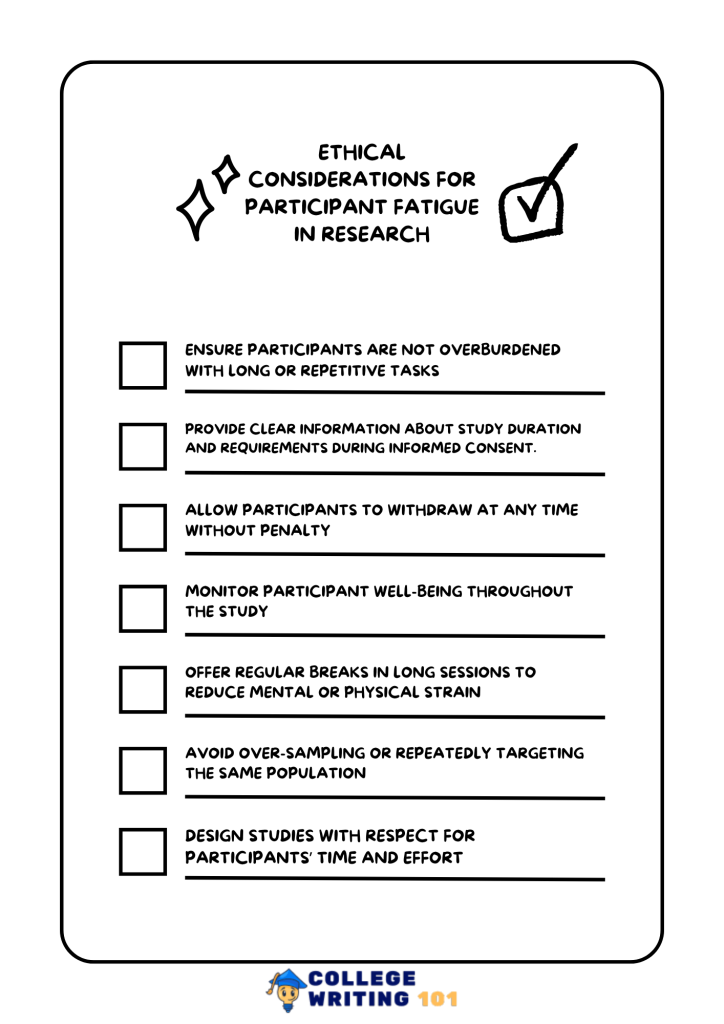
Strategies to Minimize Participant Fatigue
Study Design Optimization
Careful attention to study design can prevent many causes of participant fatigue. Researchers should critically evaluate the necessity of each measure and eliminate redundant or marginally useful questions. Pilot testing with target populations helps identify problematic elements before full implementation. Breaking long surveys into shorter modules distributed over time can maintain engagement while collecting comprehensive data.
Clear Communication and Expectation Setting
Transparent communication from the outset establishes realistic expectations and builds trust. Participants should understand the full scope of their commitment, including time requirements, frequency of assessments, and study duration. Regular updates about study progress and timeline changes help participants feel informed and valued. Providing a clear rationale for study procedures helps participants understand why their contribution matters.
Flexible Participation Options
Building flexibility into study protocols accommodates participants’ varying circumstances and preferences. Offering multiple time slots for appointments, allowing participants to complete assessments at their convenience, and providing options for make-up sessions reduce logistical stress. For online studies, enabling participants to save progress and complete surveys in multiple sessions prevents data loss and reduces pressure.
Streamlined Survey Design
Thoughtful survey construction can significantly reduce participant burden. Using adaptive questioning that skips irrelevant items based on previous responses shortens surveys for many participants. Implementing progress indicators helps participants understand how much remains to complete. Grouping related questions logically and using clear, simple language reduces cognitive load.
Appropriate Compensation and Recognition
Fair compensation acknowledges participants’ time and effort, though the form may vary by study type and population. Beyond monetary payment, researchers can provide certificates of appreciation, summary reports of findings, or opportunities to learn about research results. Recognition should be proportionate to the participant burden and culturally appropriate for the target population.
Technology Solutions and User Experience
Well-designed digital platforms can reduce rather than increase participant burden. Intuitive interfaces, mobile-responsive designs, and reliable technical infrastructure minimize frustration. Automated reminders can be helpful but should be customizable to participant preferences. Providing technical support and alternative access methods ensures that technology barriers don’t create unnecessary fatigue.
Meaningful Engagement Strategies
Helping participants connect with the research purpose maintains motivation throughout the study. Sharing interim findings, highlighting how the research addresses important problems, and demonstrating real-world applications of the work can sustain engagement. Involving participants in aspects of the research process, such as providing feedback on procedures, can increase investment.
Personalization and Individual Accommodation
Recognizing that participants have different needs and preferences allows for targeted approaches to fatigue prevention. Some participants may prefer email communication while others prefer phone calls. Accommodating cultural preferences, language needs, or accessibility requirements shows respect for participants as individuals and can prevent frustration-related fatigue.
Proactive Fatigue Monitoring and Response
Implementing systems to detect early signs of fatigue enables intervention before problems become severe. Regular check-ins with participants about their experience can identify concerns early. When fatigue is detected, researchers can offer support, adjust procedures where possible, or help participants make informed decisions about continued participation.
Building Positive Relationships
Strong researcher-participant relationships can sustain engagement through challenging periods. Training research staff in respectful communication, active listening, and problem-solving helps create positive interactions. Consistency in staff assignments allows relationships to develop, and recognizing participants as partners rather than subjects fosters mutual respect.
Strategic Timing and Pacing
Thoughtful scheduling can minimize the impact of external factors on participant fatigue. Avoiding data collection during predictably stressful periods (such as holidays or exam periods) reduces competing demands. Spacing assessments appropriately allows participants to recover between intensive data collection periods. Building buffer time into study timelines accommodates delays without creating pressure.
Incentive Structure Optimization
Well-designed incentive structures can maintain motivation without creating coercion. Graduated payment schedules that increase over time acknowledge growing participant investment and offset fatigue effects. Completion bonuses reward participants who finish the full study. Non-monetary incentives such as priority access to results or continuing education credits may appeal to different motivations.
Quality Assurance and Continuous Improvement
Regular evaluation of study procedures allows for real-time improvements. Analyzing dropout patterns, participant feedback, and data quality indicators can reveal systemic problems. Exit interviews with withdrawn participants provide valuable insights for refining procedures. Implementing changes based on participant feedback demonstrates responsiveness and may improve retention.
Alternative Study Designs
When traditional approaches prove too burdensome, researchers can consider alternative designs that reduce participant load while maintaining scientific rigor. Mixed-methods approaches might reduce quantitative burden by supplementing with rich qualitative data from smaller samples. Ecological momentary assessment using brief, frequent measures may be less fatiguing than lengthy retrospective surveys.
Collaboration and Resource Sharing
Coordinating with other researchers can reduce over-solicitation of specific populations and share recruitment costs. Multi-site studies can distribute participant burden across locations. Sharing validated instruments and best practices helps the research community develop more efficient approaches to data collection.
Training and Support for Research Staff
Well-trained research staff are essential for implementing fatigue-prevention strategies effectively. Training should cover participant communication, problem-solving, and early identification of fatigue signs. Staff should understand the importance of participant experience and be empowered to make reasonable accommodations within study protocols.
Ethical Framework Integration
Embedding fatigue prevention within the ethical framework of research ensures that participant welfare remains central to study design and implementation. Regular ethical review of participant burden, ongoing consent processes that acknowledge changing circumstances, and clear policies for supporting distressed participants create a foundation for respectful research relationships.
FAQs
What is the fatigue effect in research?
The fatigue effect occurs when participants’ performance, attention, or motivation decreases over time during a study. This can happen in long experiments, repeated tasks, or surveys, leading to lower-quality data, slower responses, and less accurate or inconsistent results.
What is research fatigue?
Research fatigue refers to a situation where participants become tired, bored, or disengaged because they have been repeatedly asked to participate in studies, surveys, or interviews. It can also apply to overburdened populations who experience multiple studies on the same topic. This often results in lower participation rates or less reliable responses.
What is an example of a fatigue study?
An example would be a study on cognitive performance where participants are asked to complete a long series of memory and attention tasks over several hours. As the session progresses, participants may respond slower, make more mistakes, or provide incomplete answers due to mental fatigue. Another example is a longitudinal survey where participants are repeatedly asked the same questions over months or years, leading to disengagement.
What is reviewer fatigue?
Reviewer fatigue occurs in academic or peer-review contexts when reviewers evaluate many manuscripts, grant applications, or proposals consecutively. Over time, the reviewer’s attention and critical assessment abilities decline, increasing the likelihood of errors, superficial reviews, or delayed feedback.