Parts of speech are the basic building blocks of the English language. They help us understand how words work in a sentence and how ideas are clearly shared. Every sentence we speak or write depends on parts of speech to make sense. From naming objects to showing action or describing feelings, each word has a role to play. Learning parts of speech helps students improve reading, writing, and speaking skills. It also makes grammar rules easier to understand and apply. Whether you are writing an essay, sending an email, or having a conversation, knowing how words function can improve clarity and confidence.
Types of Parts of Speech
1. Nouns
Nouns are words that name people, places, things, ideas, or concepts. They are the subjects and objects of our sentences.
Types of Nouns:
- Common Nouns: General names for people, places, or things (dog, city, teacher, book)
- Proper Nouns: Specific names that are capitalized (Sarah, London, Microsoft, Mount Everest)
- Concrete Nouns: Things you can perceive with your senses (apple, music, perfume, rain)
- Abstract Nouns: Ideas, qualities, or concepts you cannot touch (love, freedom, courage, intelligence)
- Collective Nouns: Groups of people or things (team, flock, family, committee)
- Countable Nouns: Can be counted (three books, five cats, two ideas)
- Uncountable Nouns: Cannot be counted individually (water, rice, information, furniture)
Examples in sentences:
- “The teacher gave homework to the students.” (common nouns)
- “Emma visited Paris last December.” (proper nouns)
- “Honesty is the best policy.” (abstract nouns)
2. Pronouns
Pronouns replace nouns to avoid repetition and make sentences smoother. They refer to people, places, things, or ideas without naming them directly.
Types of Pronouns:
- Personal Pronouns: Refer to specific people or things (I, you, he, she, it, we, they, me, him, her, us, them)
- Possessive Pronouns: Show ownership (mine, yours, his, hers, its, ours, theirs)
- Reflexive Pronouns: Refer back to the subject (myself, yourself, himself, herself, itself, ourselves, themselves)
- Demonstrative Pronouns: Point to specific things (this, that, these, those)
- Interrogative Pronouns: Used to ask questions (who, whom, whose, which, what)
- Relative Pronouns: Connect clauses (who, whom, whose, which, that)
- Indefinite Pronouns: Refer to non-specific people or things (someone, anyone, everyone, nobody, something, all, some, many)
Examples in sentences:
- “She gave him the book because it was his.” (personal and possessive pronouns)
- “I taught myself to play guitar.” (reflexive pronoun)
- “This is the car that I want to buy.” (demonstrative and relative pronouns)
- “Who took my pen?” (interrogative pronoun)
- “Everyone should bring something to the party.” (indefinite pronouns)
3. Verbs
Verbs express actions, occurrences, or states of being. They are essential to every sentence because they tell us what is happening.
Types of Verbs:
- Action Verbs: Express physical or mental actions (run, jump, think, believe, write, dance)
- Linking Verbs: Connect the subject to additional information (be, am, is, are, was, were, become, seem, appear, feel, look)
- Helping/Auxiliary Verbs: Work with main verbs (have, has, had, do, does, did, can, could, will, would, shall, should, may, might, must)
- Transitive Verbs: Require a direct object (She threw the ball)
- Intransitive Verbs: Do not require a direct object (He laughed)
Examples in sentences:
- “The athlete runs every morning.” (action verb)
- “She is a doctor.” (linking verb)
- “They have been studying for hours.” (helping verbs + main verb)
- “The chef prepared dinner.” (transitive verb – what did he prepare? dinner)
- “The baby cried.” (intransitive verb – no object needed)
4. Adjectives
Adjectives modify or describe nouns and pronouns, providing more information about their qualities, quantities, or characteristics.
Types of Adjectives:
- Descriptive Adjectives: Describe qualities (beautiful, tall, intelligent, red, smooth)
- Quantitative Adjectives: Indicate quantity (some, many, few, several, numerous)
- Demonstrative Adjectives: Point out specific items (this, that, these, those)
- Possessive Adjectives: Show ownership (my, your, his, her, its, our, their)
- Interrogative Adjectives: Used in questions (which, what, whose)
- Articles: Special adjectives (a, an, the)
Examples in sentences:
- “The beautiful, red rose bloomed in the sunny garden.” (descriptive adjectives)
- “Many students attended several lectures.” (quantitative adjectives)
- “This book is better than that one.” (demonstrative adjectives)
- “My sister lost her keys.” (possessive adjectives)
- “Which dress should I wear?” (interrogative adjective)
5. Adverbs
Adverbs modify verbs, adjectives, or other adverbs. They typically answer questions like how? when? where? why? or to what extent?
Types of Adverbs:
- Manner: How something happens (quickly, slowly, carefully, loudly, well, badly)
- Time: When something happens (now, then, yesterday, soon, already, still)
- Place: Where something happens (here, there, everywhere, outside, nearby)
- Frequency: How often something happens (always, never, often, seldom, sometimes, usually)
- Degree: To what extent (very, quite, too, almost, extremely, hardly)
Examples in sentences:
- “She sang beautifully.” (manner – how she sang)
- “I will call you tomorrow.” (time – when I’ll call)
- “The children played outside.” (place – where they played)
- “He always arrives on time.” (frequency – how often)
- “The coffee is extremely hot.” (degree – to what extent)
- “She runs very quickly.” (adverb modifying another adverb)
6. Prepositions
Prepositions show relationships between nouns or pronouns and other words in a sentence. They often indicate position, direction, time, or method.
Common Prepositions:
- Position/Place: in, on, at, under, over, above, below, behind, beside, between, among
- Direction: to, toward, into, onto, through, across, from
- Time: at, on, in, before, after, during, since, until, by
- Other relationships: with, without, of, for, about, by, like
Examples in sentences:
- “The book is on the table.” (position)
- “She walked through the park to her house.” (direction)
- “The meeting is at 3 PM on Monday.” (time)
- “I made this cake for you with love.” (other relationships)
- “The cat jumped over the fence into the garden.” (combining prepositions)
7. Conjunctions
Conjunctions connect words, phrases, or clauses. They help create complex sentences and show relationships between ideas.
Types of Conjunctions:
- Coordinating Conjunctions: Connect equal elements (for, and, nor, but, or, yet, so – remember FANBOYS)
- Subordinating Conjunctions: Connect dependent clauses to independent clauses (because, although, since, when, while, if, unless, after, before, until, as)
- Correlative Conjunctions: Work in pairs (either…or, neither…nor, both…and, not only…but also, whether…or)
Examples in sentences:
- “I wanted to go, but it was raining.” (coordinating conjunction)
- “She studied hard because she wanted to pass the exam.” (subordinating conjunction)
- “Either you come with me or you stay here.” (correlative conjunction)
- “He is smart, yet he lacks common sense.” (coordinating conjunction)
- “Although it was late, we continued working.” (subordinating conjunction)
8. Interjections
Interjections are words or phrases that express sudden emotion or feeling. They often stand alone and are followed by an exclamation point or comma.
Common Interjections:
- Joy/Excitement: Wow! Hooray! Yay! Yippee! Awesome!
- Surprise: Oh! Whoa! Gosh! My goodness!
- Pain: Ouch! Ow! Yikes!
- Greeting: Hi! Hello! Hey!
- Hesitation: Um, uh, er, well
- Disgust: Ew! Yuck! Gross!
- Approval: Bravo! Great! Excellent!
Examples in sentences:
- “Wow! That’s amazing!”
- “Ouch! That hurt!”
- “Well, I’m not sure about that.”
- “Congratulations! You did it!”
- “Alas, we lost the game.”
How to Identify Parts of Speech in a Sentence
General Strategy
When analyzing a sentence, follow these steps:
- Read the entire sentence first to understand its meaning
- Identify the verb(s) – find the action or state of being
- Find the subject – who or what is doing the action
- Locate objects and complements – what receives the action
- Identify modifiers – words that describe or add detail
- Look for connecting words – conjunctions and prepositions
- Check for emotions or exclamations – interjections
How to Identify Each Part of Speech
1. NOUNS – Ask: “Who or what?”
Key Questions:
- Who or what is this sentence about?
- Who or what is performing the action?
- Who or what is receiving the action?
Identification Tips:
- Often preceded by articles (a, an, the)
- Can be made plural (usually by adding -s or -es)
- Can show possession (add ‘s or s’)
- Can follow prepositions (in the house, on the table)
- Common endings: -tion, -ment, -ness, -ity, -er, -or, -ism
Example: “The teacher gave the students a difficult test on Monday.”
- teacher, students, test, Monday = nouns (people, things, and time)
2. PRONOUNS – Ask: “What replaces a noun?”
Key Questions:
- Does this word replace a noun?
- Does it refer to a person or thing without naming it?
Identification Tips:
- Replaces a noun to avoid repetition
- Common pronouns: I, you, he, she, it, we, they, me, him, her, us, them
- Possessive forms: mine, yours, his, hers, ours, theirs
- Demonstrative: this, that, these, those
- Indefinite: someone, anyone, everyone, something, nothing
Example: “She gave him the book because it was his.”
- She, him, it, his = pronouns (replacing specific nouns)
3. VERBS – Ask: “What’s happening?” or “What is?”
Key Questions:
- What action is taking place?
- What is the state of being?
- What is the subject doing?
Identification Tips:
- Can be changed to different tenses (walk → walked → will walk)
- Often preceded by helping verbs (is, have, will, can, should)
- Action verbs show what someone does
- Linking verbs (be, seem, become) connect subject to description
- Can often add -ing or -ed
Example: “The dog is running quickly and has been barking all night.”
- is running, has been barking = verbs (showing action and state)
4. ADJECTIVES – Ask: “Which one?” “What kind?” “How many?”
Key Questions:
- What does the noun look like?
- How many are there?
- Which specific one?
Identification Tips:
- Comes before a noun or after a linking verb
- Describes qualities, quantities, or characteristics
- Can often be made comparative (big → bigger → biggest)
- Common endings: -ful, -less, -ous, -ive, -al, -able
- Articles (a, an, the) are special adjectives
Example: “The beautiful, tall woman wore a red dress and carried three bags.”
- beautiful, tall, red, three = adjectives (describing the nouns)
5. ADVERBS – Ask: “How?” “When?” “Where?” “To what extent?”
Key Questions:
- How is the action performed?
- When does it happen?
- Where does it take place?
- How often does it occur?
- To what degree or extent?
Identification Tips:
- Many end in -ly (quickly, slowly, beautifully)
- Modify verbs, adjectives, or other adverbs
- Can usually be moved to different positions in the sentence
- Answer: how, when, where, why, how often, to what extent
Example: “She sang very beautifully and always arrived early for practice.”
- very = adverb (modifying another adverb “beautifully”)
- beautifully = adverb (how she sang)
- always = adverb (how often)
- early = adverb (when)
6. PREPOSITIONS – Ask: “Where is it in relation to something else?”
Key Questions:
- Where is something located?
- What is the relationship between two things?
- When did it happen in relation to time?
Identification Tips:
- Followed by a noun or pronoun (called the object of the preposition)
- Shows position, direction, time, or relationship
- Common prepositions: in, on, at, by, for, with, to, from, under, over, between, through
- Forms prepositional phrases: preposition + noun/pronoun
Example: “The cat jumped onto the table and hid under the chair during the storm.”
- onto, under, during = prepositions (showing relationships)
- Phrases: onto the table, under the chair, during the storm
7. CONJUNCTIONS – Ask: “What connects these words or ideas?”
Key Questions:
- What word joins two parts together?
- What shows the relationship between clauses?
Identification Tips:
- Coordinating (FANBOYS): for, and, nor, but, or, yet, so
- Subordinating: because, although, since, when, while, if, unless, after, before
- Correlative (pairs): either…or, neither…nor, both…and, not only…but also
- Connects words, phrases, or clauses of equal or unequal importance
Example: “I wanted to go to the party, but I was tired because I worked all day.”
- but = coordinating conjunction (joining equal clauses)
- because = subordinating conjunction (showing cause)
8. INTERJECTIONS – Ask: “Does it express sudden emotion?”
Key Questions:
- Does it express a strong feeling?
- Is it separated from the rest of the sentence?
- Does it show emotion or reaction?
Identification Tips:
- Often followed by an exclamation point or comma
- Stands alone or at the beginning of a sentence
- Expresses emotion, not grammatical connection
- Common interjections: wow, ouch, hey, oh, alas, hurray, oops
Example: “Wow! That was an amazing performance. Well, I think we should leave now.”
- Wow = interjection (expressing amazement)
- Well = interjection (showing hesitation)
Step-by-Step Practice Example
Let’s analyze this sentence together:
“The curious students quickly read several interesting articles about space exploration yesterday.”
Step 1: Find the verb
- “read” = verb (action)
Step 2: Find the subject
- Who read? “students” = noun (subject)
Step 3: Find the object
- Read what? “articles” = noun (direct object)
Step 4: Identify adjectives
- “The” = article (adjective)
- “curious” = adjective (describes students)
- “several” = adjective (how many articles)
- “interesting” = adjective (what kind of articles)
Step 5: Identify adverbs
- “quickly” = adverb (how they read)
- “yesterday” = adverb (when they read)
Step 6: Identify prepositions
- “about” = preposition (shows relationship)
- Prepositional phrase: “about space exploration”
Step 7: Identify remaining nouns
- “space” = noun (part of compound noun)
- “exploration” = noun (object of preposition)
Complete breakdown:
- Adjectives: The, curious, several, interesting
- Noun: students, articles, space, exploration
- Adverb: quickly, yesterday
- Verb: read
- Preposition: about
Common Tricks and Tips
Test for Nouns:
- Can you put “the” or “a” in front of it?
- Can you make it plural?
- Can you show possession with ‘s?
Test for Verbs:
- Can you change the tense?
- Can you add “will” or “can” before it?
- Does it show action or state of being?
Test for Adjectives:
- Can you add “very” before it?
- Does it answer which, what kind, or how many?
- Can you make it comparative (add -er or more)?
Test for Adverbs:
- Does it end in -ly?
- Can you move it to another position in the sentence?
- Does it answer how, when, where, why, or to what extent?
Test for Prepositions:
- Does it show location or time?
- Is it followed by a noun or pronoun?
- Can you say “_____ the box” (in, on, under, over)?
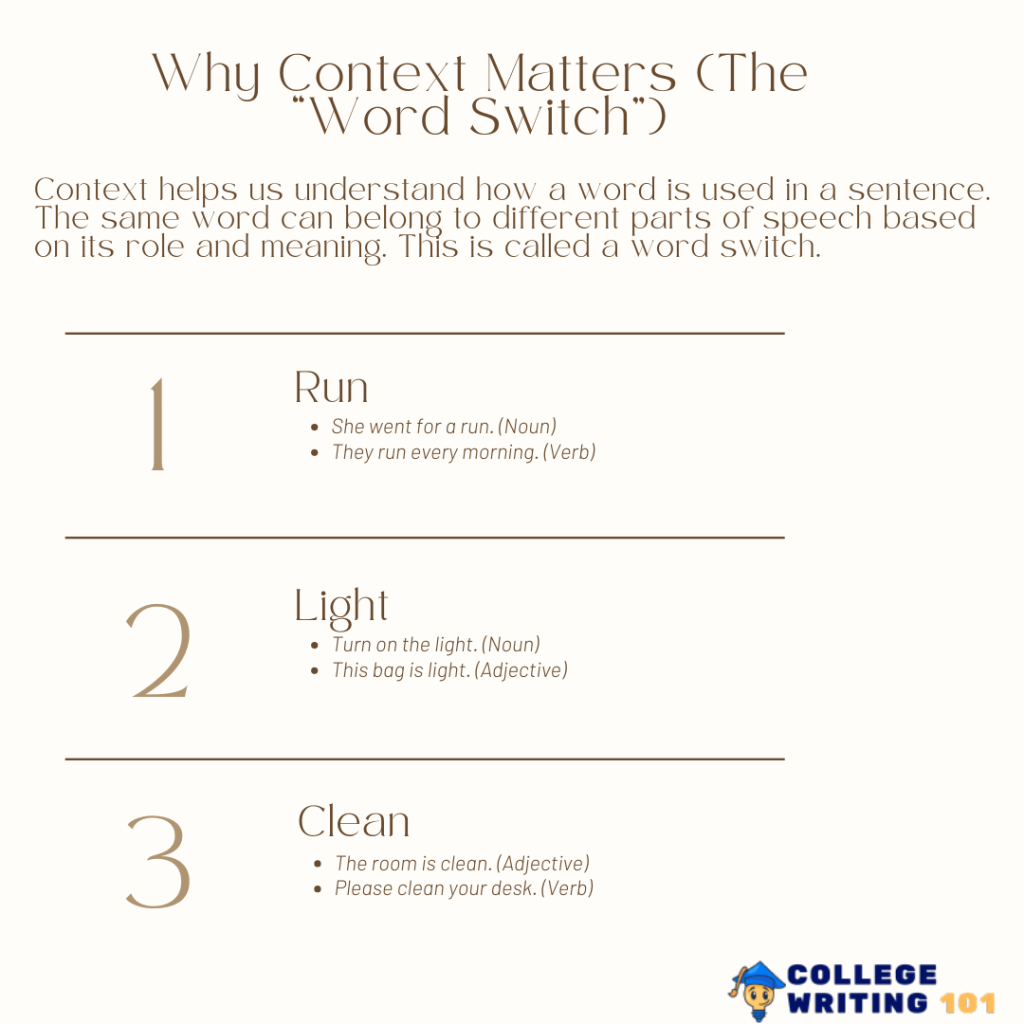
Remember the Word Function Rule
The same word can be different parts of speech depending on how it’s used:
- “Light the candle.” (verb)
- “Turn on the light.” (noun)
- “I need a light jacket.” (adjective)
- “She will run tomorrow.” (verb)
- “She went for a run.” (noun)
- “Go inside the house.” (preposition)
- “Please come inside.” (adverb)
- “The inside of the box was empty.” (noun)
Practice Exercise
Try identifying the parts of speech in this sentence:
“Oh! The young girl quickly and carefully painted a beautiful picture of her beloved grandmother yesterday.”
- Interjection: Oh
- Articles/Adjectives: The, a, her
- Adjectives: young, beautiful, beloved
- Noun: girl, picture, grandmother, yesterday
- Adverbs: quickly, carefully, yesterday
- Conjunction: and
- Verb: painted
- Preposition: of
Can’t spare the hours to write?
We’ll deliver your completed assignment on time, every time
FAQs
What is the most common part of speech?
Nouns are the most common because they name people, places, things, or ideas.
What part of speech shows action?
Verbs show action or a state of being.
What are function words?
Function words connect ideas and include prepositions, conjunctions, and articles.