
A well-structured persuasive speech can transform minds, inspire action, and create lasting change. Whether you’re advocating for a cause, presenting a business proposal, or debating a contentious issue, the foundation of your success lies in a carefully crafted outline that guides your audience from skepticism to conviction.
Creating an effective persuasive speech outline requires more than simply listing your main points. It demands strategic organization that builds momentum, addresses counterarguments, and culminates in a compelling call to action. The most powerful speakers understand that persuasion is both an art and a science—combining emotional appeal with logical reasoning while maintaining credibility throughout their presentation.
What is a persuasive speech?
A persuasive speech is a form of public speaking designed to convince an audience to adopt a particular viewpoint, change their beliefs, or take specific action. Unlike informative speeches that simply present facts, persuasive speeches aim to influence how people think, feel, or behave about a topic.
The primary goal of persuasive speaking is to move your audience from their current position to your desired position through compelling arguments and emotional connection. This type of speech relies on three key elements: ethos (credibility and trustworthiness of the speaker), pathos (emotional appeals that connect with the audience), and logos (logical reasoning supported by evidence).
Persuasive speeches are commonly used in various settings, from political campaigns and courtroom arguments to business presentations and social advocacy. They address controversial or debatable topics where multiple viewpoints exist, such as policy changes, social issues, product recommendations, or lifestyle choices.
Effective persuasive speeches acknowledge opposing viewpoints while systematically building a case for the speaker’s position. They often include personal stories, statistics, expert testimony, and real-world examples to strengthen their arguments. The ultimate measure of success is whether the audience is moved to think differently, change their behavior, or take the action the speaker recommends.
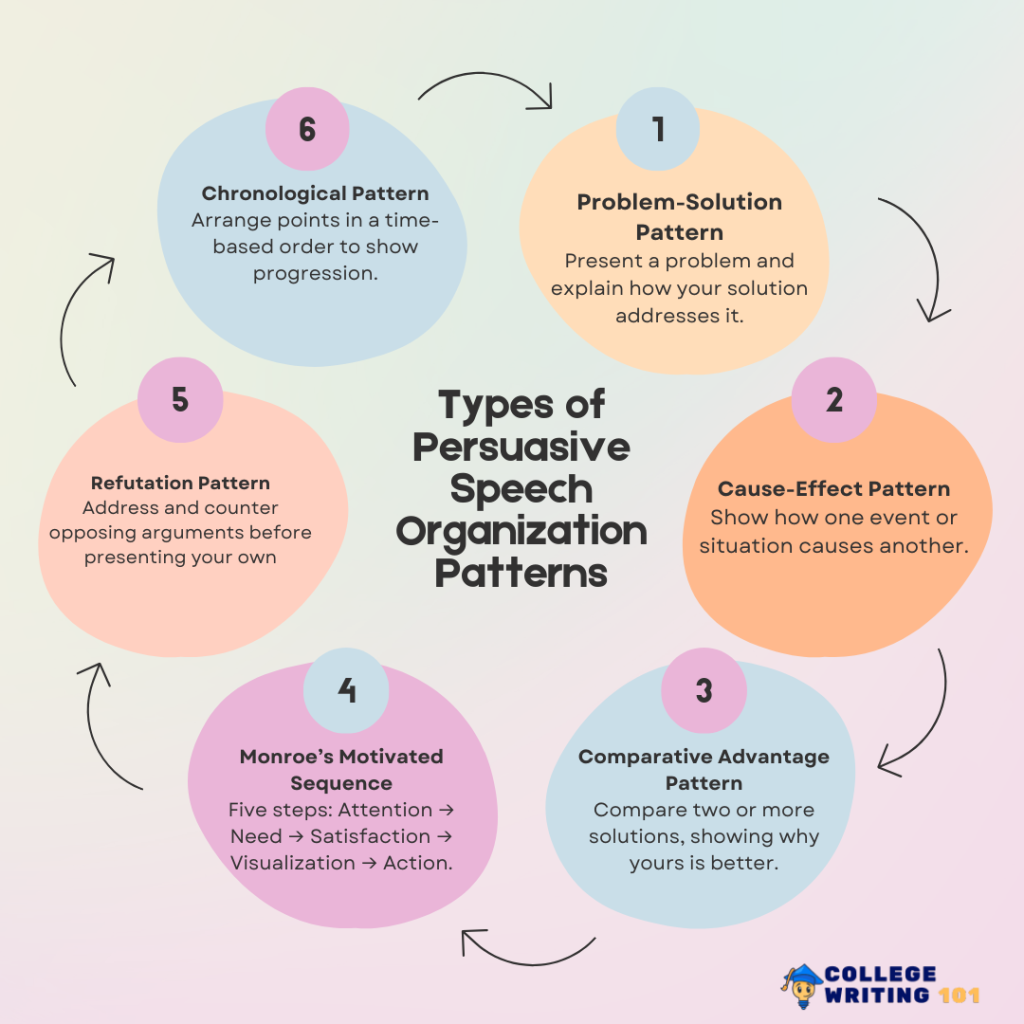
Structure of a Persuasive Speech Outline
I. Introduction (10-15% of speech time)
A. Attention-Getter (Hook)
- Startling statistic
- Thought-provoking question
- Personal anecdote
- Bold statement
- Relevant quotation
- Visual aid or demonstration
B. Establish Credibility (Ethos)
- Personal experience with the topic
- Research conducted
- Expertise or qualifications
- Connection to the audience
C. Relate to Audience
- Show relevance to their lives
- Address their interests or concerns
- Establish common ground
- Acknowledge their perspective
D. Thesis Statement
- Clear position on the topic
- Preview of main arguments
- Specific call to action (if applicable)
E. Preview of Main Points
- First main argument
- Second main argument
- Third main argument (if applicable)
II. Body (70-80% of speech time)
A. First Main Point
- Topic sentence – Clear statement of the point
- Supporting evidence a. Statistics and data b. Expert testimony c. Examples and case studies d. Personal experiences
- Analysis and explanation a. How evidence supports the point b. Why this matters to the audience
- Transition to next point
B. Second Main Point
- Topic sentence – Clear statement of the point
- Supporting evidence a. Statistics and data b. Expert testimony c. Examples and case studies d. Personal experiences
- Analysis and explanation a. How evidence supports the point b. Why this matters to the audience
- Transition to next point
C. Third Main Point (if applicable)
- Topic sentence – Clear statement of the point
- Supporting evidence a. Statistics and data b. Expert testimony c. Examples and case studies d. Personal experiences
- Analysis and explanation a. How evidence supports the point b. Why this matters to the audience
- Transition to conclusion
D. Addressing Counterarguments (Optional but Recommended)
- Acknowledge opposing viewpoints a. State the counterargument fairly b. Show respect for different perspectives
- Refute with evidence a. Provide contrary evidence b. Point out flaws in opposing logic c. Show why your position is stronger
- Reinforce your position
III. Conclusion (10-15% of speech time)
A. Signal the Conclusion
- Transitional phrase
- Clear indication that you’re wrapping up
B. Restate Thesis
- Rephrase your main argument
- Emphasize your position
C. Summarize Main Points
- Brief recap of first main point
- Brief recap of second main point
- Brief recap of third main point (if applicable)
D. Call to Action
- Specific action you want audience to take a. What to do b. When to do it c. How to do it
- Benefits of taking action
- Consequences of inaction (if appropriate)
E. Memorable Closing
- Return to opening hook
- Inspiring quotation
- Powerful final thought
- Challenge to the audience
- Vision of the future
IV. Additional Outline Components
A. References/Bibliography
- All sources cited in APA, MLA, or required format
- Credible and current sources
- Variety of source types
B. Visual Aids (if applicable)
- Slides or presentation materials
- Props or demonstrations
- Handouts for audience
C. Timing Notes
- Time allocation for each section
- Practice timing markers
- Flexibility for audience interaction
Example of a Persuasive Speech Outline
Topic: Schools Should Allow Students to Take Mental Health Days
General Purpose: To Persuade
Specific Purpose: To convince my audience that educational institutions should implement mental health day policies for students
Thesis Statement: Schools must recognize student mental health as equally important as physical health by allowing excused mental health days to prevent burnout, reduce anxiety, and improve academic performance.
I. Introduction (2 minutes)
A. Attention-Getter
Last Tuesday, 16-year-old Sarah sat in her AP Chemistry class, heart racing, palms sweating, unable to focus on the lesson because she had been awake until 3 AM finishing homework, studying for three tests, and worrying about college applications. Sound familiar? According to the American Psychological Association, 45% of teenagers report feeling stressed every single day.
B. Establish Credibility
As a former high school student who experienced severe academic burnout, and having researched this topic extensively through peer-reviewed studies and interviews with mental health professionals, I understand both the personal and systemic impact of student stress.
C. Relate to Audience
Whether you’re a student, parent, or educator, you’ve witnessed or experienced the mounting pressure in today’s academic environment. We wouldn’t expect a student with the flu to perform at their best—so why do we expect peak performance from students struggling with anxiety, depression, or overwhelming stress?
D. Thesis Statement
Schools must recognize student mental health as equally important as physical health by allowing excused mental health days to prevent burnout, reduce anxiety, and improve academic performance.
E. Preview of Main Points
Today, I will demonstrate that student mental health is in crisis, show how mental health days provide necessary relief and benefits, and address common concerns about implementing this policy.
II. Body (6 minutes)
A. First Main Point: Student Mental Health Crisis Demands Action
1. Topic Sentence
The current state of student mental health has reached crisis levels, requiring immediate intervention from educational institutions.
2. Supporting Evidence
- Statistics: The National Alliance on Mental Illness reports that 32% of students experience persistent feelings of sadness, with suicide being the second leading cause of death among people aged 15-24.
- Expert Testimony: Dr. Lisa Damour, adolescent psychologist, states that “chronic stress fundamentally changes the developing teenage brain, impacting learning, memory, and emotional regulation.”
- Case Study: Oregon became the first state to allow mental health days in 2019, with initial reports showing decreased absenteeism and improved classroom engagement.
3. Analysis
These statistics aren’t just numbers—they represent millions of young people struggling in silence. When we ignore mental health, we’re not just failing individual students; we’re creating a generation unable to cope with life’s challenges.
4. Transition
Now that we understand the severity of the crisis, let’s examine how mental health days can provide essential support.
B. Second Main Point: Mental Health Days Provide Essential Benefits
1. Topic Sentence
Allowing students to take mental health days creates measurable improvements in academic performance, stress management, and overall well-being.
2. Supporting Evidence
- Research Data: A 2022 study by the University of California found that students with access to mental health days showed 23% improvement in test scores and 31% reduction in reported anxiety levels.
- Personal Example: Emma, a junior from Colorado, reported that taking one mental health day per semester helped her “reset and return to school feeling capable rather than overwhelmed.”
- Expert Support: The American Academy of Pediatrics endorses mental health days, stating they “teach students to recognize their limits and practice self-care.”
3. Analysis
These benefits extend beyond individual students. When mental health is prioritized, classroom environments become more positive, teacher stress decreases, and the entire school culture improves. Mental health days aren’t about skipping school—they’re about creating sustainable success.
4. Transition
Despite these clear benefits, critics raise several concerns that deserve our attention.
C. Third Main Point: Addressing Valid Concerns About Implementation
1. Topic Sentence
While concerns about mental health day policies are understandable, practical solutions exist for every potential challenge.
2. Addressing Counterarguments
Concern 1: Students will abuse the system
- Counterpoint: Current sick day policies already rely on trust between families and schools without widespread abuse.
- Evidence: Utah schools report no increase in overall absences after implementing mental health days, suggesting students use them responsibly.
Concern 2: Academic disruption
- Counterpoint: One planned mental health day prevents multiple unplanned absences due to stress-related illness.
- Solution: Implement clear guidelines: limit to 2-3 days per semester, require parent communication, provide makeup work procedures.
Concern 3: Cost and resources
- Counterpoint: Prevention costs far less than intervention. Every dollar spent on mental health support saves $4 in future healthcare and educational costs.
3. Analysis
These concerns reflect legitimate care for educational quality, but they shouldn’t prevent us from supporting student well-being. With proper guidelines and communication, mental health days enhance rather than hinder the educational experience.
4. Transition to Conclusion
The evidence is clear: mental health days are not just beneficial—they’re necessary for student success.
III. Conclusion (2 minutes)
A. Signal Conclusion
In closing, the choice before us is simple but critical.
B. Restate Thesis
We must treat student mental health with the same urgency and respect as physical health by implementing comprehensive mental health day policies in our schools.
C. Summarize Main Points
We’ve seen that student mental health has reached crisis levels, that mental health days provide measurable benefits for academic and personal success, and that practical solutions exist for implementation concerns.
D. Call to Action
Here’s what you can do today:
- Students: Advocate for mental health day policies at your school council meetings
- Parents: Contact your school board members and express support for mental health initiatives
- Educators: Propose pilot programs to your administration
- Everyone: Visit mentalhealthamerica.net to find resources and advocacy tools
The time for action is now—before another student suffers in silence.
E. Memorable Closing
Remember Sarah from my opening? Six months after her school implemented mental health days, she reported feeling “finally able to breathe and succeed.” Every student deserves that same opportunity to thrive, not just survive, their educational journey. The question isn’t whether we can afford to implement mental health days—it’s whether we can afford not to.
IV. References
- American Psychological Association. (2023). Stress in America: Generation Z. APA Press.
- Damour, L. (2022). The emotional lives of teenagers: Raising connected, capable, and compassionate adolescents. Ballantine Books.
- Johnson, M., et al. (2022). Impact of mental health support on academic performance. Journal of School Health, 45(3), 234-247.
- National Alliance on Mental Illness. (2023). Mental health by the numbers. NAMI.org.
- Oregon Department of Education. (2021). Mental health days policy evaluation report. State of Oregon Publications.
- Smith, K. (2023). Utah schools mental health initiative: Year two assessment. Educational Policy Review, 18(2), 112-128.
FAQs
How do you start a persuasive speech?
Begin with a strong hook—such as a question, statistic, quote, or story—to grab attention.
What are 5 examples of persuasive speech?
Recycling should be mandatory.
School uniforms improve learning.
Social media harms mental health.
Exercise should be part of the workday.
Animal testing should be banned.
What is a good opening for a persuasive speech?
A surprising fact, emotional story, or powerful question that makes the audience want to listen.