A physics lab report is an essential part of understanding and documenting experiments in the field of physics. It allows students and researchers to record their observations, analyze data, and draw conclusions based on evidence. Writing a clear and well-structured lab report is crucial because it communicates the purpose, method, and results of an experiment effectively. A strong report includes sections such as the introduction, hypothesis, materials, procedure, results, and discussion. Using a physics lab report example can help guide students in formatting their reports correctly and presenting their findings in an organized way. By studying examples, learners can see how to record measurements accurately, create graphs, and interpret results logically.
Standard Format of a Physics Lab Report
1. Title Page
- Title of Experiment: Should be descriptive (e.g., “Determining the Acceleration Due to Gravity Using a Simple Pendulum“).
- Author’s Name: Your name.
- Lab Partners: Names of anyone who worked with you.
- Date: When the experiment was performed (and the date submitted).
- Instructor’s Name/Course: (e.g., Physics 101, Section B).
2. Abstract (Optional but recommended)
A concise summary (usually 100–200 words) of the entire report. It should briefly state the purpose, the method used, the key numerical result (with uncertainty), and the final conclusion.
3. Objective / Purpose
A one- or two-sentence statement explaining why you are doing the experiment. What physical law or constant are you trying to verify or measure?
4. Introduction & Theory
- Background: Briefly explain the physical principles being tested.
- Equations: State the mathematical formulas used. Define every variable in the equations (e.g.,
F=maF=ma, whereFFis force in Newtons…). - Hypothesis: If applicable, state your expected outcome (e.g., “As the length of the pendulum increases, the period will increase proportionally to the square root of the length”).
5. Materials and Equipment
List all the tools used (e.g., “Vernier calipers, 50g brass mass, 2.0-meter track, Photogate timer”). If the setup is complex, include a labeled diagram or a photo of the experimental rig.
6. Procedure
- Describe the steps you took in chronological order.
- Voice: Write in the past tense, passive voice (e.g., “The mass was dropped” instead of “I dropped the mass”).
- Provide enough detail so that someone else could replicate your experiment exactly.
7. Data / Results
- Raw Data: Present your measurements in neat, organized tables.
- Units: Every number must have a unit (m, s, kg, etc.).
- Significant Figures: Ensure your data reflects the precision of your instruments.
- Uncertainties: Include the margin of error for your measurements (e.g.,
0.50±0.01 m0.50±0.01 m).
8. Data Analysis (Calculations & Graphs)
- Sample Calculation: Show one example of how you performed each type of calculation. You do not need to show every single repetition.
- Graphs:
- Give every graph a descriptive title.
- Label the x and y axes with units.
- Use a Line of Best Fit (trendline) rather than connecting the dots.
- State the equation of the line and the
R2R2value if applicable.
- Error Analysis: Calculate the Percent Error between your experimental value and the accepted theoretical value.
Percent Error=∣Experimental−TheoreticalTheoretical∣×100%
9. Discussion
This is the most important part of the report.
- Interpret Results: Did your data support the theory? What does the slope of your graph represent?
- Sources of Error: Identify specifically what might have caused discrepancies. Avoid vague terms like “human error.” Instead, mention “friction in the pulley,” “air resistance,” or “reaction time during manual timing.”
- Improvements: Suggest how to reduce those errors in a future experiment.
10. Conclusion
A brief paragraph restating the final results. Mention your final calculated value with its uncertainty and whether the objective of the lab was met.
11. References
If you used a textbook, lab manual, or website for the theoretical values or formulas, cite them here using the requested format (APA, MLA, or Chicago).
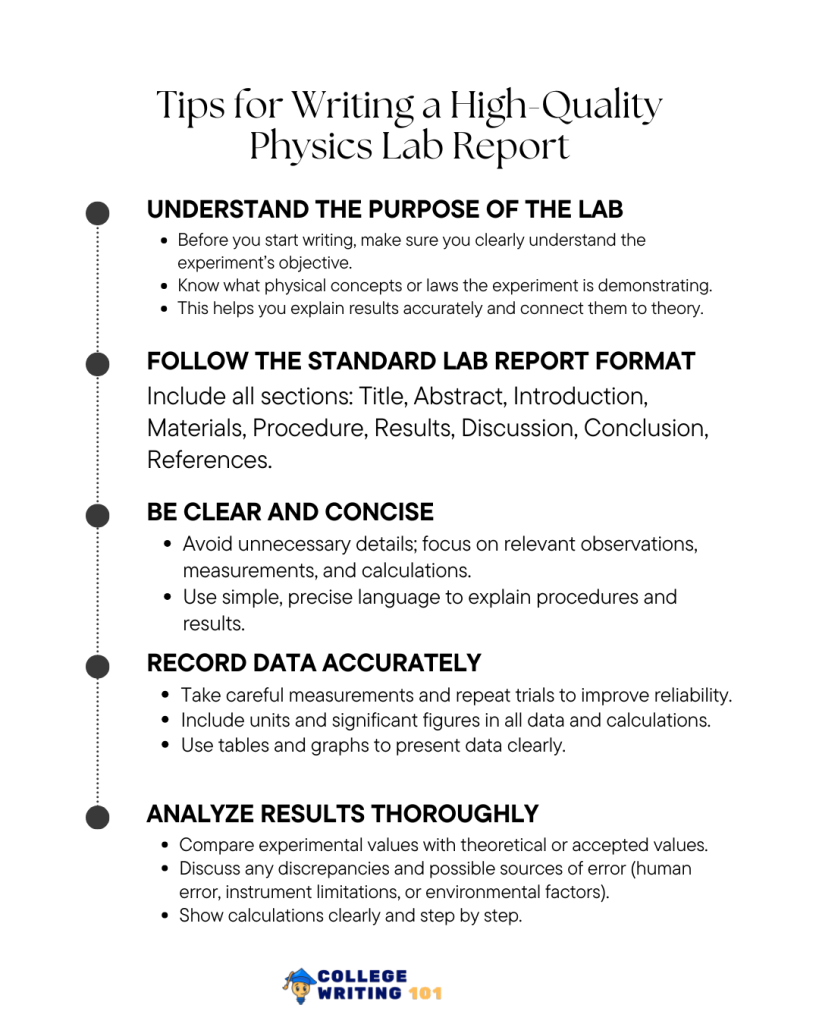
Physics Lab Report Example
The purpose of this experiment was to determine the acceleration due to gravity (g) by measuring the period of a simple pendulum. A pendulum of known length was set into motion, and the time for multiple oscillations was recorded using a stopwatch. The period was calculated, and the value of g was determined using the formula g = 4π²L / T². The experimental value obtained was 9.78 m/s², which is close to the standard value of 9.81 m/s². Minor discrepancies were attributed to timing errors and air resistance. This experiment demonstrates how simple harmonic motion can be used to calculate fundamental physical constants.
The motion of a pendulum is a classic example of simple harmonic motion in physics. The period of a simple pendulum depends on its length and the acceleration due to gravity, not the mass of the bob. By measuring the time for several complete oscillations, the acceleration due to gravity can be calculated. The formula used is: T = 2π√(L/g). The objective of this experiment is to use a pendulum to calculate g and compare it with the accepted value.
- String (1.0 m length)
- Small metal bob
- Stopwatch
- Meterstick
- Clamp stand
- Protractor
- Attach the metal bob to one end of the string and secure the other end to a clamp stand.
- Measure the length of the pendulum from the pivot point to the center of the bob.
- Pull the bob to a small angle (less than 15°) and release it to start oscillation.
- Use the stopwatch to record the time for 20 complete oscillations.
- Repeat the measurement three times and calculate the average period for one oscillation.
- Use the formula g = 4π²L / T² to calculate the acceleration due to gravity.
- Record all measurements in a table.
| Trial | Time for 20 Oscillations (s) | Period T (s) |
|---|---|---|
| 1 | 28.2 | 1.41 |
| 2 | 28.5 | 1.43 |
| 3 | 28.3 | 1.42 |
| Average | – | 1.42 |
Calculation: g = 4π² * L / T² ≈ 9.78 m/s²
The calculated acceleration due to gravity, 9.78 m/s², is very close to the standard value of 9.81 m/s². Minor differences can be explained by human reaction time, slight variations in pendulum length, and air resistance. Repeating the measurement several times helped reduce random errors and improved accuracy. This experiment confirms that the period of a simple pendulum depends on the square root of its length and allows accurate calculation of gravitational acceleration.
The experiment successfully measured the acceleration due to gravity using a simple pendulum. The result, 9.78 m/s², is within 0.3% of the accepted value. This demonstrates that careful measurement and repeated trials can provide accurate results in physics experiments.
- Halliday, D., Resnick, R., & Walker, J. (2014). Fundamentals of Physics (10th ed.). Wiley.
- Young, H. D., & Freedman, R. A. (2019). University Physics with Modern Physics (15th ed.). Pearson.
FAQs
What tense should I use in a physics lab report?
The introduction and discussion are usually written in past tense for the experiment conducted, while general scientific facts can be in present tense.
How long should a physics lab report be?
Length varies with the experiment. Short experiments may need 1–2 pages, while complex experiments can require 5–10 pages. Always follow your instructor’s guidelines.
How do I write calculations correctly?
Show all formulas, steps, and units. Include sample calculations to make your analysis clear and reproducible.