
Effective rebuttals form the backbone of persuasive writing and critical thinking. Whether you’re crafting an academic essay, preparing for a debate, or simply engaging in thoughtful discourse, knowing how to construct a compelling counterargument can transform your communication skills. A well-crafted rebuttal doesn’t merely dismiss opposing views—it acknowledges them respectfully while presenting evidence and reasoning that challenges their validity.
Understanding the anatomy of strong rebuttals helps writers anticipate objections, strengthen their own arguments, and demonstrate intellectual honesty. The most powerful rebuttals combine logical reasoning with concrete examples, showing readers exactly how alternative perspectives fall short or overlook crucial evidence. They bridge the gap between opposing viewpoints and guide audiences toward a more complete understanding of complex issues.
What is a rebuttal?
A rebuttal is a response that contradicts or challenges an argument, claim, or accusation by presenting opposing evidence or reasoning. It’s essentially a counterargument that aims to disprove, weaken, or cast doubt on someone else’s position.
Key characteristics of a rebuttal include:
Purpose: To refute or oppose an existing argument by showing why it’s incorrect, incomplete, or flawed.
Structure of a Good Rebuttal
A well-constructed rebuttal follows a clear, logical structure that systematically addresses opposing arguments while maintaining credibility and respect.
1. Acknowledgment Begin by fairly summarizing the opposing argument or claim you’re addressing. This demonstrates that you understand the position and aren’t creating a straw man. Use phrases like “While it’s true that…” or “Proponents argue that…”
2. Transition Signal your disagreement with transitional phrases such as “However,” “Nevertheless,” or “On the contrary.” This prepares readers for the shift in perspective.
3. Counter-Evidence Present your contradicting evidence, which may include:
- Statistical data or research findings
- Expert testimony or authoritative sources
- Logical reasoning that exposes flaws
- Historical examples or case studies
- Alternative interpretations of existing evidence
4. Explanation Clearly explain why your evidence undermines the original argument. Connect the dots for your audience, showing how your evidence directly challenges the opposing position.
5. Conclusion Reinforce your position with a brief summary that ties your rebuttal back to your main argument. This strengthens your overall case and provides closure to the counterargument.
6. Respectful Tone Throughout, maintain a professional, respectful tone that focuses on ideas rather than attacking individuals or groups who hold opposing views.
Rebuttal Techniques
1. Direct Contradiction
Definition: Present evidence that directly contradicts the opposing claim using concrete data, research studies, or verifiable facts.
When to Use: When you have strong, indisputable evidence that clearly disproves the argument.
Example: Opposing Argument: “Renewable energy is too expensive and will hurt the economy.”
Rebuttal: “While critics argue that renewable energy is too costly, recent data contradicts this claim. Solar panel costs have dropped by 85% since 2010, and wind energy costs have fallen by 70% over the same period according to the International Renewable Energy Agency. Major corporations like Google and Apple have achieved cost savings by switching to renewables, demonstrating that clean energy is now economically advantageous.”
Key Elements:
- Specific statistics (85% drop in solar costs)
- Credible sources (International Renewable Energy Agency)
- Real-world examples (Google, Apple)
2. Attacking Assumptions
Definition: Challenge the underlying assumptions or premises that support the opposing argument.
When to Use: When the opponent’s argument relies on questionable or unproven assumptions.
Example: Opposing Argument: “Video games cause violent behavior in children.”
Rebuttal: “While some people argue that video games lead to an increase in violence, this position is based on a correlation between violence and video game use, but a correlation is not the same as cause and effect. There have been no studies to indicate that video games cause violent behavior.”
Key Elements:
- Identifies the flawed assumption (correlation = causation)
- Explains why the assumption is problematic
- Points to lack of supporting evidence
3. Attacking Relevance
Definition: Acknowledge the opponent’s evidence but demonstrate that it’s irrelevant to the core issue being debated.
When to Use: When the opposing argument presents true information that doesn’t actually support their conclusion.
Example: Opposing Argument: “Homework shouldn’t be assigned because it doesn’t take much of students’ time anyway.”
Rebuttal: “It’s true that homework doesn’t take that much time, but that point has nothing to do with whether homework promotes learning. Free time is important, but it has no bearing on learning.”
Key Elements:
- Acknowledges the truth of the opponent’s claim
- Clearly states why it’s irrelevant
- Redirects focus to the actual issue
4. Attacking Impact
Definition: Challenge the significance or consequences of the opposing argument, showing that even if true, it doesn’t matter.
When to Use: When you can’t directly disprove the opponent’s facts but can minimize their importance.
Example: Opposing Argument: “Zoos should be banned because they encourage people to see animals as subjects in captivity.”
Rebuttal: “Yes, zoos do show animals in captivity; however, there’s not a logical connection between seeing animals in captivity and thinking of them as captives in all situations. People also see animals in the wild, on television programs, in documentaries, and in other situations. They don’t appear to generalize from these settings, so there’s no reason to assume that seeing an animal in captivity means people always think of that species as a captive.”
Key Elements:
- Accepts the opponent’s premise
- Challenges the logical connection to consequences
- Provides alternative perspective
5. Alternative Explanation
Definition: Acknowledge the evidence presented but offer a different interpretation that supports your position.
When to Use: When the same facts can reasonably support multiple conclusions.
Example: Opposing Argument: “Crime rates decreased after implementing stricter gun laws, proving gun control works.”
Rebuttal: “While it’s true that crime rates decreased following the new legislation, this correlation could be explained by several other factors. The same period saw increased police presence, improved economic conditions, and expanded youth programs. Without controlling for these variables, we cannot attribute the decrease solely to gun legislation.”
Key Elements:
- Acknowledges the factual claim
- Presents alternative causal factors
- Shows multiple possible interpretations
6. Exposing Logical Fallacies
Definition: Identify specific flaws in reasoning such as false dichotomies, hasty generalizations, or ad hominem attacks.
When to Use: When the opponent’s argument contains clear logical errors.
Common Fallacies to Address:
- False Dichotomy: “You’re either with us or against us.”
- Ad Hominem: Attacking the person rather than their argument
- Straw Man: Misrepresenting the opponent’s position
- Appeal to Emotion: Using emotions instead of logic
Example: Opposing Argument: “Everyone knows that social media is destroying our youth. Just look at how teenagers behave today compared to previous generations.”
Rebuttal: “This argument commits the logical fallacy of hasty generalization by making broad claims about ‘everyone’ and ‘all teenagers’ without providing specific evidence. Additionally, it relies on anecdotal observations rather than systematic research. Multiple studies by the Pew Research Center show more nuanced effects of social media, with both positive and negative outcomes depending on usage patterns.”
7. Comparative Analysis
Definition: Compare the opposing argument to similar situations, historical precedents, or analogous cases where the logic failed.
When to Use: When you can draw parallels that highlight problems with the opponent’s reasoning.
Example: Opposing Argument: “We should ban all artificial intelligence research because it’s dangerous.”
Rebuttal: “This argument mirrors historical reactions to other transformative technologies. Similar fears were expressed about automobiles (‘frightening horses’), electricity (‘dangerous to health’), and the internet (‘destroying social interaction’). In each case, regulation and safety measures proved more effective than outright bans, allowing society to harness benefits while minimizing risks.”
Key Elements:
- Historical parallels
- Pattern recognition
- Alternative approaches that worked
8. Burden of Proof Shift
Definition: Challenge opponents to provide stronger evidence for extraordinary claims.
When to Use: When opponents make strong claims without adequate support.
Example: Opposing Argument: “Alternative medicine is just as effective as conventional medicine.”
Rebuttal: “This claim requires extraordinary evidence given that conventional medicine undergoes rigorous clinical trials and peer review. Alternative medicine advocates must provide the same level of scientific validation—randomized controlled trials, statistical significance, and reproducible results—before their treatments can be considered equally effective.”
Rebuttal Examples in Everyday Debate
Common Everyday Debate Scenarios
1. Family Dinner Discussions
Topic: Should teenagers have later curfews?
Parent’s Argument: “Teenagers need earlier curfews because they don’t make responsible decisions and need structure.”
Teenager’s Rebuttal: “While I understand your concern about responsibility, I think a later curfew would actually help me develop better decision-making skills. When I have to be home by 9 PM, I don’t get to practice making choices about when to leave parties or how to manage my time. My friends who have 11 PM curfews seem more responsible because they’ve had to learn these skills.”
Technique Used: Attacking assumptions (that earlier curfews create responsibility) and offering alternative explanation (later curfews develop responsibility).
2. Workplace Discussions
Topic: Remote work vs. office work
Colleague’s Argument: “Remote work reduces productivity because people get distracted at home.”
Your Rebuttal: “That’s a common concern, but recent data tells a different story. A Stanford study found remote workers were 13% more productive than office workers. The key isn’t location—it’s having clear goals and accountability measures. When I work from home, I actually get more done because I avoid office interruptions like impromptu meetings and casual conversations.”
Technique Used: Direct contradiction with specific data, plus personal evidence.
3. Friend Group Planning
Topic: Choosing a vacation destination
Friend’s Argument: “We should go to the mountains because beaches are boring—all you do is sit in the sand.”
Your Rebuttal: “I can see why you might think beaches are just about sitting around, but that’s not really accurate. Beach destinations offer hiking, water sports, exploring coastal towns, and cultural experiences. Plus, even if we did want to relax, that might be exactly what we need after this stressful semester.”
Technique Used: Attacking relevance (sitting in sand isn’t the full beach experience) and turning the “weakness” into a strength.
Everyday Rebuttal Strategies
Acknowledge validity in the opposing view before presenting your counter-perspective.
Example: Statement: “Electric cars are too expensive for regular people.” Rebuttal: “Yes, the upfront cost is higher, but when you factor in fuel savings, tax incentives, and lower maintenance costs, the total cost of ownership is often less than traditional cars over five years.”
The Evidence Flip
Use the same evidence to support a different conclusion.
Example: Statement: “Social media usage among teens has increased 40% in two years, proving it’s addictive.” Rebuttal: “That same 40% increase occurred during a global pandemic when teens were isolated from friends. Rather than showing addiction, it demonstrates social media’s value for maintaining crucial peer connections during unprecedented circumstances.”
The Scope Challenge
Question whether the argument applies as broadly as claimed.
Example: Statement: “Homework is useless because kids forget everything over summer break anyway.” Rebuttal: “Even if some information is forgotten over summer—which happens with all learning, not just homework—that doesn’t mean homework is useless. The daily practice builds study habits, time management skills, and deeper understanding that extends beyond memorizing facts.”
Real Conversation Examples
Political Discussion at Work
Setting: Casual conversation during lunch break
Coworker: “Raising minimum wage just forces businesses to fire people. It’s basic economics.”
Your Response: “That’s one economic theory, but real-world data shows it’s more complex. When Seattle raised their minimum wage to $15, employment actually increased in most sectors. The Congressional Budget Office found that while some job losses might occur, millions more workers benefit from higher wages. The net effect depends on local economic conditions, not just theory.”
Why This Works: Uses concrete examples, acknowledges complexity, and presents data rather than just opinion.
Family Discussion About Technology
Setting: Dinner conversation about screen time
Parent: “Kids today are addicted to their phones. They can’t even have a conversation without checking them.”
Teenager: “I understand it looks that way, but phones aren’t just entertainment devices for us—they’re how we stay connected with friends, get help with homework, and access information. When I ‘check my phone,’ I might be responding to a study group message or checking tomorrow’s schedule. It’s like when you keep your work phone nearby in case something important comes up.”
Why This Works: Provides alternative explanation, uses relatable analogy, and shows understanding of the parent’s perspective.
Neighborhood Discussion
Setting: Community meeting about a proposed dog park
Resident: “Dog parks are noisy and attract irresponsible pet owners who don’t clean up after their animals.”
Your Response: “Those are valid concerns that well-designed dog parks address. The proposed location is away from residential areas, and successful dog parks actually reduce neighborhood mess because they give owners a designated space. Dog parks with proper rules and maintenance typically attract responsible owners who want a safe space for their pets.”
Why This Works: Acknowledges concerns as valid, shows how the specific proposal addresses them, and reframes the target audience.
FAQs
Why are rebuttals important?
Rebuttals strengthen your argument by showing that you have considered other viewpoints and can logically refute them. This makes your position more persuasive and credible.
Can you give a simple example of a rebuttal?
Yes. Argument: “Video games make students lazy.”
Rebuttal: “On the contrary, many video games improve problem-solving skills, teamwork, and strategic thinking, which are beneficial for students.”
What are common mistakes in writing rebuttals?
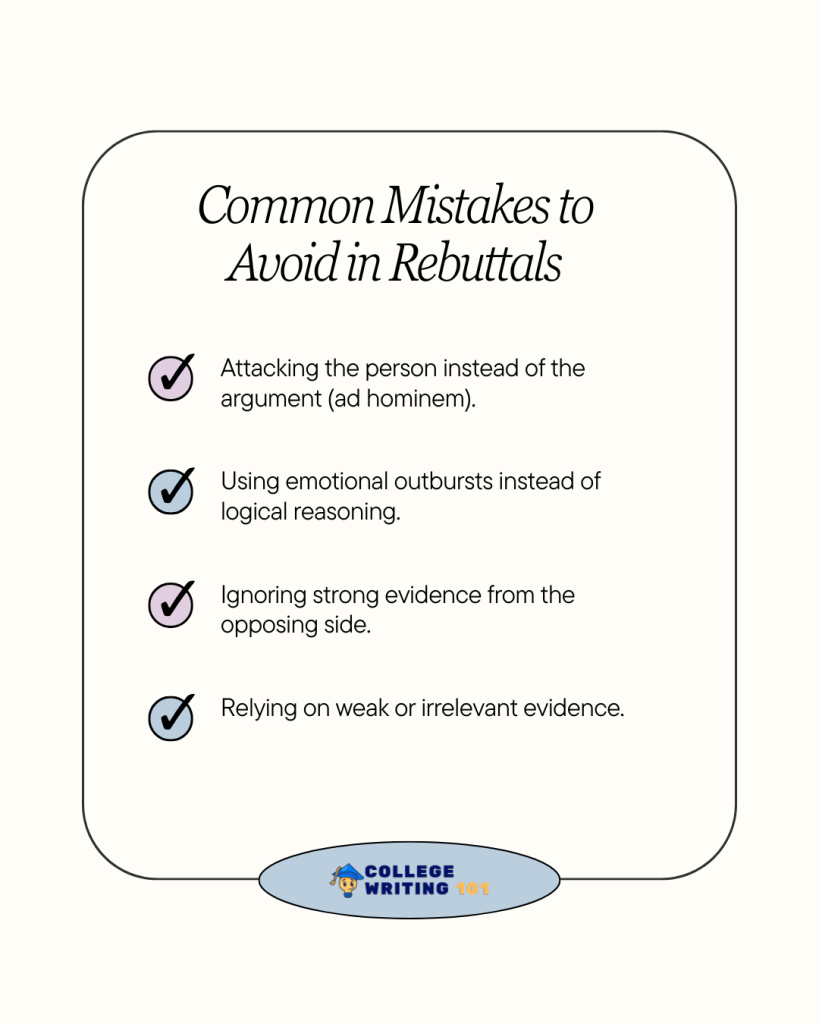
Some common mistakes include attacking the person instead of the argument, providing weak or no evidence, ignoring valid points from the other side, and making overgeneralized claims.