
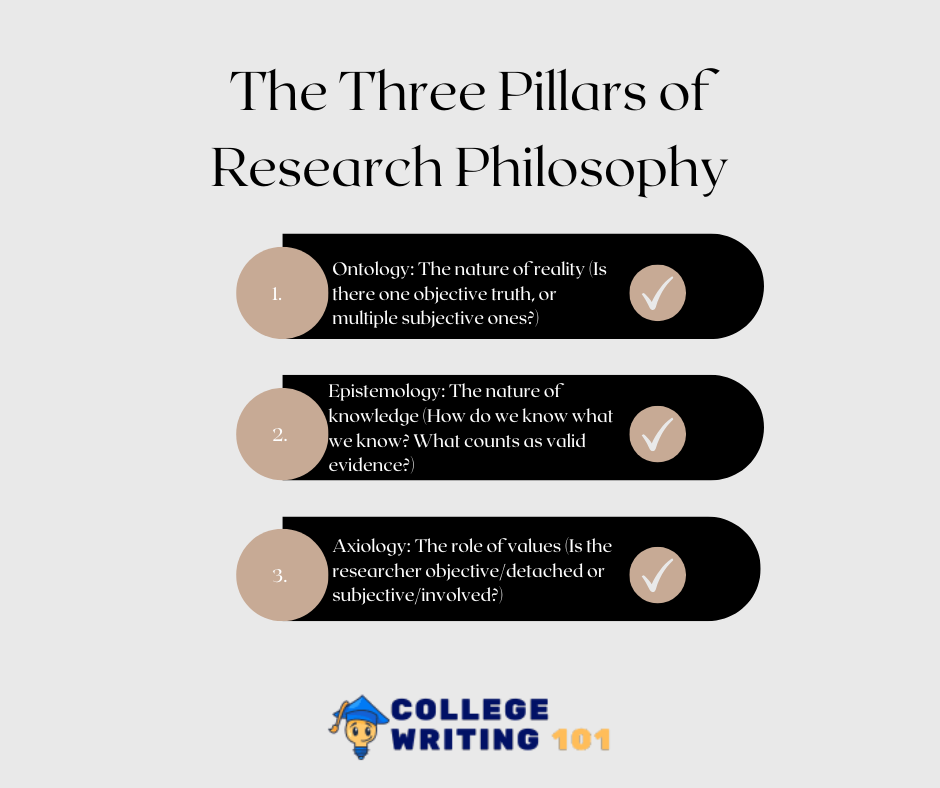
Research philosophy explains how knowledge is created, tested, and understood in research. It shapes the way researchers think about reality, truth, and evidence. Every study is guided by a research philosophy, whether the researcher is aware of it or not. This philosophy affects the choice of research questions, methods, data collection, and analysis. By understanding research philosophy, students and researchers can design stronger studies and clearly explain their decisions.
There are different types of research philosophy, each based on specific beliefs about the world and how it can be studied. Common types include positivism, interpretivism, realism, and pragmatism. Each one suits different research goals and subjects. Learning these approaches helps researchers choose the best path for their work.
Assignment due but your schedule’s packed?
Reach out now and let our experts take it from here
Why Research Philosophy Is Important
It makes your assumptions visible. Every researcher has beliefs about what counts as “real” knowledge and how to get it. Research philosophy forces you to examine these beliefs consciously rather than smuggling them in unexamined. Are you assuming there’s one objective truth to discover, or that truth is constructed through social interaction? Your answer fundamentally changes your research design.
It ensures coherence. Your philosophical stance should align with your methods. If you believe reality is socially constructed (interpretivist), running purely quantitative surveys might create contradictions. Philosophy helps you choose methods that actually fit what you’re trying to learn and how you think learning happens.
It strengthens your work’s credibility. Being explicit about your philosophical position helps readers understand and evaluate your research on its own terms. A positivist and an interpretivist might study the same phenomenon completely differently – and both can be rigorous and valuable when they’re philosophically consistent.
It helps you navigate real research dilemmas. When you hit inevitable choices – should I prioritize breadth or depth? Objectivity or understanding meaning? Generalizable findings or context-specific insights? – your philosophical foundation gives you a compass rather than leaving you guessing.
Main Types of Research Philosophy
1. Positivism
Core Beliefs
Positivism holds that there is an objective reality that exists independently of human perception, and that this reality can be discovered through systematic, scientific observation. Knowledge should be based on observable phenomena that can be measured, quantified, and verified.
Ontology: Realist – an objective reality exists “out there” waiting to be discovered
Epistemology: Objective knowledge is obtained through systematic observation and measurement, independent of the researcher
Key Characteristics
- Emphasizes quantitative methods and statistical analysis
- Values objectivity, detachment, and researcher neutrality
- Seeks generalizable laws and universal patterns
- Uses deductive reasoning (theory to observation)
- Aims for replication and verification
- Believes in value-free research
When to Use Positivism
Positivism works well when you’re studying phenomena that can be observed and measured objectively, when you want to test theories, establish cause-and-effect relationships, or produce findings that can be generalized across contexts.
Real-World Examples
Example 1: Medical Research A pharmaceutical company testing a new drug for hypertension would use a positivist approach. They conduct randomized controlled trials with experimental and control groups, measure blood pressure readings objectively, use statistical analysis to determine effectiveness, and aim to produce generalizable results that will apply to the broader population with hypertension.
Example 2: Educational Testing Researchers studying whether a new teaching method improves math scores might compare standardized test results between classrooms using the new method versus traditional methods. They collect quantitative data, control for variables like prior achievement and class size, and use statistical tests to determine if differences are significant.
Example 3: Consumer Behavior A market researcher investigating whether price discounts increase product sales would analyze sales data across different pricing strategies, controlling for seasonality and other variables. The assumption is that consumer behavior follows predictable patterns that can be measured and generalized.
Limitations
Critics argue that positivism oversimplifies complex social phenomena, ignores context and meaning, assumes researchers can be truly objective (which may be impossible), and reduces human experience to numbers. Human behavior often doesn’t follow universal laws the way physical phenomena do.
2. Interpretivism (Constructivism)
Core Beliefs
Interpretivism argues that reality is not objective but socially constructed through human interaction, language, and shared meanings. Since people interpret the world differently based on their experiences and contexts, understanding these subjective meanings is crucial.
Ontology: Relativist – multiple realities exist, constructed through social interaction
Epistemology: Knowledge is created through interpretation and understanding of subjective meanings
Key Characteristics
- Emphasizes qualitative methods like interviews, ethnography, and case studies
- Values depth over breadth, understanding over prediction
- Acknowledges the researcher as part of the research process
- Uses inductive reasoning (observation to theory)
- Focuses on context, meaning, and interpretation
- Embraces subjectivity and reflexivity
When to Use Interpretivism
Interpretivism is appropriate when you’re exploring subjective experiences, meanings, motivations, or cultural phenomena where context matters deeply and universal generalizations would miss the richness of human experience.
Real-World Examples
Example 1: Workplace Culture Study A researcher studying how employees experience organizational culture in a tech startup wouldn’t just measure satisfaction scores. They’d conduct in-depth interviews, observe workplace interactions, attend meetings, and analyze how employees describe and make sense of their work environment. The goal is understanding the lived experience and shared meanings within that specific context.
Example 2: Patient Experience of Chronic Illness Rather than just tracking symptoms and medication adherence, an interpretivist researcher would explore how patients make sense of living with diabetes—their fears, coping strategies, identity changes, and how illness affects their relationships. Through narrative interviews, they’d uncover the personal meanings and experiences that statistics can’t capture.
Example 3: Understanding Homelessness Instead of only collecting demographic data on homeless populations, an interpretivist approach might involve spending time in shelters, conducting life history interviews, and understanding how individuals experience and make sense of homelessness. This reveals the complex social, psychological, and economic factors from the perspective of those living it.
Limitations
Critics note that interpretivism can be overly subjective, making findings difficult to verify or generalize. The researcher’s own biases heavily influence interpretation. Results may not be comparable across studies, and the approach can be time-intensive with smaller sample sizes.
3. Critical Realism
Core Beliefs
Critical realism occupies middle ground, acknowledging that an objective reality exists but arguing that our access to it is always mediated through human interpretation and social structures. Reality operates in layers, and surface observations don’t always reveal underlying causal mechanisms.
Ontology: Stratified reality with three domains:
- Empirical: What we observe and experience
- Actual: Events that occur (whether we observe them or not)
- Real: Underlying mechanisms and structures that generate events
Epistemology: Knowledge is possible but fallible; we can approximate understanding of reality while acknowledging our limitations
Key Characteristics
- Combines elements of both positivist and interpretivist approaches
- Distinguishes between transitive knowledge (our theories) and intransitive reality (the actual world)
- Uses retroduction—reasoning backward from observed patterns to possible causal mechanisms
- Values both quantitative and qualitative methods
- Acknowledges context while seeking deeper explanations
- Emphasizes causal mechanisms over correlations
When to Use Critical Realism
Critical realism works well for complex social problems where you want to understand not just what happens but why it happens—uncovering the underlying mechanisms while acknowledging that social contexts shape how these mechanisms operate.
Real-World Examples
Example 1: Educational Inequality A critical realist studying why students from low-income families perform worse academically wouldn’t simply correlate income with test scores (empirical level). They’d investigate the actual mechanisms at work: reduced access to educational resources, stress from economic insecurity affecting cognitive development, lower-quality schools in poor neighborhoods, and teacher expectations shaped by class bias (real level). The research recognizes these mechanisms exist independently of observation but manifest differently in different contexts.
Example 2: Climate Change Action Researchers might observe that some communities adopt green technologies while others don’t (empirical). They’d then investigate underlying mechanisms: economic structures that make sustainable choices affordable or prohibitive, cultural values around environmental stewardship, political systems that incentivize or discourage action, and power relations that determine who benefits from the status quo (real). These mechanisms are real but their effects vary by context.
Example 3: Mental Health Treatment Effectiveness Rather than just measuring whether therapy reduces depression symptoms (empirical), critical realists would explore the mechanisms: neurobiological changes, cognitive restructuring, social support, therapeutic alliance, and how socioeconomic contexts enable or constrain these mechanisms. A treatment might work through specific mechanisms that are real, even if we can’t directly observe them and even if their effectiveness varies by context.
Limitations
Critics argue that critical realism can be philosophically complex and difficult to operationalize. Identifying causal mechanisms is challenging, and the approach may claim to do more than is actually achievable. The distinction between different levels of reality can seem abstract.
Life getting in the way of your assignments?
We understand, that’s exactly why we’re here to help
4. Pragmatism
Core Beliefs
Pragmatism sidesteps the ontological debates about the nature of reality and focuses instead on practical consequences and what works. Truth is defined by usefulness—theories and methods are judged by whether they solve real-world problems effectively.
Ontology: Reality exists but philosophical debates about its exact nature are less important than practical inquiry
Epistemology: Knowledge is provisional and judged by its practical consequences and utility
Key Characteristics
- Research questions drive methodology, not philosophical commitments
- Freely mixes qualitative and quantitative approaches (mixed methods)
- Values practical outcomes over philosophical consistency
- Emphasizes problem-solving and action
- Views theory as a tool rather than truth
- Accepts multiple perspectives if they’re useful
When to Use Pragmatism
Pragmatism is ideal for applied research, policy studies, evaluation research, and situations where you need actionable insights and a single method won’t capture the full picture. It’s particularly popular in fields like education, public health, and business.
Real-World Examples
Example 1: School Dropout Prevention Program Evaluation Researchers evaluating an intervention to reduce dropout rates would use whatever methods help answer the question: quantitative analysis of dropout rates before and after the program, surveys measuring student engagement, interviews with students about barriers they face, focus groups with teachers about implementation challenges, and cost-benefit analysis. The goal is understanding what works and why, not philosophical purity.
Example 2: Healthcare Service Improvement A hospital studying emergency room wait times might use patient flow data (quantitative), observe ER processes (qualitative), interview staff about bottlenecks, survey patient satisfaction, and test different triage systems. Each method provides different insights, and all contribute to solving the practical problem of reducing wait times while maintaining care quality.
Example 3: Community Development Project Researchers assessing a poverty reduction initiative might track income and employment statistics, conduct ethnographic observation in the community, survey residents about quality of life changes, interview program administrators, analyze policy documents, and measure health outcomes. Pragmatism allows them to use whatever combination of approaches provides the most complete and useful understanding.
Limitations
Critics argue that pragmatism lacks theoretical depth and may sacrifice rigor for convenience. Without clear philosophical grounding, research can become inconsistent or unprincipled. The focus on “what works” might ignore important questions about justice, power, or underlying causes.
5. Postmodernism/Poststructuralism
Core Beliefs
Postmodernism questions the very possibility of objective truth, universal theories, or grand narratives. It emphasizes that knowledge is always shaped by language, power relations, and historical context. What we call “truth” often reflects and reinforces dominant power structures.
Ontology: Reality is fragmented, unstable, and constructed through discourse and power relations
Epistemology: Knowledge is contextual, partial, always contested, and inseparable from power
Key Characteristics
- Deconstructs taken-for-granted assumptions and dominant narratives
- Examines how language creates rather than reflects reality
- Focuses on power, marginalization, and whose voices are heard
- Embraces contradiction, ambiguity, and multiple interpretations
- Questions the neutrality of research and science
- Values marginalized perspectives and local knowledge
- Uses discourse analysis, deconstruction, genealogy
When to Use Postmodernism
Postmodernism is valuable when examining how knowledge and truth claims are constructed, challenging dominant narratives, analyzing power relations, or giving voice to marginalized groups whose experiences contradict mainstream accounts.
Real-World Examples
Example 1: Gender Studies Research A postmodern researcher might examine how medical and psychological discourses have historically constructed “femininity” and “masculinity” as binary, natural categories—and how these constructions serve particular power interests. Rather than accepting gender categories as given, they’d analyze how language, institutions, and practices create and police these categories, and how non-binary people challenge and resist these dominant narratives.
Example 2: Colonial History Instead of writing a single “true” history of colonialism, a postmodern historian would examine multiple competing narratives: official colonial records versus indigenous oral histories, how colonizers justified their actions through “civilizing mission” discourse, and how these narratives continue to shape contemporary power relations. The research reveals how “objective history” often privileges colonizer perspectives.
Example 3: Mental Health Diagnosis A postmodern study might examine how psychiatric diagnostic categories (like ADHD or depression) are not simply discoveries of natural phenomena but are constructed through particular historical, cultural, and economic contexts. The research would explore how these diagnoses reflect cultural norms, serve pharmaceutical industry interests, medicalize normal variation, and how patients navigate or resist these labels.
Example 4: Development Policy Critique Researchers might deconstruct how international development discourse constructs “developing” nations as backward or deficient, requiring Western intervention. They’d examine how this language reproduces colonial power relations, silences local knowledge systems, and serves economic interests of wealthy nations—challenging the assumption that Western development models represent universal progress.
Limitations
Critics argue that postmodernism’s rejection of objective truth is self-contradictory (claiming truth doesn’t exist is itself a truth claim), can lead to relativism where all views are equally valid, makes systematic research difficult, and may focus so much on critique that it offers little constructive alternative.
Choosing Your Research Philosophy
Your choice depends on several factors:
Nature of your research question: Are you measuring effects (positivism), understanding meanings (interpretivism), uncovering mechanisms (critical realism), solving problems (pragmatism), or challenging dominant narratives (postmodernism)?
Your field’s norms: Natural sciences lean positivist; humanities lean interpretivist; social sciences use all approaches depending on the question.
Practical constraints: Time, access, resources, and your own skills and training matter.
Your worldview: Your philosophical stance should align with your genuine beliefs about knowledge and reality, not just convenience.
The phenomenon you’re studying: Some subjects lend themselves more naturally to certain approaches.
Mixed or Multi-Paradigm Research
Increasingly, researchers combine philosophical approaches, though this requires careful justification. You might use pragmatism as an overarching framework to justify mixing methods, or conduct research in stages with different philosophical foundations for different phases.
The key is being explicit and consistent. Whatever philosophy you choose, articulate it clearly, ensure your methods align with it, and acknowledge its limitations. Research philosophy isn’t just a theoretical nicety—it’s the foundation that makes your research coherent, defensible, and meaningful.
Time crunch? We thrive under pressure
Get your assignment completed by professionals who never miss a deadline.
Research Philosophy vs Research Approach
Detailed Comparison Table
| Aspect | Research Philosophy | Research Approach |
|---|---|---|
| Definition | Your fundamental assumptions about the nature of reality (ontology) and how we can know about it (epistemology) | The logical structure and pathway you follow to investigate your research question |
| What it answers | “What is knowledge?” “What is reality?” “How can we know things?” | “How do I move between theory and data?” “What logical path do I follow?” |
| Level in research design | Foundational/philosophical layer – the deepest level of assumptions | Methodological layer – sits between philosophy and specific methods |
| Primary types | • Positivism • Interpretivism • Critical Realism • Pragmatism • Postmodernism | • Deductive (theory → data) • Inductive (data → theory) • Abductive (iterative between both) |
| Focus | Your worldview and beliefs about knowledge and reality | The reasoning process and logic of your investigation |
| Scope | Broad and encompassing – shapes entire research worldview | More specific – defines direction of reasoning |
| When chosen | Early in research design, based on beliefs and research question nature | After philosophy, based on whether you’re testing or building theory |
| Example question | “Do I believe there’s one objective truth or multiple subjective realities?” | “Am I starting with a theory to test, or collecting data to generate theory?” |
| Influences | • Your field’s traditions • Your worldview • Nature of phenomenon • Research question type | • Research question • Existing theory • Research philosophy • Practical considerations |
| Flexibility | Generally consistent throughout a study (though mixed approaches exist) | Can sometimes be combined (e.g., abductive approach uses both deductive and inductive reasoning) |
How to Choose the Right Research Philosophy
Choosing the right research philosophy helps you decide how to collect data, analyze results, and explain your findings. Follow these simple steps to make the right choice:
1. Understand Your Research Question
Start with your main question.
- If you want to measure facts or test a theory, you may need a positivist approach.
- If you want to understand people’s views or experiences, interpretivism may fit better.
2. Know the Main Research Philosophies
- Positivism: Focuses on facts, numbers, and testing ideas.
- Interpretivism: Focuses on meanings, opinions, and human behavior.
- Pragmatism: Uses methods that best answer the question, often mixing data types.
- Realism: Accepts that reality exists but is shaped by social factors.
3. Match Philosophy with Methods
Quantitative methods often align with positivism.
Qualitative methods often align with interpretivism.
Mixed methods usually fit pragmatism.
4. Consider Your Field and Goals
Your subject area, time limits, and data access also matter. Choose what best supports clear and valid results.
FAQs
What happens if the wrong research philosophy is chosen?
Using the wrong philosophy can lead to weak results, unclear findings, and poor alignment between methods and conclusions.
Is research philosophy required in a thesis or dissertation?
In most academic studies, especially theses and dissertations, explaining the research philosophy is expected.
Can I use more than one research philosophy?
Yes, pragmatism allows the use of more than one philosophy, especially when combining qualitative and quantitative methods.