
A research statement is an essential document that outlines a scholar’s past work, current projects, and future research goals. Often required in academic job applications, graduate school admissions, or grant proposals, it provides committees with a clear understanding of a researcher’s expertise, interests, and long-term vision. More than just a summary of achievements, a strong research statement highlights how a scholar’s work contributes to their field and demonstrates the potential for continued growth and innovation.
Writing an effective statement can be challenging, as it requires balancing technical detail with accessibility for a broader academic audience. Using examples can help illustrate what makes a research statement effective, showing how to organize ideas, emphasize originality, and present future directions. This article provides a sample research statement and explains its key components, offering guidance for students and professionals seeking to create a document that communicates their academic journey with clarity and purpose.
What is a Research Statement?
A research statement is a concise document that outlines a scholar’s research background, current work, and future research plans. It serves as both a summary of academic contributions and a roadmap for future directions in a particular field. Unlike a personal statement, which focuses on motivations and experiences, a research statement is primarily academic and emphasizes research skills, ideas, and goals.
Typically, a strong research statement includes four main parts:
- Research Interests – the broad themes or areas of inquiry the scholar is passionate about.
- Past Research – a summary of completed projects, publications, or significant findings.
- Current Research – ongoing work, methodologies, or projects in progress.
- Future Directions – planned research goals, potential collaborations, and expected contributions to the field.
Importance of a Research Statement
Career Advancement and Opportunities
Research statements are crucial gatekeepers in academic career progression. They directly influence hiring decisions, as search committees use them to evaluate candidates’ research potential, methodological sophistication, and fit with institutional priorities. For early-career researchers, a compelling research statement can distinguish them in competitive job markets by demonstrating clear vision and achievable goals.
The document also plays a vital role in securing funding. Grant reviewers examine research statements to assess project feasibility, innovation, and the researcher’s capability to execute proposed work. A well-crafted statement can mean the difference between securing essential funding and facing resource constraints that limit research progress.
Intellectual Clarity and Focus
Writing a research statement forces researchers to articulate their intellectual trajectory clearly. This process of crystallization helps identify core themes, methodological preferences, and theoretical commitments that might otherwise remain implicit. The act of writing often reveals connections between disparate projects and helps researchers recognize the broader significance of their work.
The statement serves as a roadmap for future research, helping scholars maintain focus amid competing demands and opportunities. It provides a framework for making strategic decisions about which projects to pursue, collaborations to develop, and directions to explore.
Professional Communication and Networking
Research statements facilitate communication with colleagues across disciplinary boundaries. They translate specialized work into language accessible to broader academic audiences, enabling interdisciplinary collaboration and cross-pollination of ideas. The document serves as an introduction when meeting potential collaborators, mentors, or institutional partners.
For established researchers, updated research statements help communicate evolving interests and capabilities to administrators, colleagues, and the broader scholarly community. They’re essential for sabbatical applications, visiting positions, and collaborative opportunities that require clear articulation of research goals.
Institutional Alignment and Resource Allocation
Universities and research institutions use research statements to make strategic decisions about faculty hiring, resource allocation, and program development. These documents help administrators understand how individual research programs align with institutional missions and strategic priorities.
Research statements also inform decisions about laboratory space, equipment needs, and support staff allocation. They help institutions plan for future resource requirements and identify opportunities for shared facilities or collaborative investments.
Legacy and Impact Documentation
Beyond immediate practical applications, research statements create a record of intellectual development and scholarly contributions. They document the evolution of ideas, methodological innovations, and theoretical advances that might not be fully captured in individual publications.
For senior researchers, research statements help articulate the cumulative impact of their work and its influence on their fields. They provide context for understanding how discrete projects contribute to larger intellectual frameworks and scholarly conversations.
Structure of a Strong Research Statement
Opening Section: Research Identity and Vision
The opening paragraph should immediately establish your research identity and primary scholarly focus. Begin with a clear, accessible statement of your research area that situates your work within broader academic conversations. This introduction should articulate your central research questions and explain why they matter to both specialists and general academic audiences.
Avoid generic openings or overly technical jargon that might alienate readers from other disciplines. Instead, craft an engaging hook that demonstrates the significance and relevance of your research while establishing your unique perspective or approach.
Research Background and Training
This section provides essential context about your scholarly development. Describe your academic training, highlighting experiences that shaped your research interests and methodological expertise. Include relevant coursework, mentorship relationships, and formative research experiences that contributed to your current focus.
Discuss how your background positions you to tackle your research questions effectively. This might include language skills, technical training, archival experience, fieldwork capabilities, or theoretical grounding that gives you particular advantages in your research area.
Current Research Program
Present your ongoing research projects in detail, explaining their objectives, methodologies, and significance. Structure this section around major themes or projects rather than chronologically listing everything you’ve done. Show how different projects connect to create a coherent research program.
For each major project, explain the research questions, your approach to answering them, and what you’ve discovered or expect to find. Include concrete details about sources, methods, or data that demonstrate the feasibility and rigor of your work. Discuss preliminary findings, publications, or other outcomes that show progress and impact.
Methodology and Theoretical Framework
Dedicate space to explaining your research methods and theoretical approaches. This section demonstrates your methodological sophistication and helps readers understand how you conduct research. Explain why you’ve chosen particular approaches and how they suit your research questions.
Address both practical methods (archival research, statistical analysis, ethnographic fieldwork, textual analysis) and theoretical frameworks that guide your work. Show awareness of methodological debates in your field and explain how your approach contributes to or advances these conversations.
Future Research Directions
Outline your planned research agenda for the next five to ten years. Present specific projects or questions you intend to pursue, explaining how they build upon your current work while expanding into new areas. Show progression and development rather than simply listing disconnected future projects.
Explain how your future work will contribute to your field and potentially influence other disciplines. Discuss the broader implications of your research program and its potential impact on academic knowledge, policy, or practice.
Broader Impact and Significance
Throughout the statement, but particularly in a dedicated section near the end, articulate why your research matters beyond narrow academic circles. Explain how your work contributes to larger scholarly debates, addresses societal challenges, or offers new insights into fundamental questions.
Discuss potential applications of your research, whether in policy, education, technology, or other areas. Show awareness of how your work fits into broader intellectual and social contexts.
Practical Considerations and Resources
Address the practical aspects of your research program. Discuss resource requirements such as funding, archival access, laboratory facilities, or collaborative relationships. Show that you’ve thought realistically about what you need to succeed and have plans for securing necessary support.
Mention relevant grants you’ve received or applied for, institutional affiliations that support your work, and collaborative relationships that enhance your research capacity.
Conclusion: Synthesis and Vision
Close with a strong conclusion that synthesizes your research program’s coherence and significance. Reiterate your central contributions and explain how your various projects work together to advance knowledge in your field. End with a forward-looking statement that conveys enthusiasm for your research agenda and confidence in your ability to execute it.
Characteristics of a Good Research Statement
Clarity and Accessibility
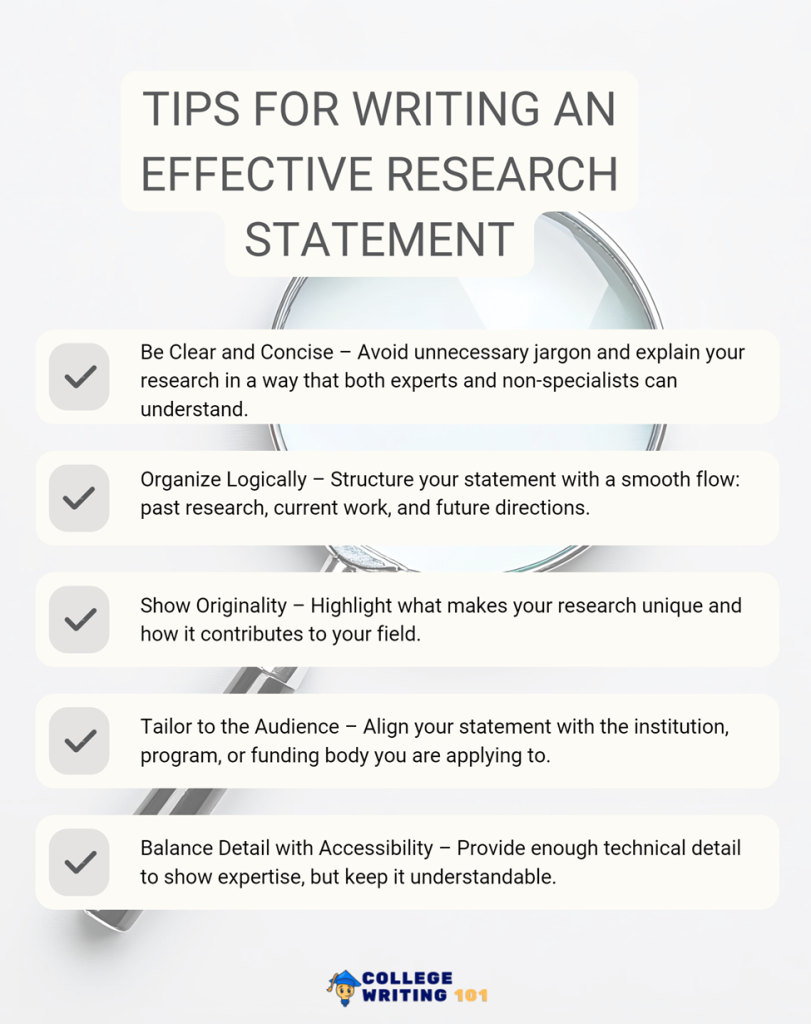
Exceptional research statements communicate complex ideas with remarkable clarity. They translate specialized terminology and theoretical concepts into language accessible to educated readers across disciplines, without sacrificing intellectual rigor. This accessibility demonstrates the researcher’s deep understanding of their work and ability to engage diverse audiences.
The writing style should be direct and engaging, avoiding unnecessary jargon while maintaining scholarly credibility. Sentences flow logically, arguments develop coherently, and technical concepts are explained clearly. Readers should never struggle to understand what the researcher does or why it matters.
Intellectual Coherence and Vision
Strong research statements reveal a unified intellectual vision that connects seemingly disparate projects and interests. Rather than presenting a scattered list of research activities, they demonstrate how different projects contribute to a larger scholarly agenda. This coherence shows strategic thinking and suggests the researcher can sustain focused inquiry over time.
The statement should articulate a clear research philosophy that explains the researcher’s approach to generating knowledge. This might involve theoretical commitments, methodological preferences, or disciplinary perspectives that provide consistent frameworks for understanding the work.
Specificity and Concreteness
Effective research statements balance broad vision with specific details that demonstrate expertise and feasibility. They provide concrete examples of sources, methods, findings, or applications that show the researcher has moved beyond abstract theorizing to actual scholarly work.
Details about archival collections, datasets, field sites, or collaborative relationships indicate serious engagement with research materials. Specific publication plans, grant applications, or conference presentations show practical steps toward realizing research goals.
Innovation and Originality
Distinguished research statements identify genuine gaps in existing knowledge and propose innovative approaches to addressing them. They show awareness of current scholarly debates while offering fresh perspectives or novel methodologies that advance understanding.
Innovation might involve applying established methods to new problems, combining approaches from different disciplines, or developing entirely new theoretical frameworks. The key is demonstrating that the research will generate new knowledge rather than simply confirming existing understanding.
Methodological Sophistication
Strong statements demonstrate command of appropriate research methods and awareness of methodological debates within the field. They explain why particular approaches are suited to specific research questions and show familiarity with both possibilities and limitations of chosen methods.
This sophistication extends to theoretical frameworks, showing how the researcher engages with relevant scholarly traditions while potentially contributing to their development. The statement should convey methodological flexibility and willingness to adapt approaches as research questions evolve.
Realistic Ambition
Good research statements balance ambitious goals with realistic assessment of what can be accomplished within given timeframes and resource constraints. They show the researcher has thought carefully about practical requirements and developed feasible plans for executing their research agenda.
This realism extends to understanding career trajectories, funding landscapes, and institutional contexts that shape research possibilities. The statement should convey confidence without appearing naive about challenges involved in academic research.
Broader Significance and Impact
Exceptional statements articulate clearly why the research matters beyond narrow academic circles. They connect specialized scholarly work to larger questions about human knowledge, social challenges, or cultural understanding that resonate with diverse audiences.
This broader significance might involve policy implications, educational applications, technological developments, or contributions to public understanding. The key is showing awareness of how academic research connects to wider social contexts and human concerns.
Narrative Structure and Flow
Strong research statements tell compelling stories about intellectual development and future possibilities. They create logical progressions from past experiences through current work to future plans, showing how each stage builds upon previous accomplishments while opening new directions.
The narrative should maintain reader engagement while covering necessary information efficiently. Transitions between sections feel natural, and the overall structure supports rather than impedes the development of key arguments.
Evidence of Productivity and Progress
Good statements provide concrete evidence of research productivity through publications, presentations, grants, or other scholarly achievements. They demonstrate that the researcher can complete projects and disseminate findings effectively within academic communities.
This evidence should be woven naturally into the narrative rather than presented as a simple list of accomplishments. The focus remains on how past productivity indicates future potential rather than merely cataloging achievements.
Self-Awareness and Reflection
Distinguished research statements show thoughtful reflection on the researcher’s intellectual development, methodological choices, and career trajectory. They acknowledge limitations or challenges while demonstrating confidence in addressing them.
This self-awareness extends to understanding how the researcher’s work fits within broader scholarly landscapes and institutional contexts. The statement should show strategic thinking about career development and research planning.
Adaptability and Growth Potential
Strong statements suggest intellectual flexibility and capacity for growth rather than rigid adherence to predetermined research paths. They show awareness of how research questions might evolve and demonstrate willingness to adapt methods or approaches as new opportunities arise.
This adaptability indicates scholarly maturity and suggests the researcher can thrive in dynamic academic environments where research priorities and funding opportunities constantly shift.
Research Statement Example
Research Statement: Digital Archives and Cultural Memory in Post-Conflict Societies
Introduction
My research examines how digital technologies reshape the preservation, transmission, and contestation of cultural memory in post-conflict societies. Drawing on methods from digital humanities, memory studies, and comparative literature, I investigate how communities use digital archives, social media platforms, and virtual memorialization practices to negotiate competing narratives about traumatic historical events. This work addresses fundamental questions about how technological mediation affects collective memory formation and challenges traditional approaches to transitional justice and reconciliation.
The urgency of this research stems from our current moment, when digital platforms have become primary sites for memory construction while simultaneously enabling the rapid spread of historical misinformation. Understanding how post-conflict societies navigate these digital memory landscapes offers crucial insights for scholars, policymakers, and communities grappling with historical trauma in an increasingly connected world.
Research Background and Training
My interdisciplinary training has prepared me uniquely for this research agenda. My doctoral work in Comparative Literature at Columbia University, where I specialized in trauma narratives and memory studies, provided theoretical grounding in how societies process collective trauma through cultural production. During my dissertation research on testimonial literature in Latin America, I became fascinated by how digitization was transforming access to historical documents and enabling new forms of community engagement with traumatic pasts.
Recognizing the need for technical skills to pursue these questions, I completed a post-doctoral fellowship in Digital Humanities at Stanford University, where I learned computational text analysis, database design, and digital preservation methods. This technical training, combined with my fluency in Spanish, Portuguese, and French, positions me to conduct comparative research across multiple linguistic and cultural contexts.
My fieldwork experience in Colombia, Guatemala, and Rwanda has given me firsthand understanding of how post-conflict communities navigate memory politics while my collaboration with the Digital Library Federation and the International Association of Sound and Audiovisual Archives has provided expertise in digital preservation standards and metadata protocols essential for long-term research sustainability.
Current Research Program
Project One: The Colombian Digital Memory Archive
My primary current project examines Colombia’s pioneering use of digital technologies in documenting conflict-related human rights violations. Working with the Centro Nacional de Memoria Histórica and local community organizations, I am analyzing how the digitization of testimony, photographs, and documents has transformed both official memory construction and grassroots memorialization practices.
Using a mixed-methods approach combining computational text analysis with ethnographic observation, I have processed over 15,000 digitized testimonies to identify patterns in how different communities narrate experiences of displacement, violence, and loss. My preliminary findings reveal significant differences between urban and rural communities’ digital memory practices, with rural communities more likely to integrate traditional oral storytelling techniques into digital formats.
This research has already generated two peer-reviewed publications and a database of Colombian digital memory initiatives that has become a resource for other researchers. I am currently preparing a monograph based on this work for submission to Duke University Press, titled “Digital Testimonies: Technology and Memory in Colombia’s Peace Process.”
Project Two: Comparative Analysis of Digital Memorial Practices
Building on the Colombian case study, I am conducting comparative research on digital memorialization across three post-conflict contexts: Colombia, Northern Ireland, and Cambodia. This project examines how different political, technological, and cultural factors shape digital memory practices through analysis of memorial websites, social media campaigns, and virtual reality commemorative experiences.
Working with local partners in each context, I have documented over 200 digital memorial initiatives and conducted interviews with their creators, users, and critics. My analysis reveals fascinating variations in how communities adapt digital technologies to local memory cultures while also identifying common challenges around sustainability, authenticity, and inclusivity that transcend national contexts.
This comparative approach has illuminated how factors like internet infrastructure, government censorship, and intergenerational digital literacy gaps affect digital memory practices in ways that single-case studies cannot capture.
Project Three: Artificial Intelligence and Historical Testimony
My newest project investigates the ethical and methodological implications of using artificial intelligence to process large archives of historical testimony. Working with computer scientists at MIT and historians at the Shoah Foundation, I am developing protocols for using natural language processing to identify patterns in survivor testimonies while preserving human agency in interpretation.
This work addresses urgent questions about how AI might both enhance and distort historical understanding. Through careful comparison of human and machine analysis of the same testimony collections, we are documenting where AI can responsibly augment historical research and where human judgment remains irreplaceable.
Methodology and Theoretical Framework
My research employs a mixed-methods approach that combines computational analysis with traditional humanistic interpretation. I use digital tools like topic modeling, sentiment analysis, and network analysis to identify patterns across large collections of texts, images, and metadata, then apply close reading and ethnographic methods to understand the cultural significance of these patterns.
Theoretically, my work draws on trauma studies, particularly the insights of Cathy Caruth and Dominick LaCapra about the relationship between memory and representation, while incorporating newer scholarship on digital culture from scholars like Wenzel Chrostowski and Sarah Pink. I am particularly influenced by Ann Cvetkovich’s work on trauma archives and José Medina’s epistemology of resistance, which provide frameworks for understanding how marginalized communities use cultural production to contest dominant historical narratives.
My approach to digital methods is informed by critical digital humanities scholarship that emphasizes the importance of examining the cultural and political contexts that shape technological systems. I work closely with community partners to ensure that digital tools serve local memory needs rather than imposing external research agendas.
Future Research Directions
Book Project: Digital Memory and Transitional Justice
Over the next three years, I will complete my first monograph, which synthesizes findings from my Colombian and comparative research to argue that digital technologies are fundamentally transforming how post-conflict societies pursue transitional justice. The book will demonstrate how digital archives, virtual memorials, and social media platforms create new possibilities for survivor agency while also generating novel challenges around representation, access, and historical authority.
Grant Project: Global Digital Memory Observatory
I am developing a major grant proposal to the National Endowment for the Humanities to establish a Global Digital Memory Observatory that would systematically document and analyze digital memory practices worldwide. This five-year, $2.8 million project would create an international network of researchers using standardized methods to study digital memorialization across diverse cultural contexts.
The Observatory would produce an open-access database of global digital memory initiatives, develop best practices for community-engaged digital memory research, and create educational resources for scholars, practitioners, and community organizations working in this area.
Collaboration: AI Ethics in Historical Research
Building on my current AI project, I plan to establish a working group on AI ethics in historical research that would bring together historians, computer scientists, and community advocates to develop guidelines for responsible use of AI in processing historical testimony. This work addresses growing concerns about how automated analysis might reproduce historical biases or diminish survivor agency.
New Geographic Focus: Digital Memory in the Middle East
I am planning to extend my comparative research to include case studies from Iraq, Lebanon, and Syria, where ongoing conflicts and displacement have generated innovative digital memory practices. This expansion would allow me to examine how digital memory formation occurs during rather than after violent conflict, addressing a significant gap in current scholarship.
Broader Impact and Significance
My research contributes to several important scholarly conversations while also addressing practical challenges facing post-conflict communities worldwide. Within academia, this work advances digital humanities methodology by demonstrating how computational approaches can enhance rather than replace traditional humanistic analysis. It also contributes to memory studies by showing how digitization creates new forms of collective memory that cannot be understood through frameworks developed for analog media.
For transitional justice practitioners, my research provides evidence-based guidance on how digital technologies can support reconciliation processes while highlighting potential pitfalls that require careful navigation. The comparative framework I am developing helps practitioners learn from innovations in other contexts while adapting approaches to local conditions.
The policy implications of this work are significant. As governments worldwide grapple with questions about digital preservation, online hate speech, and historical misinformation, my research provides empirical evidence about how digital memory practices actually function in post-conflict societies. This evidence can inform more nuanced and effective policy approaches.
Perhaps most importantly, my community-engaged research methodology ensures that the communities most affected by historical trauma have agency in how their experiences are documented, analyzed, and remembered. By working directly with survivor organizations and memory initiatives, I aim to produce scholarship that serves rather than extracts from the communities it studies.
Resources and Collaboration
This research program requires significant resources and collaborative relationships that I have systematically developed. I have secured funding from the National Science Foundation, the American Council of Learned Societies, and the Wenner-Gren Foundation totaling $185,000 over three years. I am currently awaiting decisions on applications to the National Endowment for the Humanities and the Social Science Research Council that would provide an additional $450,000.
My institutional affiliations provide crucial support for this work. As a faculty affiliate with the Center for Digital Humanities at my university, I have access to high-performance computing resources and technical support for digital preservation. My appointments as visiting researcher at the Centro Nacional de Memoria Histórica in Bogotá and the Institute for Global Security at Queen’s University Belfast provide access to archives and local expertise essential for comparative research.
Collaborative relationships with community organizations in each research site ensure that my work remains grounded in local needs and perspectives. These partnerships also provide pathways for research findings to inform community-led memory initiatives and advocacy efforts.
Conclusion
My research program addresses fundamental questions about how digital technologies are transforming collective memory in an era marked by ongoing conflict, displacement, and historical denial. By combining rigorous computational analysis with community-engaged research methods, I aim to produce scholarship that advances academic understanding while supporting communities’ efforts to preserve, transmit, and contest memories of historical trauma.
The comparative framework I am developing provides a foundation for understanding digital memory as a global phenomenon while remaining attentive to local specificities that shape how technologies are adapted and used. As digital platforms become increasingly central to how societies remember and forget, this research offers crucial insights for scholars, practitioners, and communities navigating the opportunities and challenges of our digital age.
Looking forward, I am excited about the potential for this research to contribute to more just and inclusive approaches to collective memory that harness digital technologies’ democratizing potential while addressing their risks. The interdisciplinary methods I am developing and the collaborative relationships I am building position me to make sustained contributions to this vital area of inquiry while training the next generation of scholars to engage thoughtfully with digital memory’s complexities and possibilities.
FAQs
What is an example of a research purpose statement?
Example: “The purpose of this study is to examine the impact of social media use on the academic performance of university students.”
What is an example of a research topic statement?
Example: “This research will explore how renewable energy adoption affects economic growth in developing countries.”
How long is a research statement?
A research statement is usually 1–3 pages long, depending on the requirements of the institution or program.