
A semi-structured interview is a common research method used in education, social science, business, and healthcare. It combines prepared questions with the freedom to ask follow-up questions during the interview. This approach helps researchers collect detailed information while still keeping the discussion focused on the main topic. Unlike structured interviews, which follow a fixed script, semi-structured interviews allow flexibility. At the same time, they are more organized than unstructured interviews, making the data easier to compare and analyze.
Key Features of a Semi-Structured Interview
Prepared interview guide The interviewer develops a list of key questions or topics in advance, creating a framework for the conversation. This guide ensures important areas are covered while allowing room for spontaneity.
Flexibility in questioning Unlike structured interviews, the interviewer can deviate from the script. Questions don’t need to follow a rigid order, and the interviewer can skip irrelevant questions or add new ones based on what emerges during the conversation.
Open-ended questions Questions are typically phrased to encourage detailed, narrative responses rather than simple yes/no answers. For example, “Tell me about your experience with…” rather than “Did you like…?”
Probing and follow-up The interviewer can ask clarifying questions, request examples, or dig deeper into interesting or unexpected responses. This is where much of the valuable insight comes from.
Conversational tone The format feels more like a guided conversation than a formal interrogation. This helps build rapport and encourages interviewees to share more openly.
Balanced structure It maintains enough consistency to allow comparison across different interviews while being adaptable enough to capture individual perspectives and unexpected themes.
Active listening The interviewer must pay close attention to responses to know when to probe deeper, when to move on, and how to connect different parts of the conversation.
Semi-Structured Interview vs Structured Interview
| Feature | Structured Interview | Semi-Structured Interview |
|---|---|---|
| Question format | Fixed, predetermined questions asked in the same order to all participants | Core questions prepared, but order and wording can be flexible |
| Flexibility | No deviation from script; interviewer follows rigid protocol | Interviewer can adapt questions, add follow-ups, and explore new topics |
| Question types | Often closed-ended or limited response options | Primarily open-ended questions encouraging detailed responses |
| Standardization | Highly standardized across all interviews | Moderate standardization with room for customization |
| Follow-up questions | Minimal or none; only pre-scripted probes allowed | Encouraged; interviewer can probe based on responses |
| Data comparability | Very high; easy to compare and quantify responses | Moderate; comparable on core questions but varies in depth |
| Interviewer skill required | Lower; primarily needs to read questions accurately | Higher; requires active listening, judgment, and adaptability |
| Time required | Usually shorter and more predictable | Variable; can be longer depending on responses |
| Best for | Large-scale surveys, quantitative research, standardized assessments | Qualitative research, exploratory studies, understanding complex experiences |
| Data analysis | Easier to analyze statistically | More complex; requires thematic or content analysis |
| Rapport building | Limited; feels more formal and impersonal | Better; conversational tone builds trust |
| Example use cases | Market research surveys, standardized job screening, clinical diagnostic interviews | Academic research, UX studies, in-depth job interviews, investigative journalism |
Semi-Structured Interview vs Unstructured Interview
| Feature | Semi-Structured Interview | Unstructured Interview |
|---|---|---|
| Preparation | Interview guide with predetermined core questions and topics | Minimal preparation; only broad topic or research area defined |
| Structure level | Moderate structure with flexibility | Minimal to no structure; completely open-ended |
| Question format | Mix of prepared and spontaneous questions | Almost entirely spontaneous questions based on conversation flow |
| Consistency | Core questions ensure some consistency across interviews | Little consistency; each interview follows its own path |
| Interview guide | Used as a framework; ensures key topics are covered | No formal guide; interviewer relies on general objectives |
| Control | Interviewer maintains moderate control over direction | Interviewee has more control over topics and direction |
| Comparability | Moderate; can compare responses on core questions | Low; difficult to compare across interviews systematically |
| Flexibility | High flexibility within a framework | Complete flexibility; conversation can go anywhere relevant |
| Interviewer skill | Requires balance of structure and adaptability | Requires excellent listening, improvisation, and conversational skills |
| Time investment | Moderate and somewhat predictable | Highly variable; can be very time-intensive |
| Data richness | Rich data with some structure for analysis | Very rich, detailed data but potentially unfocused |
| Best for | Research needing both depth and some comparability | Exploratory research, life histories, ethnographic studies |
| Risk of missing topics | Lower; guide ensures coverage of key areas | Higher; important topics might not emerge naturally |
| Analysis complexity | Moderate; themes emerge from both structured and open responses | High; requires extensive coding and interpretation |
| Example use cases | User research, program evaluations, dissertation interviews | Anthropological fieldwork, biographical interviews, initial exploratory research |
When to Use a Semi-Structured Interview
When you need both depth and consistency You want rich, detailed responses but also need to compare findings across multiple participants. Semi-structured interviews let you explore individual perspectives while ensuring everyone addresses your core research questions.
Exploratory research with some focus You’re investigating a topic where you have some knowledge and specific questions, but expect to discover unexpected themes or insights. The flexibility allows you to pursue interesting leads that emerge during conversation.
Complex or sensitive topics When discussing nuanced subjects like personal experiences, organizational culture, or sensitive issues, the conversational approach helps build trust while ensuring you cover necessary ground. The flexibility lets you adjust your approach based on the participant’s comfort level.
User experience and customer research Understanding how people interact with products, services, or systems benefits from prepared questions about key features while allowing you to dig into specific pain points or usage patterns that arise.
Qualitative academic research Dissertation research, case studies, and qualitative studies often require systematic data collection that’s still open to rich narrative. Semi-structured interviews provide methodological rigor while capturing complexity.
Job interviews for professional roles When hiring requires assessing both specific competencies and cultural fit, semi-structured interviews ensure all candidates are evaluated on core criteria while allowing natural conversation to reveal personality and thinking style.
Program evaluation Assessing the effectiveness of programs, interventions, or initiatives benefits from consistent questions about outcomes while exploring participants’ diverse experiences and unexpected effects.
When participants have varied experiences If interviewees come from different backgrounds or have different relationships to your topic, semi-structured interviews let you tailor follow-up questions while maintaining a common foundation.
Limited time with expert participants When interviewing busy professionals or hard-to-reach participants, you need to ensure you cover essential questions while being responsive to their unique expertise and insights.
Semi-Structured Interview Question Examples
User Experience Research
Core questions:
- “Walk me through the last time you used [product/app]. What were you trying to accomplish?”
- “What aspects of [product] do you find most valuable in your daily routine?”
- “Have you encountered any challenges or frustrations while using [product]?”
Potential follow-ups:
- “Can you give me a specific example of when that happened?”
- “How did you work around that issue?”
- “What would have made that experience better?”
Job Interviews
Core questions:
- “Tell me about a time when you had to manage multiple competing priorities. How did you approach it?”
- “Describe a situation where you disagreed with a team member. How did you handle it?”
- “What attracted you to this role, and how does it fit with your career goals?”
Potential follow-ups:
- “What was the outcome of that situation?”
- “Looking back, would you do anything differently?”
- “What did you learn from that experience?”
Academic Research (e.g., studying remote work experiences)
Core questions:
- “How has your work routine changed since transitioning to remote work?”
- “What impact has remote work had on your relationships with colleagues?”
- “How do you maintain boundaries between work and personal life?”
Potential follow-ups:
- “Can you describe what a typical workday looks like for you now?”
- “That’s interesting—can you tell me more about why that matters to you?”
- “Have you noticed any changes over time in how you feel about this?”
Healthcare/Patient Experience
Core questions:
- “What led you to seek treatment for [condition]?”
- “How would you describe your experience with the healthcare system?”
- “What information or support would have been helpful during your treatment?”
Potential follow-ups:
- “How did that make you feel?”
- “Who else was involved in that decision?”
- “What happened next?”
Customer Feedback
Core questions:
- “What motivated you to choose our service over alternatives?”
- “How well does our product meet your needs?”
- “If you could change one thing about your experience with us, what would it be?”
Potential follow-ups:
- “What specifically made that feature important to you?”
- “How often does that situation come up?”
- “Have you shared your experience with others?”
Educational Research (e.g., studying teaching methods)
Core questions:
- “How do you typically approach lesson planning for this subject?”
- “What challenges do you face in engaging students with diverse learning needs?”
- “How do you assess whether students have understood the material?”
Potential follow-ups:
- “Can you give me an example from a recent lesson?”
- “What do you think contributed to that success/challenge?”
- “How have your approaches evolved over time?”
How to Conduct a Semi-Structured Interview
Before the Interview
Define your research objectives Clarify what you’re trying to learn and why. This guides your question development and helps you stay focused during the interview.
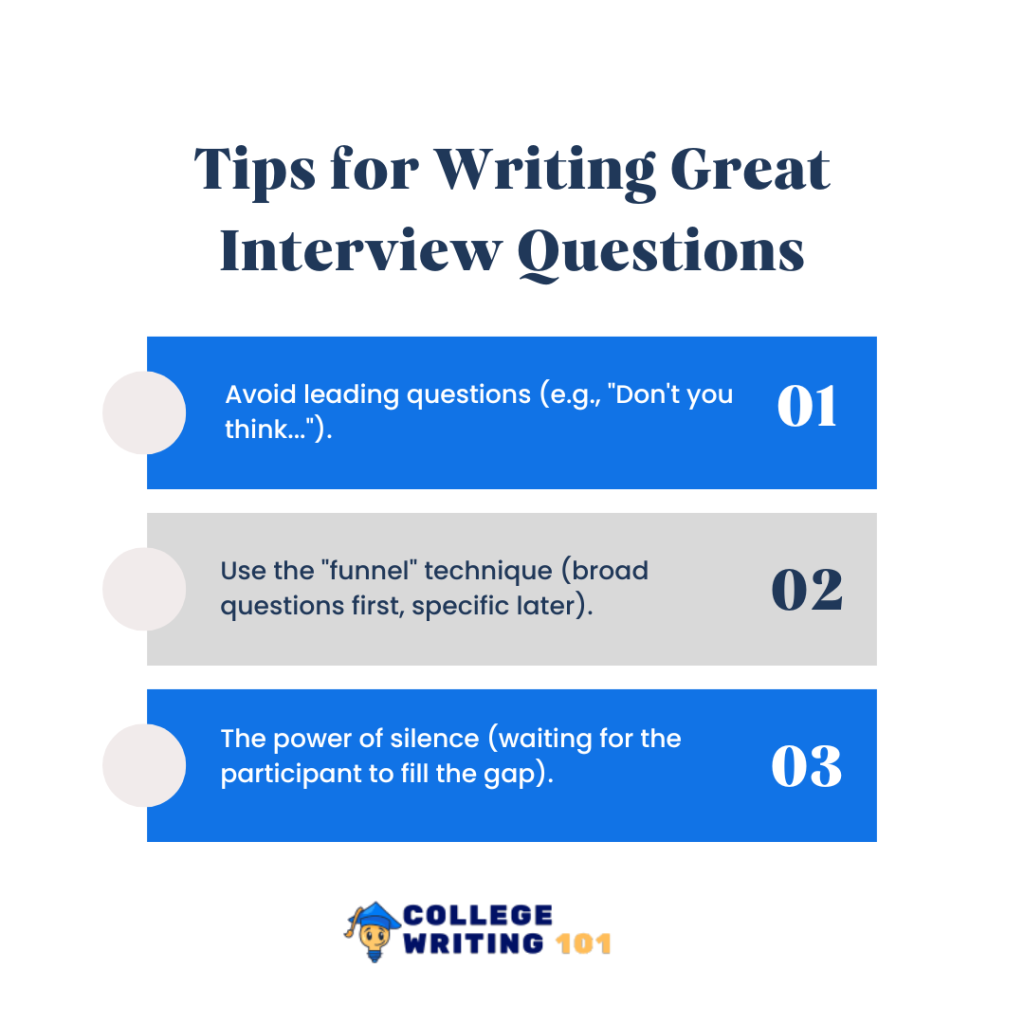
Develop your interview guide Create a list of core questions and topics you want to cover. Organize them logically, typically starting with easier, broader questions before moving to more specific or sensitive topics. Include potential follow-up probes for each main question.
Prepare logistics
- Choose an appropriate setting (quiet, private, comfortable)
- Test your recording equipment if applicable
- Prepare consent forms and explain how data will be used
- Allocate enough time (typically 30-90 minutes depending on scope)
Research your participant If possible, learn relevant background information so you can tailor questions and avoid asking for information you already have.
Practice your questions Rehearse to ensure questions are clear, unbiased, and flow naturally. Pilot test with a colleague if possible.
During the Interview
Build rapport (5-10 minutes)
- Start with casual conversation to help the participant relax
- Explain the purpose, format, and how their information will be used
- Obtain informed consent
- Assure confidentiality if applicable
- Let them know there are no right or wrong answers
Set expectations
- Explain the semi-structured format: you have questions prepared but the conversation can flow naturally
- Mention approximate duration
- Encourage them to ask for clarification if needed
- Let them know they can decline to answer any question
Start with easy questions Begin with straightforward, non-threatening questions to build comfort. Save sensitive or complex topics for when rapport is established.
Use your guide flexibly
- Cover your core questions but don’t be bound by order
- Follow interesting threads that emerge
- Skip questions that have already been answered naturally
Practice active listening
- Give full attention; avoid planning your next question while they’re speaking
- Use non-verbal cues (nodding, eye contact) to show engagement
- Don’t interrupt unless necessary for clarification
Ask effective follow-up questions
- Probe for specifics: “Can you give me an example?”
- Seek clarification: “What do you mean by…?”
- Explore feelings: “How did that make you feel?”
- Encourage elaboration: “Tell me more about that”
- Explore context: “What led to that situation?”
Use silence strategically Don’t rush to fill pauses. People often share their most insightful thoughts after a moment of reflection.
Stay neutral and non-judgmental
- Avoid showing surprise, approval, or disapproval
- Don’t debate or correct the participant
- Use neutral acknowledgments: “I see,” “Thank you for sharing that”
Monitor time and energy Be aware of fatigue (yours and theirs) and adjust pacing accordingly. It’s okay to skip less critical questions if time runs short.
Take brief notes Even if recording, jot down key points, interesting quotes, or reminders for follow-up questions. This also shows engagement.
Managing Common Challenges
If someone gives very brief answers:
- Use more open-ended follow-ups
- Ask for examples or stories
- Show genuine curiosity about their responses
If someone goes off-topic:
- Acknowledge their point, then gently redirect: “That’s interesting. Going back to…”
- Find connections to bring the conversation back
If someone seems uncomfortable:
- Acknowledge it: “I notice this might be difficult to discuss”
- Offer to skip the question or return to it later
- Take a short break if needed
If you realize you’ve missed something:
- It’s okay to circle back: “Earlier you mentioned… can we explore that more?”
Closing the Interview
Signal the end is approaching “I just have a few more questions…” helps prepare them for closure.
Ask final open-ended questions
- “Is there anything else you think I should know about this topic?”
- “What haven’t I asked that you think is important?”
- “Do you have any questions for me?”
Thank them sincerely Express genuine appreciation for their time and insights.
Explain next steps Let them know how their information will be used, when they might see results, and how to contact you with questions.
Debrief with yourself immediately Take 10-15 minutes right after to note impressions, context, non-verbal cues, and anything important that wasn’t recorded.
After the Interview
Transcribe or review promptly Process the interview while it’s fresh in your memory. Note any context that might not be clear from the recording alone.
Reflect on your technique Consider what worked well and what you’d improve for the next interview. Adjust your guide if needed.
Follow up if necessary If clarification is needed or you promised to share something, follow through promptly.
Maintain confidentiality Store data securely and honor any commitments you made about anonymity.
Advantages of Semi-Structured Interviews
Flexible questioning
Interviewers can ask follow-up questions based on the participant’s answers, which helps gather clearer and more complete information.
Balanced structure
Prepared questions keep the interview focused, while open-ended questions allow natural conversation.
Deeper responses
Participants can explain their thoughts in detail instead of choosing short or fixed answers.
Better understanding of views
Researchers can explore opinions, experiences, and reasons behind answers more easily.
Improved participant comfort
The relaxed format often makes participants feel more at ease, leading to more honest responses.
Comparable data
Since all interviews follow a similar guide, responses can still be compared across participants.
Useful for complex topics
This method works well when topics need explanation, examples, or personal experience.
Disadvantages of Semi-Structured Interviews
Time-consuming
Conducting interviews and analyzing open-ended responses takes more time than structured interviews.
Interviewer bias
Follow-up questions and reactions may influence how participants respond.
Harder to analyze
Answers are often long and varied, which makes coding and comparison more difficult.
Less consistency
Different participants may be asked different follow-up questions, leading to uneven data.
Requires skilled interviewers
Interviewers need training to ask clear questions and stay neutral during the interview.
Smaller sample sizes
Because interviews take longer, researchers may include fewer participants.
Not easy to replicate
The flexible nature of this method makes it harder for other researchers to repeat the study in the same way.
Semi-Structured Interview in Research (With Example)
Research Example: Student Experiences with Online Learning
Let me walk you through a complete example of how semi-structured interviews work in research.
Research Context
Research question: How do undergraduate students experience the transition from in-person to online learning, and what factors influence their engagement and success?
Participants: 20 undergraduate students from various disciplines who experienced the transition to online learning
Data collection: 45-60 minute individual interviews conducted via video call
Interview Guide Development
The researcher develops an interview guide with five main topic areas:
1. Background and context
- Tell me about your experience as a student before the transition to online learning
- What was your typical approach to studying and engaging with coursework?
2. The transition experience
- Describe what it was like when your classes moved online
- What were your initial reactions and expectations?
3. Learning and engagement
- How has online learning affected your ability to understand course material?
- What does a typical study session look like for you now?
4. Challenges and adaptations
- What have been the biggest challenges you’ve faced with online learning?
- How have you adapted your study strategies or routines?
5. Support and resources
- What kinds of support have been most helpful to you?
- What additional resources or support would make a difference?
Sample Interview Excerpt
Here’s how an actual interview might unfold:
Researcher: “Let’s start with your experience before classes moved online. Tell me about what your typical week looked like as a student.”
Student (Sarah): “Well, I’m a junior majoring in biology, and before everything moved online, I was on campus pretty much all day. I had three lab courses, so I’d be in the lab Tuesday and Thursday afternoons, and I really liked that hands-on work.”
Researcher: “What did you like about the hands-on work specifically?”
Student: “I guess… I learn better when I can actually see things and manipulate them. Like, reading about cell division in a textbook is one thing, but actually looking at cells under a microscope and seeing the different stages—that’s when it really clicks for me. Plus, I could ask the TA questions right there if something didn’t make sense.”
Researcher: “That makes sense. So when classes moved online, what happened with those lab courses?”
Student: “They tried to do virtual labs, which was… [pauses] I mean, they did their best, but it’s not the same. We’d watch videos of experiments or use these simulation programs. It felt like just watching someone else do science instead of doing it myself.”
Researcher: “How did that affect your understanding of the material?”
Student: “Honestly, I struggled. I mean, I still passed the courses, but I don’t feel like I really learned it the same way. There were concepts I would have understood immediately if I could have just done the experiment, but trying to learn it from a video or simulation—I’d have to watch it like three or four times and it still didn’t stick as well.”
Researcher: “You mentioned watching videos multiple times. Tell me more about how you adapted your study approach.”
Student: “So I realized pretty quickly that I needed to be more proactive. Before, I could just show up to class and lab, ask questions, work with my lab partner, and that was enough. But online, if I didn’t understand something, I had to figure it out on my own. I started taking way more detailed notes, pausing videos constantly, and I joined a Discord server with other bio students where we could help each other.”
Researcher: “That’s interesting—the Discord server. How did that come about?”
Student: “One of my classmates mentioned it in the Zoom chat during lecture. At first, I thought it would be too distracting, but it actually became one of my main study resources. We’d share notes, explain concepts to each other, and sometimes screen-share if someone was stuck on a problem. It wasn’t the same as being in the lab together, but it was better than trying to figure everything out alone.”
Researcher: “It sounds like peer connection was really important. Did you find other ways to stay connected with classmates or professors?”
Student: “With professors, it was hit or miss. Some held regular office hours on Zoom and were really responsive to emails. Others kind of… disappeared? Like, they’d post lecture videos and assignments, but it was hard to get feedback or ask questions. That made a huge difference in how much I got out of different classes.”
Researcher: “Can you give me an example of a professor who handled it well?”
Student: “Yeah, my organic chemistry professor—even though that’s not normally my favorite subject—she set up these small breakout room sessions twice a week where like five or six of us could work through problems together with her there to help. It felt more like the in-person experience. She also did this thing where she’d record short videos responding to common questions that came up in the homework. That was really helpful.”
Researcher: “What made those breakout sessions work well?”
Student: “I think it was the small group size. In a Zoom call with 40 people, I’d never unmute myself to ask a question. But with just five or six people, it felt safe to say ‘I don’t understand this’ or to work through a problem out loud. And hearing other people’s questions helped too—sometimes someone else would ask something I didn’t even realize I was confused about.”
FAQs
Do semi-structured interviews require an interview guide?
Yes, an interview guide helps keep the discussion focused while allowing flexibility.
Are semi-structured interviews qualitative or quantitative?
They are mainly used in qualitative research because they focus on opinions, experiences, and detailed explanations.
How long should a semi-structured interview last?
They usually last between 30 and 60 minutes, depending on the research topic.