A narrative essay is a type of writing that tells a story from a personal point of view. It allows writers to share real experiences, thoughts, and feelings in a clear and engaging way. Unlike formal academic essays, narrative essays focus on events, characters, and settings, much like a short story. Narrative essay examples can help students understand how to organize ideas, build a strong opening, and end with a clear message. They also show how details, dialogue, and descriptions can make a story more interesting and easy to follow. By reading good examples, writers can learn how to stay focused on one main idea and keep the reader interested from start to finish.
Key Features of a Narrative Essay
Purpose and Perspective
A narrative essay recounts events from a specific point of view, usually first person (“I”), to create an intimate connection with readers. Unlike other essays that primarily inform or persuade, narratives engage readers emotionally while still making a point or sharing a lesson.
Story Elements
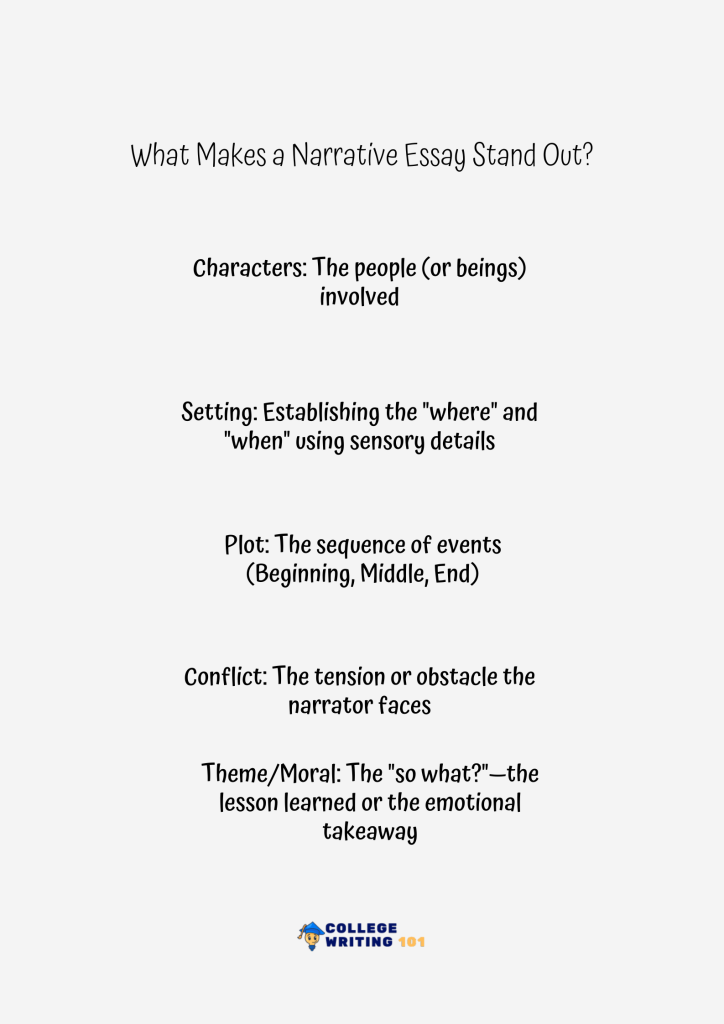
Strong narrative essays incorporate fundamental storytelling components: a clear plot with beginning, middle, and end; developed characters (often including the author); a specific setting that grounds the story in time and place; and conflict or tension that drives the narrative forward. These elements work together to create a cohesive, engaging account.
Vivid Details and Description
Effective narratives use sensory details—sights, sounds, smells, textures, tastes—to immerse readers in the experience. Rather than simply stating what happened, skilled narrative writers show scenes through specific, concrete details that help readers visualize and feel the events.
Chronological Organization
Most narrative essays follow a chronological structure, though they may use flashbacks or begin in medias res (in the middle of action). The sequence of events should be clear and logical, with smooth transitions guiding readers through the story’s progression.
Meaningful Theme or Insight
Beyond simply recounting events, narrative essays reveal something significant—a lesson learned, a realization gained, or a truth discovered. This underlying meaning gives the story purpose and resonance, transforming personal experience into universal insight.
Authentic Voice
The writer’s genuine voice and personality shine through, making the narrative feel honest and real rather than contrived or artificial.
Structure of a Narrative Essay
Introduction
The opening sets the stage for your story and captures reader attention. You might begin with a compelling hook—an intriguing statement, vivid description, or moment of action—that draws readers in immediately. The introduction should establish the basic context (who, what, where, when) and hint at the story’s significance without revealing everything upfront. Many writers include a thesis statement or thematic hint that suggests what the narrative will explore or reveal.
Rising Action
This section develops the story by introducing the central conflict or challenge and building tension through a series of events. You’ll provide essential background information, develop characters and relationships, and use descriptive details to immerse readers in your experience. The rising action moves chronologically through the events leading up to the story’s pivotal moment, with each scene advancing the plot and deepening the emotional stakes.
Climax
The climax represents the turning point or most intense moment of your narrative—the peak of conflict, the moment of realization, or the critical decision. This is where tension reaches its highest point and something significant changes. The climax might be a dramatic external event or a quieter internal revelation, but it should feel like the moment everything has been building toward.
Falling Action
After the climax, the falling action shows the immediate consequences and begins resolving the story’s tension. This section is typically brief but important, as it demonstrates how the pivotal moment affected you or changed the situation. The energy begins to settle as loose ends start tying up.
Conclusion
The ending brings closure while highlighting the story’s deeper meaning. Rather than simply summarizing what happened, reflect on the experience’s significance—what you learned, how you changed, or what insights you gained. The conclusion should feel satisfying and purposeful, connecting the specific events to broader themes or universal truths. It often circles back to ideas introduced earlier, creating a sense of completeness.
Narrative Essay Examples
Meeting the Queen of England
Introduction
The velvet rope felt impossibly thin between us—just a burgundy strand separating my trembling twelve-year-old self from Queen Elizabeth II. I had imagined this moment a thousand times during the six-month preparation for our school choir’s performance at Windsor Castle, but nothing had prepared me for the weight of her gaze or the way my carefully rehearsed curtsy would abandon me entirely.
Rising Action
The journey to this moment had begun in September when Mrs. Patterson announced that our choir had been selected to perform at a royal charity event. “You’ll be representing not just our school, but your country,” she’d said, her eyes sweeping across our stunned faces. That afternoon, I’d raced home to tell my grandmother, who had emigrated from Jamaica to England in 1960 and had spent decades cleaning the very halls of power where I would now sing.
“My granddaughter, performing for the Queen,” she’d whispered, tears streaming down her weathered cheeks. In that moment, the opportunity transformed from exciting to profound. I wasn’t just going to Windsor Castle; I was carrying my grandmother’s dreams, her decades of invisible labor, her dignity.
The next months blurred into endless rehearsals. We practiced our bows and curtsies until our legs ached. We memorized protocol: never speak unless spoken to, address her as “Your Majesty” first and then “Ma’am” (pronounced like “ham,” not “mom”), never turn your back on her. I lay awake nights worrying I’d forget the words to “Jerusalem” or trip over my own feet.
Climax
Now, standing in the gilt-edged reception room after our performance, I watched her approach our line. She moved with unhurried grace, speaking briefly to each student. My heart hammered against my ribs. Two students away. One. Then she was there, directly before me.
“And what will you do after you finish school?” she asked, her voice lighter than I’d expected.
My mind went blank. Every prepared response evaporated. In the deafening silence, I thought of my grandmother scrubbing floors in buildings like this. And suddenly, the words came: “I want to be a barrister, Your Majesty. So I can give voice to people who aren’t in rooms like this.”
Her expression shifted—something flickered in her eyes that might have been surprise or approval or merely polite interest. “That’s a worthy ambition,” she said. “I wish you every success.” She held my gaze for one more second, then moved on.
Falling Action
I don’t remember the rest of the reception. My fellow choir members told me later that I’d been shaking, that I’d executed a perfect curtsy without even realizing it. Mrs. Patterson squeezed my shoulder as we boarded the coach home. “That was beautifully said,” she murmured.
I called my grandmother from the motorway service station, standing in the fluorescent-lit corridor by the restrooms because I couldn’t wait another moment. “I met her, Gran. I met the Queen, and I told her about becoming a barrister.”
Her silence stretched so long I thought we’d been disconnected. Then: “My beautiful girl. You already are somebody.”
Conclusion
That was eight years ago. I’m now in my second year at university, studying law, and I carry a photo in my wallet—not of the Queen, but of my grandmother on her first day in England, young and hopeful in her best dress. Meeting Queen Elizabeth taught me that the greatest power isn’t in royal approval or velvet ropes or gilded rooms. It’s in claiming your own voice, in honoring the sacrifices that put you in those rooms, and in remembering that you belong there not because someone grants you permission, but because your dreams and your grandmother’s dreams are equally worthy of space.
I still get nervous before big moments—job interviews, moot court competitions, difficult conversations. But I think back to that twelve-year-old girl who found her voice when it mattered most, and I remember: I’ve already curtsied before a queen. Everything else is just practice.
The Day I Stopped Being Invisible
Introduction
I became invisible on my first day at Lincoln High School. Not literally, of course, but in the way that matters most to a fifteen-year-old—socially, completely, devastatingly invisible. I had transferred midway through sophomore year after my parents’ divorce forced us to move across the city, leaving behind my friends, my old life, and apparently, my ability to be seen. For three months, I perfected the art of disappearing: eating lunch in bathroom stalls, taking the long route between classes to avoid crowded hallways, speaking only when called upon. Then came the day Ms. Chen’s film project changed everything.
Rising Action
“You’ll be working in pairs,” Ms. Chen announced, and my stomach dropped. Partner projects were my personal nightmare—the awkward moment when everyone paired up instantly and I’d be left standing alone, waiting for the teacher to assign me to a group that clearly didn’t want me.
But Ms. Chen was already reading names off her list. “Sarah and Marcus. Devon and Isabella. And…” she paused, looking up with a slight smile, “Raj and Maya.”
I glanced across the room at Maya Chen—yes, the teacher’s daughter, but more importantly, the girl who seemed to exist in a completely different atmosphere than the rest of us. She directed the school’s theater productions, had started a film club, and moved through the hallways with the kind of confidence I couldn’t imagine possessing. She caught my eye and nodded once, neutrally.
Our first meeting after school was excruciating. I had nothing prepared. Maya, meanwhile, arrived with a notebook full of ideas, sketches, and shot lists.
“So I was thinking we could do something on identity,” she said. “Maybe exploring what makes people feel invisible in high school.”
My face must have betrayed something because she stopped mid-sentence. “What?”
“Nothing. That’s… that’s a good idea.” I couldn’t tell her that she’d just described my entire existence.
Over the next two weeks, something unexpected happened. Maya needed me. Not in a pity way, but genuinely needed my input. She was brilliant with the camera and had a natural eye for composition, but she kept asking, “What do you think? Does this feel honest? What would make this more real?”
At first, I gave safe answers. But gradually, as we filmed interviews with other students about their experiences of feeling unseen—the kid who stuttered, the girl who wore a hijab, the boy in a wheelchair—I found myself speaking up more. “We should film this from a lower angle. It makes them look more powerful.” “What if we cut to black between stories? Let the silence speak.”
Maya started writing down my suggestions. Actually implementing them. One afternoon, as we reviewed footage in the editing lab, she turned to me suddenly. “You know you’re really good at this, right? You see things other people miss.”
Climax
The day of the film festival arrived, and every junior and senior media studies class packed into the auditorium. Our film was scheduled last. As the lights dimmed and our opening shot appeared—a crowded hallway filmed in slow motion, sound faded, focusing on the spaces between people rather than the people themselves—my hands went numb.
Then came the interviews, the stories of invisibility, and finally, the ending sequence Maya and I had debated for hours: a montage showing the same students, but this time the camera held steady on their faces as they spoke directly to the lens, no longer background extras in someone else’s story but fully present, fully seen.
The lights came up to silence. My heart sank. Then someone in the back started clapping. Then another. Within seconds, the entire auditorium was on its feet.
Ms. Chen took the microphone. “Would our filmmakers please stand?”
Maya jumped up immediately, beaming. I remained frozen in my seat until she grabbed my hand and pulled me up beside her. The applause continued, but more than that, people were actually looking at me—not through me, not past me, but at me. I saw recognition in their faces, a connection.
A girl from my English class caught my eye and mouthed, “That was amazing.”
In that moment, something fundamental shifted. I wasn’t becoming visible because people suddenly noticed me. I was becoming visible because I had finally allowed myself to be seen.
Falling Action
After the screening, a cluster of students approached us. Some wanted to talk about the film’s message, others shared their own stories of feeling invisible. A junior asked if I’d be interested in helping with the video yearbook. The stuttering boy from our film thanked us, his eyes wet.
Maya squeezed my shoulder. “Told you,” she said simply.
That evening, I called my dad at his new apartment—something I’d been avoiding because talking to him meant acknowledging that our family had fractured. “Dad? I did something today. Something important. And I think I want to tell you about it.”
Conclusion
That film project didn’t magically make high school easy or turn me into someone I wasn’t. I still preferred small groups to large crowds, still needed solitude to recharge, still felt the old anxiety flutter in crowded hallways. But I had discovered something crucial: invisibility wasn’t something that happened to me. It was something I had chosen, a protective shell I’d built after too much change and too much loss.
The real transformation wasn’t learning to be loud or outgoing or someone else’s definition of visible. It was learning that my quiet observations, my careful attention, my way of seeing the world from the margins—these weren’t weaknesses or signs of inadequacy. They were my strengths. The very thing that made me feel invisible was actually a superpower when I chose to use it deliberately rather than hide behind it.
I’m finishing my senior year now, co-president of the film club Maya and I expanded together. I still eat lunch in quiet corners sometimes, but now it’s a choice, not a necessity. And when I look through a camera lens, I don’t just see the obvious subjects everyone else notices. I see the students at the edges of the frame, the ones about to disappear into the background. And I make sure to point the camera their way, to tell their stories, to remind them and myself: you are here, you matter, you are impossibly, undeniably, powerfully visible.
No time to finish your assignment?
Our writers are ready to deliver quality work on schedule
The $47 Lesson
Introduction
I learned the true cost of financial ignorance on a Tuesday afternoon in March, staring at my bank account balance: -$47.23. Not forty-seven dollars. Negative forty-seven dollars. I was three months into my first real job after college, earning what had seemed like an impressive salary, and somehow I was broke. Worse than broke—I owed the bank money I didn’t have. The overdraft fee notification glowed on my phone screen like an accusation, and in that moment of shame and confusion, I realized that despite sixteen years of formal education, nobody had ever taught me how money actually worked.
Rising Action
The path to negative forty-seven dollars had been paved with what I thought were reasonable decisions. I’d signed my job offer without negotiating, assuming the number they offered was fixed and that asking for more would seem ungrateful. I’d agreed to a salary without calculating what would remain after taxes, rent, student loan payments, and basic living expenses. The first paycheck had seemed enormous compared to my college job earnings, and I’d celebrated by upgrading my phone plan, subscribing to three streaming services, and saying yes to every dinner invitation.
“You’re making real money now,” my roommate Jordan had said, splitting another restaurant bill that somehow always crept past sixty dollars. “You can afford to live a little.”
But I wasn’t living a little. I was hemorrhaging money without realizing it because I had no system, no budget, no understanding of the difference between gross and net income. I’d downloaded a budgeting app once but abandoned it after two days when manually categorizing every transaction felt overwhelming.
The overdraft happened because I’d forgotten about my car insurance’s annual payment. I’d set it up months earlier to auto-pay from my checking account and then completely forgot it existed. When the $432 charge hit an account that held $385, the bank “helpfully” covered the difference and charged me $47 for the privilege.
I called my older sister Elena that evening, trying to keep the panic from my voice. Elena was a financial analyst, the family member who’d always seemed to have her life together while I’d been the creative one, the English major, the person who chose passion over practicality.
“How much do you actually bring home each month?” she asked.
I told her my salary.
“No, how much hits your account after taxes and your 401k contribution?”
Long pause. “I don’t know. I’ve never actually calculated it.”
Her sigh was gentle but devastating. “We need to talk. Can I come over this weekend?”
Climax
That Saturday, Elena arrived with her laptop and a sympathetic but no-nonsense expression. For four hours, she walked me through what she called “financial basics that should be basic but somehow aren’t.”
We started with my actual take-home pay—a number significantly smaller than the salary I’d been mentally spending. Then she had me list every recurring expense: rent, utilities, student loans, subscriptions, car payment, insurance, phone bill. She didn’t judge, just typed each one into a spreadsheet.
“Okay, your fixed expenses are $2,840 per month. You bring home $3,100. That leaves you $260 for groceries, gas, toiletries, clothing, entertainment, and savings. And you’ve been spending what?”
I pulled up my bank statements. We both stared at the numbers. Last month: $847 on restaurants and bars. The month before: $623. I felt sick.
“I’m terrible with money,” I whispered. “I’m never going to figure this out.”
Elena closed the laptop and looked at me directly. “You’re not terrible with money. You’re just financially illiterate, and that’s not your fault—it’s a failure of our education system. But here’s the thing: literacy can be learned. You learned to read English, didn’t you? You can learn to read a budget.”
That reframing changed everything. This wasn’t a moral failing or a personality flaw. It was a skill I’d never been taught, and skills could be acquired.
We spent the rest of the afternoon building what Elena called my “financial foundation.” She taught me about the 50/30/20 rule, explained the difference between good debt and bad debt, showed me how to set up automatic transfers to savings before I could spend the money. She helped me call my phone company and negotiate a lower rate, reviewed my streaming subscriptions and cut two I rarely used, and set up calendar reminders for every annual payment I’d been ignoring.
But the most important thing she taught me wasn’t technical. “Financial literacy isn’t about restriction,” she said. “It’s about intentionality. It’s about making sure your money goes toward things you actually value instead of disappearing into things you don’t even remember buying.”
Falling Action
The next three months were humbling. I said no to dinners I wanted to attend. I meal-prepped on Sundays. I walked to work when the weather allowed and watched my savings account—which I’d opened that weekend with Elena—slowly climb from zero to $200, then $400. My coworkers probably thought I’d become antisocial. What they didn’t see was the quiet satisfaction of checking my budget spreadsheet and seeing every dollar accounted for.
Then something unexpected happened at work. During a team meeting, our manager mentioned the company was opening a new position in my department—essentially a promotion—and encouraged people to apply. The old me would have hesitated, doubted, assumed I wasn’t ready. But I’d been practicing a different kind of confidence: the confidence that comes from knowing exactly where you stand.
I applied, and when they offered me the position, I did something that shocked even myself: I negotiated. I’d spent weeks researching industry salary ranges, understanding my worth, calculating my budget needs. When they offered $58,000, I countered with $63,000 and presented my research. We settled at $61,000.
Elena screamed when I called her. “Do you know what you just did? You just gave yourself a raise of thousands of dollars every year going forward. That compounds. That affects every future salary. That changes your retirement savings trajectory.”
Conclusion
Three years have passed since the day I discovered I was negative forty-seven dollars. I’m now leading financial literacy workshops at work—informal lunch sessions where I share what I’ve learned with other young professionals who, like me, graduated with degrees in everything except how to manage money. The irony isn’t lost on me that the English major who couldn’t balance her own checkbook is now teaching others about compound interest and retirement planning.
But that’s exactly why I do it. I understand the shame, the confusion, the feeling that everyone else somehow received a manual you never got. I know what it’s like to believe that financial struggles reflect personal inadequacy rather than educational gaps.
Financial literacy hasn’t made me rich, but it’s given me something more valuable: agency. When my car broke down last month, I had an emergency fund. When I wanted to take a pottery class, I budgeted for it intentionally. When my company offered a 401k match, I understood exactly what that meant and maxed it out. I’m saving for a house down payment, not because I’m depriving myself, but because I’ve aligned my spending with my actual priorities.
The most profound change isn’t in my bank account—though that’s certainly improved. It’s in how I move through the world. Financial literacy gave me the confidence to negotiate my salary, the stability to take calculated risks in my career, the freedom to make choices based on what I value rather than what I can afford in the moment. It transformed money from a source of constant anxiety into a tool I understand and control.
I still keep that overdraft notification on my phone, a screenshot filed in a folder labeled “Remember.” Not as punishment, but as a reminder that negative forty-seven dollars was the price of admission to a life I actually understand how to navigate. And honestly? Best money I never actually had to spend.
Narrative Essay vs Descriptive Essay
| Aspect | Narrative Essay | Descriptive Essay |
|---|---|---|
| Primary Purpose | To tell a story and convey a meaningful lesson or insight | To create a vivid picture of a person, place, object, or experience |
| Focus | Events and actions unfolding over time | Sensory details and characteristics of a subject |
| Structure | Chronological with clear beginning, middle, and end (plot-driven) | Spatial or logical organization (detail-driven) |
| Time Element | Progresses through time; shows change and development | Often captures a single moment or static subject |
| Key Components | Plot, characters, conflict, climax, resolution | Sensory imagery, figurative language, precise details |
| Point of View | Usually first person (“I”); occasionally third person | Can be first, second, or third person |
| Verb Tense | Primarily past tense (telling what happened) | Often present tense (describing what is) |
| Action vs Description | Emphasizes action and events | Emphasizes description and observation |
| Conflict | Requires conflict or tension to drive the story forward | Does not require conflict; focuses on representation |
| Character Development | Characters grow and change throughout the story | Characters or subjects are portrayed in depth but don’t necessarily change |
| Dialogue | Often includes dialogue to advance the plot | May include dialogue but primarily for atmospheric effect |
| Emotional Journey | Takes reader on an emotional journey through events | Evokes emotions through vivid sensory experience |
| Conclusion | Reflects on the story’s meaning or lesson learned | Reinforces the dominant impression of the subject |
| Example Topic | “The day I overcame my fear of public speaking” | “My grandmother’s kitchen on Sunday mornings” |
| Reader Experience | Follows along with a story; anticipates what happens next | Visualizes and experiences the subject through senses |
| Length of Time Covered | Can span minutes to years | Usually captures a brief moment or timeless quality |
| Essential Question | “What happened and what did it mean?” | “What does this look, feel, sound, smell, or taste like?” |
FAQs
How do you start a narrative essay?
You start a narrative essay with a hook. This can be a question, a short scene, or an interesting moment that grabs the reader’s attention.
What tense should a narrative essay be written in?
Most narrative essays are written in the past tense because they describe events that already happened.
What is a good topic for a narrative essay?
A good topic is a real experience that taught you a lesson, changed your thinking, or had a strong impact on your life.