A strong thesis statement is the backbone of any successful essay or paper. It acts as a roadmap, clearly presenting your central argument and setting the direction for your entire work. Without this clear focus, your writing can seem scattered or unconvincing to a reader. This article will explain what makes an effective thesis, moving beyond basic definitions to show you how to build one. We will break down the key qualities of a persuasive central claim and provide straightforward, practical examples across different subjects. By the end, you will have a direct understanding of how to write a precise and powerful thesis statement that gives your writing purpose and strength from the very first paragraph.
What Is a Thesis Statement?
A thesis statement is a single, clear sentence that presents the central argument or main point of an essay or research paper. It acts as a guide for both the writer and the reader, outlining the focus of the work and setting expectations for what will follow. An effective thesis is specific, arguable, and supported by evidence within the paper. It usually appears at the end of the introductory paragraph, providing a roadmap for the entire piece and establishing a foundation for a structured and persuasive discussion.
Why a Thesis Statement Is Important
A thesis statement is important for several key reasons:
It gives your writing direction and focus. Think of it as a roadmap for both you and your reader—it establishes exactly what you’re going to argue or explain, which helps you stay on track as you write and prevents you from wandering into tangential topics.
It makes a clear, specific claim. Rather than just announcing a topic (“This paper is about climate change”), a good thesis takes a position or makes an argument (“Government investment in renewable energy is essential for meeting 2030 climate targets”). This specificity gives your writing purpose and tells readers what to expect.
It helps organize your evidence and ideas. Once you’ve articulated your main argument, you can structure everything else around supporting it. Each paragraph should connect back to and advance your thesis, creating a coherent piece of writing rather than a collection of loosely related thoughts.
It demonstrates critical thinking. A strong thesis shows you’ve analyzed a topic deeply enough to take a meaningful stance on it. It signals to your reader (especially in academic contexts) that you’re not just summarizing information but engaging with ideas in a thoughtful way.
It provides a standard for evaluation. Both you and your readers can judge whether your essay successfully accomplished what it set out to do. Did you prove your thesis? Did you provide sufficient evidence? The thesis gives everyone a benchmark.
How to Write a Strong Thesis Statement
Writing a strong thesis statement is a skill that improves with practice. Here’s a step-by-step approach to crafting an effective thesis:
Start with a question. Begin by turning your topic into a question that your essay will answer. For example, if your topic is “social media and teenagers,” ask yourself: “How does social media affect teenage mental health?” This question will guide you toward a specific argument or explanation.
Do your preliminary research. Before you can take a position, you need to understand your topic. Read relevant sources, gather evidence, and identify different perspectives. This research will help you form an informed opinion or understanding that you can articulate in your thesis.
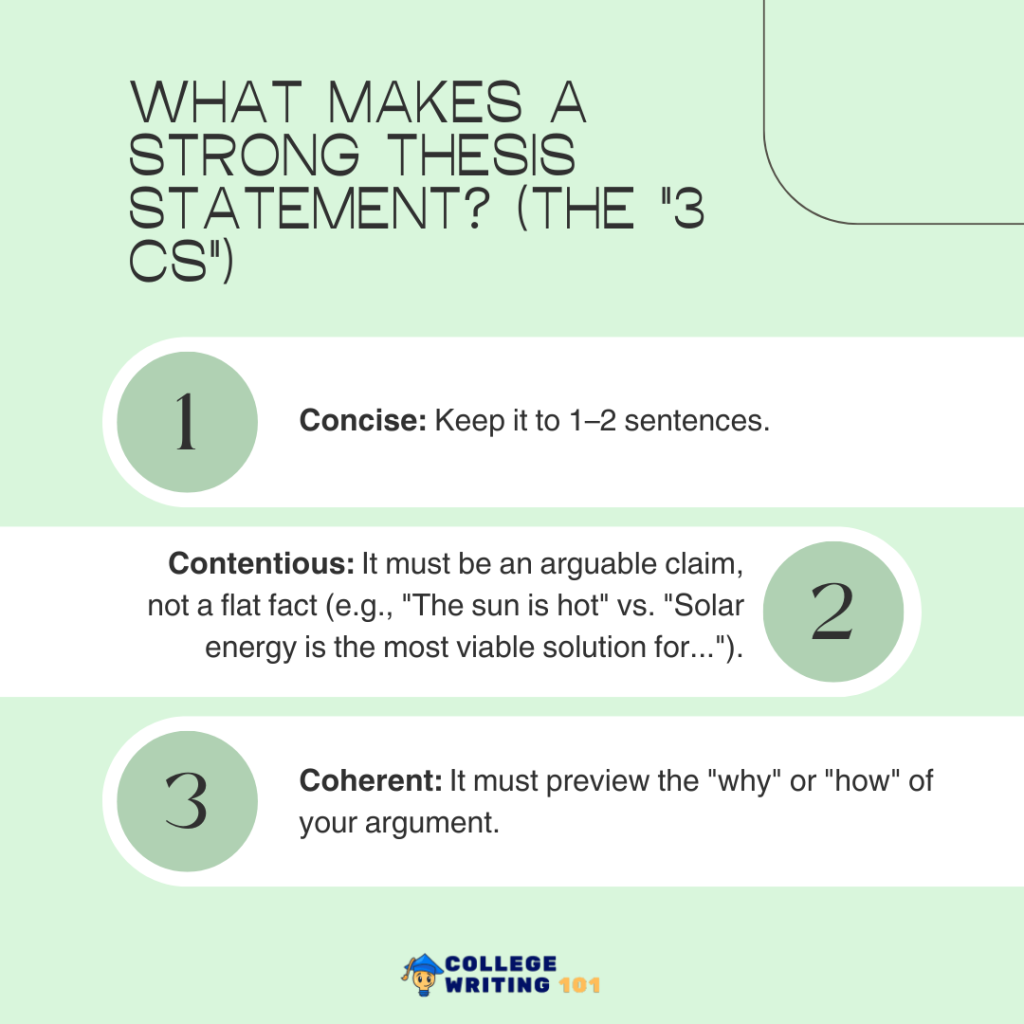
Take a clear position or make a specific claim. Your thesis should do more than announce your topic—it should stake out a position. Instead of “This essay discusses the effects of social media on teenagers,” write “Excessive social media use harms teenage mental health by increasing anxiety, disrupting sleep patterns, and promoting unrealistic social comparisons.”
Make it specific and focused. Avoid vague or overly broad statements. A thesis like “Technology is changing society” is too general. Narrow it down: “Smartphone technology has fundamentally altered interpersonal communication by reducing face-to-face interactions and creating constant digital distraction.” The more specific you are, the easier it will be to support your claim.
Ensure it’s arguable or informative. For argumentative essays, your thesis should present a position that someone could reasonably disagree with. For informative essays, it should promise to explain something meaningful. A statement like “Paris is the capital of France” isn’t a thesis—it’s just a fact. But “Paris became a cultural center due to royal patronage, strategic location, and its role in the Enlightenment” gives you something to explore and explain.
Include your main supporting points. A strong thesis often previews the structure of your essay by mentioning the key reasons or aspects you’ll discuss. For instance: “Renewable energy should replace fossil fuels because it reduces carbon emissions, creates sustainable jobs, and decreases dependence on foreign oil.” This tells readers exactly what to expect in the body paragraphs.
Place it strategically. Your thesis typically belongs at the end of your introduction paragraph. This placement allows you to build context before presenting your main argument, giving readers the background they need to understand your claim.
Revise and refine. Your first draft of a thesis is rarely your best. As you write your essay and develop your ideas, return to your thesis and sharpen it. Make sure every word counts and that your statement accurately reflects what your essay actually argues.
Test your thesis. Ask yourself: Is it specific enough? Does it take a clear position? Can I support it with evidence? Does it answer “so what?”—meaning, does it matter? If you can answer yes to all these questions, you likely have a strong thesis.
Avoid this: Don’t simply announce your topic (“This paper will discuss…”), don’t make your thesis a question, and don’t use vague language like “interesting” or “important” without explaining why. Be direct, confident, and precise.
Simple Thesis Statement Examples
Examples for an argumentative essay
- “School uniforms should be mandatory in all public schools because they reduce bullying, minimize economic disparities among students, and improve classroom focus.”
- “The voting age should be lowered to 16 because teenagers demonstrate civic engagement, are affected by policy decisions, and already possess the maturity to make informed choices.”
- “Social media companies should be held legally responsible for harmful content on their platforms because they profit from user engagement and have the technological means to moderate effectively.”
- “College athletes should be paid for their participation because they generate substantial revenue for universities, risk career-ending injuries, and deserve compensation for their labor.”
- “Single-use plastics should be banned nationwide to reduce ocean pollution, protect marine life, and encourage sustainable alternatives.”
- “Remote work should become the standard for office jobs because it increases productivity, improves work-life balance, and reduces environmental impact.”
- “The death penalty should be abolished because it violates human rights, risks executing innocent people, and fails to deter crime more effectively than life imprisonment.”
- “Universal basic income should be implemented to address job displacement from automation, reduce poverty, and provide economic security for all citizens.”
Examples for an informative essay
- “The process of photosynthesis involves light absorption by chlorophyll, carbon dioxide fixation, and the production of glucose and oxygen.”
- “Climate change results from increased greenhouse gas emissions, deforestation, and industrial activities that trap heat in Earth’s atmosphere.”
- “The human digestive system breaks down food through mechanical digestion in the mouth and stomach, and chemical digestion via enzymes throughout the gastrointestinal tract.”
- “The American Revolution was caused by taxation without representation, restrictive trade policies, and growing colonial desire for self-governance.”
- “Depression is characterized by persistent sadness, loss of interest in activities, changes in sleep and appetite, and difficulty concentrating.”
- “Blockchain technology functions as a decentralized ledger system that records transactions across multiple computers, ensuring transparency and security.”
- “The water cycle consists of evaporation from bodies of water, condensation into clouds, precipitation as rain or snow, and collection back into oceans and rivers.”
- “World War II began due to the Treaty of Versailles’ harsh terms, economic instability in Europe, and the rise of totalitarian regimes.”
- “Artificial intelligence operates through machine learning algorithms, neural networks, and vast datasets that enable computers to recognize patterns and make decisions.”
- “The Renaissance was a cultural movement marked by renewed interest in classical learning, advancements in art and science, and the rise of humanism.”
Examples for a literary analysis
- “In To Kill a Mockingbird, Harper Lee uses the symbol of the mockingbird to represent innocence destroyed by evil, as seen through the characters of Tom Robinson and Boo Radley.”
- “Shakespeare’s Hamlet explores the theme of revenge through Hamlet’s internal struggle between action and inaction, ultimately questioning whether vengeance brings justice or further tragedy.”
- “In The Great Gatsby, F. Scott Fitzgerald uses the green light as a symbol of Gatsby’s unattainable dreams and the corruption of the American Dream.”
- “1984 by George Orwell demonstrates how totalitarian governments maintain power through surveillance, propaganda, and the manipulation of language and history.”
- “In Pride and Prejudice, Jane Austen critiques the social class system of 19th-century England by showing how economic necessity and pride prevent genuine romantic connection.”
- “The monster in Mary Shelley’s Frankenstein represents the dangers of unchecked scientific ambition and society’s rejection of those who appear different.”
- “In The Catcher in the Rye, J.D. Salinger uses Holden Caulfield’s red hunting hat as a symbol of his desire for individuality and protection from the adult world he fears.”
- “Lord of the Flies by William Golding illustrates how civilization is fragile and humans are capable of descending into savagery when removed from societal structure and rules.”
- “In The Scarlet Letter, Nathaniel Hawthorne uses the letter ‘A’ as an evolving symbol that transforms from a mark of shame to a representation of strength and identity.”
- “Emily Dickinson’s poem ‘Because I could not stop for Death’ personifies death as a gentle suitor to explore themes of mortality, eternity, and the passage from life to afterlife.”
- “In Beloved, Toni Morrison uses the ghost of Beloved to represent the haunting legacy of slavery and the impossibility of escaping traumatic history.”
- “The Yellow Wallpaper by Charlotte Perkins Gilman uses the narrator’s obsession with the wallpaper to symbolize women’s oppression and the psychological effects of patriarchal control in the 19th century.”
Strong vs. Weak Thesis Statement Examples
Weak: This essay is about social media.
Strong: Social media platforms have fundamentally altered political discourse by creating echo chambers, spreading misinformation rapidly, and enabling direct politician-to-voter communication that bypasses traditional media gatekeepers.
Weak: Climate change is bad.
Strong: Climate change poses an existential threat to coastal communities through rising sea levels, increased storm intensity, and the displacement of millions of people by 2050.
Weak: Exercise is good for you.
Strong: Regular cardiovascular exercise reduces the risk of heart disease by 30%, improves mental health outcomes, and increases lifespan by an average of seven years.
Weak: I think school uniforms are a good idea.
Strong: Mandatory school uniforms improve academic performance by reducing distractions, decrease bullying related to clothing choices, and create a more equitable learning environment.
Weak: This paper will discuss Shakespeare’s Hamlet.
Strong: In Hamlet, Shakespeare explores how the paralysis of overthinking prevents decisive action, as demonstrated through Hamlet’s soliloquies, his delayed revenge, and his contrasts with characters like Fortinbras and Laertes.
Weak: Technology has changed education.
Strong: Educational technology has widened the achievement gap by providing affluent students with personalized learning tools while underfunded schools lack the infrastructure and training to implement these same resources effectively.
Weak: Fast food is unhealthy.
Strong: The fast food industry’s marketing strategies deliberately target low-income communities and children, contributing to obesity epidemics, type 2 diabetes, and long-term public health crises that disproportionately affect vulnerable populations.
Weak: There are many causes of the Civil War.
Strong: The American Civil War was primarily caused by irreconcilable economic differences between the industrial North and agrarian South, disputes over states’ rights, and the moral crisis surrounding slavery’s expansion into new territories.
Weak: Video games are popular.
Strong: Video games have become a dominant cultural force that shapes social interaction, influences political engagement among young people, and generates more revenue than the film and music industries combined.
Weak: Animal testing is controversial.
Strong: Animal testing for cosmetics should be banned worldwide because alternative testing methods are now scientifically viable, the practice causes unnecessary suffering, and consumer demand increasingly favors cruelty-free products.
Weak: The Internet affects communication.
Strong: Internet communication has eroded the quality of interpersonal relationships by replacing nuanced face-to-face conversations with superficial digital exchanges, reducing empathy through screen-mediated interaction, and creating addiction to instant gratification.
Weak: Recycling is important.
Strong: Current recycling programs fail to address plastic waste effectively because contamination rates exceed 25%, only 9% of plastic is actually recycled, and corporations continue producing non-recyclable materials without accountability.
Weak: The Great Gatsby is about the American Dream.
Strong: F. Scott Fitzgerald’s The Great Gatsby reveals the American Dream as a corrupting illusion through Gatsby’s obsessive pursuit of wealth, the moral emptiness of the elite, and the impossibility of recapturing the past.
Weak: Artificial intelligence will change things.
Strong: Artificial intelligence will displace 47% of current jobs within two decades, necessitating universal basic income, comprehensive workforce retraining programs, and new economic models that separate human value from employment.
Weak: Bullying in schools is a problem.
Strong: School bullying can be reduced by 50% through comprehensive programs that include bystander intervention training, restorative justice practices, and social-emotional learning curricula integrated across all grade levels.
Weak: Shakespeare used a lot of symbols.
Strong: Shakespeare employs blood imagery throughout Macbeth to trace the protagonist’s psychological deterioration from ambitious soldier to guilt-ridden tyrant, demonstrating how moral corruption manifests physically.
Weak: College is expensive.
Strong: Rising college tuition costs have created a student debt crisis that suppresses economic growth, delays major life milestones like homeownership and marriage, and disproportionately burdens first-generation and minority students.
Weak: People use their phones too much.
Strong: Smartphone addiction rewires neural pathways associated with attention and reward, reducing users’ capacity for deep focus, disrupting sleep cycles through blue light exposure, and increasing anxiety through constant social comparison.
Weak: Voting is a right.
Strong: Voter ID laws suppress turnout among elderly, minority, and low-income citizens who disproportionately lack required documentation, effectively disenfranchising millions under the guise of preventing virtually nonexistent in-person voter fraud.
Weak: Organic food is better.
Strong: Despite higher costs, organic food provides minimal nutritional advantages over conventional produce, though it does reduce pesticide exposure and supports more sustainable farming practices that benefit long-term soil health.
Weak: To Kill a Mockingbird has important themes.
Strong: Harper Lee’s To Kill a Mockingbird demonstrates that moral courage requires standing against community prejudice, as shown through Atticus Finch’s defense of Tom Robinson despite social ostracism and threats to his family’s safety.
Weak: The death penalty is bad.
Strong: The death penalty should be abolished because it has executed at least 18 innocent people since 1976, costs taxpayers more than life imprisonment, and fails to deter murder more effectively than alternative sentences.
Weak: Working from home has pros and cons.
Strong: Remote work increases employee productivity by 13% through elimination of commute time and fewer workplace distractions, while simultaneously creating challenges in team collaboration, professional development, and work-life boundary maintenance.
Weak: Plastic pollution is everywhere.
Strong: Microplastic contamination has infiltrated the entire food chain from plankton to humans, requiring immediate international regulation of plastic production, investment in biodegradable alternatives, and global cleanup initiatives in the world’s oceans.
Weak: Minimum wage should change.
Strong: Raising the federal minimum wage to $15 per hour would lift 1.3 million Americans out of poverty and stimulate economic growth through increased consumer spending, despite potential job losses in some sectors.
Weak: In 1984, Orwell writes about government control.
Strong: Orwell’s 1984 warns that totalitarian governments maintain power not through physical force alone but through linguistic manipulation, constant surveillance, and the systematic destruction of objective truth and historical memory.
FAQs
How long should a thesis statement be?
A thesis statement is typically one or two clear sentences.
Can a thesis statement be a question?
No. It should be a declarative sentence that states your main argument.
Where does the thesis statement go?
It is most commonly placed at the end of the introductory paragraph.