
An analytical essay is a type of writing that examines a subject in detail, breaking it down to understand its meaning and impact. Unlike a summary, an analytical essay goes beyond describing events or ideas—it interprets, evaluates, and explains how different elements work together. Writing an analytical essay requires a clear thesis, supported by evidence, examples, and logical reasoning. It encourages critical thinking and helps readers see connections that may not be immediately obvious.
For students and writers, studying examples of analytical essays is a valuable way to learn structure, style, and argument development. By reviewing analytical essay examples, you can observe how a strong introduction sets the stage, how paragraphs are organized around key points, and how evidence is used to support claims.
Need more hours in your day?
Our writers are ready to complete your assignments professionally
Key Features of an Analytical Essay
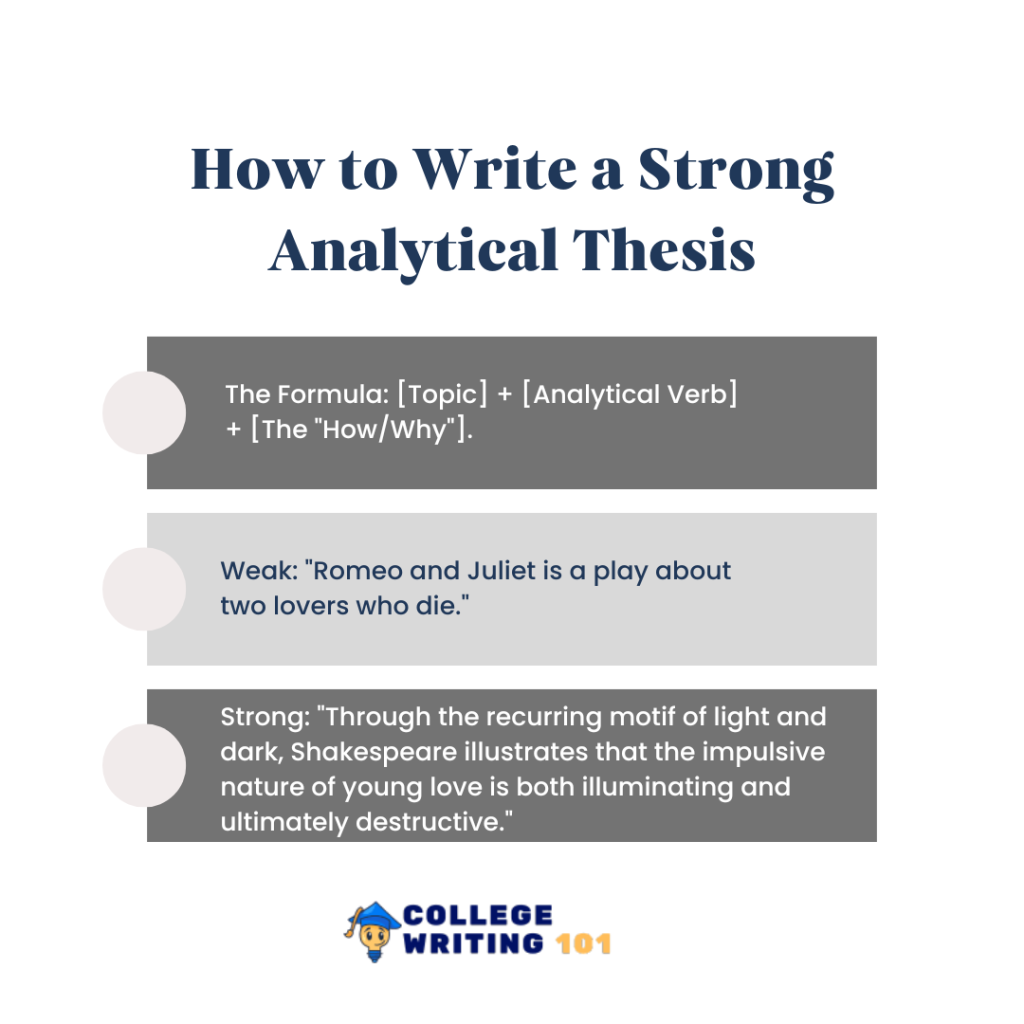
Clear Thesis Statement
The essay centers on a specific, arguable claim that presents your interpretation or analysis. This isn’t just a summary—it’s your unique insight about what the text, event, or concept means or how it functions.
Evidence-Based Arguments
Every claim you make must be supported by concrete evidence from the source material. This includes direct quotations, specific examples, and relevant data that substantiate your interpretation.
Logical Organization
The essay follows a coherent structure where each paragraph builds on the previous one. Ideas flow naturally from your introduction through body paragraphs to your conclusion, with smooth transitions connecting your points.
Close Reading and Interpretation
Rather than just describing what happens, you examine how and why it happens. You explore deeper meanings, patterns, literary devices, or underlying assumptions in your subject.
Critical Thinking
You question, evaluate, and interpret rather than simply accept information at face value. This involves considering multiple perspectives, identifying relationships between ideas, and drawing reasoned conclusions.
Focused Scope
The essay maintains a narrow, specific focus rather than trying to cover everything about a topic. Each element you discuss directly supports your central thesis.
Objective Tone
While presenting your own interpretation, you maintain an academic, professional voice. You avoid personal anecdotes or emotional language unless specifically relevant to your analysis.
Synthesis
The conclusion doesn’t just repeat your points but synthesizes them to show the larger significance of your analysis and why your interpretation matters.
The Standard Analytical Essay Structure
- Introduction:
- The Hook (Quote, startling fact, or rhetorical question).
- Background/Context (Title, author, and brief overview).
- The Thesis Statement: Explain that this is the “claim” the rest of the essay proves.
- Body Paragraphs (The TEAL Method):
- Topic Sentence: The sub-argument for this paragraph.
- Evidence: A quote or specific example.
- Analysis: Explaining how the evidence proves the topic sentence.
- Link: Transitioning to the next point.
- Conclusion:
- Restate thesis (in new words).
- Summarize main points.
- Final “So What?” (The broader significance of the analysis)
Analytical Essay Example
Example 1
Mozart’s Influence on the Classical Period
Introduction
The Hook
“Mozart is sunshine.” This simple declaration by Antonín Dvořák captures the luminous quality that Wolfgang Amadeus Mozart brought to classical music, but it barely hints at the revolutionary impact he wielded during his brief life.
Background/Context
Wolfgang Amadeus Mozart (1756-1791) composed over 600 works during the Classical period, a time when music was transitioning from the ornate Baroque style to something more balanced and accessible. His symphonies, operas, concertos, and chamber music became the gold standard against which all other composers were measured.
The Thesis Statement (This is the “claim” the rest of the essay proves)
Mozart fundamentally shaped the Classical period through his perfection of musical form, his innovative approach to opera, and his ability to infuse intellectual structure with profound emotional depth, thereby establishing the aesthetic standards that would define an entire era.
Body Paragraph 1 (Using the TEAL Method)
Topic Sentence (The sub-argument for this paragraph)
Mozart’s mastery of sonata form elevated it from a simple structural framework to an art form capable of expressing complex musical ideas.
Evidence (A quote or specific example)
In his Symphony No. 40 in G minor, Mozart demonstrates sophisticated use of sonata-allegro form in the first movement, introducing two contrasting themes—an agitated, minor-key melody followed by a lyrical, relative major theme—then developing them through unexpected harmonic progressions and thematic fragmentation.
Analysis (Explaining how the evidence proves the topic sentence)
This exemplifies how Mozart didn’t merely follow the sonata form template established by earlier composers; he expanded its expressive possibilities. By intensifying the contrast between themes and using the development section to explore darker harmonic territory, he showed that formal structure could serve dramatic and emotional purposes. The result was music that was both intellectually satisfying and emotionally compelling, demonstrating that Classical balance didn’t mean superficiality.
Link (Transitioning to the next point)
While his instrumental works redefined formal possibilities, Mozart’s operatic innovations were equally transformative in humanizing the genre.
Body Paragraph 2 (Using the TEAL Method)
Topic Sentence
Mozart revolutionized opera by creating psychologically complex characters and integrating music seamlessly with dramatic action.
Evidence
In The Marriage of Figaro (1786), Mozart gives each character distinct musical personalities: the Countess’s arias reveal her wounded dignity through soaring, ornamented lines, while Figaro’s music is characterized by rapid patter and clever rhythms that reflect his cunning nature.
Analysis
This approach represented a dramatic departure from opera seria, where characters were often one-dimensional and music served primarily to showcase vocal virtuosity. Mozart understood that music could reveal inner psychology and advance the plot simultaneously. By matching musical style to character personality and emotional state, he created multidimensional figures who felt genuinely human. This innovation influenced opera for generations, establishing the principle that music should serve drama rather than existing separately from it.
Link
Beyond structural and dramatic innovations, Mozart’s genius lay in his unique synthesis of intellectual rigor and emotional authenticity.
Body Paragraph 3 (Using the TEAL Method)
Topic Sentence
Mozart achieved a unprecedented balance between Classical restraint and Romantic expressiveness, making his music intellectually sophisticated yet immediately accessible.
Evidence
His Piano Concerto No. 21 in C major demonstrates this duality: the second movement (Andante) features a simple, hymn-like melody over steady accompaniment, yet the harmonic progressions and subtle chromaticism create profound emotional depth without disrupting the Classical sense of proportion.
Analysis
This balance was Mozart’s defining achievement. While contemporary composers like Haydn focused primarily on structural innovation and wit, Mozart infused Classical forms with genuine pathos and yearning that anticipated Romanticism. Yet he never abandoned Classical principles of balance, clarity, and formal coherence. This synthesis created a new aesthetic standard—music could be both emotionally moving and intellectually satisfying, both accessible and sophisticated. This ideal became the benchmark for Classical excellence and influenced composers well into the nineteenth century.
Link
These combined innovations cemented Mozart’s role as the defining voice of his era.
Conclusion
Restate Thesis (in new words)
Through his perfection of musical architecture, his transformation of opera into genuine music drama, and his unique fusion of formal elegance with emotional truth, Mozart established the artistic ideals that came to define the Classical era itself.
Summarize Main Points
His instrumental works showed that formal structures could serve expressive purposes, his operas demonstrated that music could create psychologically real characters, and his overall aesthetic proved that intellectual sophistication and emotional depth were not opposing forces but complementary elements of great art.
Final “So What?” (The broader significance of the analysis)
Mozart’s influence extends far beyond his own period. He proved that artistic greatness lies not in choosing between reason and emotion, structure and expression, but in achieving their perfect balance. This principle continues to inform our understanding of what makes music—and perhaps all art—truly timeless. In establishing these standards, Mozart didn’t just influence the Classical period; he became its very embodiment.
Example 2
Color Symbolism in “The Great Gatsby”
Introduction
The Hook
What if every color in a novel carried a hidden meaning, painting a portrait not just of places and people, but of the entire American Dream itself?
Background/Context
F. Scott Fitzgerald’s The Great Gatsby (1925) tells the story of Jay Gatsby’s obsessive pursuit of Daisy Buchanan against the backdrop of the wealthy Long Island elite during the Jazz Age. Beyond its compelling narrative, the novel employs a sophisticated system of color imagery that reinforces its central themes.
The Thesis Statement (This is the “claim” the rest of the essay proves)
Fitzgerald uses color symbolism—particularly green, yellow/gold, and white—as a deliberate literary device to expose the corruption underlying the American Dream, the moral emptiness of the wealthy class, and the impossibility of recapturing the past.
Body Paragraph 1 (Using the TEAL Method)
Topic Sentence (The sub-argument for this paragraph)
The color green functions throughout the novel as a symbol of Gatsby’s yearning for an unattainable dream, representing both hope and the destructive nature of obsession.
Evidence (A quote or specific example)
The green light at the end of Daisy’s dock appears first in Chapter 1, where Nick observes Gatsby “stretched out his arms toward the dark water” reaching toward “a single green light, minute and far away.” Later, in the final chapter, Nick reflects that Gatsby “believed in the green light, the orgastic future that year by year recedes before us.”
Analysis (Explaining how the evidence proves the topic sentence)
Fitzgerald’s choice of green is deliberate and multifaceted. Green traditionally symbolizes hope, renewal, and promise—the very qualities Gatsby associates with his dream of reuniting with Daisy. However, the light is described as “minute and far away,” suggesting the dream’s fundamental inaccessibility. The physical act of reaching emphasizes Gatsby’s desperate longing for something perpetually out of reach. By the novel’s end, Nick’s observation that the future “recedes before us” reveals that the green light represents not achievable goals but the tragic human tendency to pursue illusions. The green light thus embodies the paradox of the American Dream itself: inspiring and motivating, yet ultimately leading to destruction when pursued blindly.
Link (Transitioning to the next point)
While green represents Gatsby’s idealistic aspirations, the prevalence of yellow and gold reveals the corruption that taints those dreams.
Body Paragraph 2 (Using the TEAL Method)
Topic Sentence
Fitzgerald employs yellow and gold imagery to illustrate how wealth and materialism corrupt authentic values, transforming the golden promise of the American Dream into something tarnished and false.
Evidence
Gatsby’s car is described as “a rich cream color, bright with nickel, swollen here and there in its monstrous length with triumphant hat-boxes and supper-boxes and tool-boxes, and terraced with a labyrinth of wind-shields that mirrored a dozen suns.” The car is later called “the death car” and is yellow. Additionally, the novel references “two girls in twin yellow dresses” at Gatsby’s parties, and the eyeglasses of T.J. Eckleburg overlooking the valley of ashes have “yellow spectacles.”
Analysis
Fitzgerald distinguishes between gold (representing true value and old money) and yellow (representing false gold, imitation, and moral decay). Gatsby’s ostentatious yellow car embodies the vulgar display of new money—it’s showy and excessive, described in almost grotesque terms with its “monstrous length” and multiple reflections.
Significantly, this same vehicle becomes the instrument of death, killing Myrtle Wilson and triggering the tragic conclusion. The yellow dresses at Gatsby’s parties suggest the artificiality and superficiality of his social world, while Eckleburg’s yellow spectacles watching over the desolate valley of ashes imply that even divine observation has been tainted by the moral corruption of the age. Through these yellow images, Fitzgerald shows how the pursuit of wealth transforms the golden dream into something cheap, dangerous, and ultimately deadly.
Link
In contrast to the tarnished yellow of corruption, white appears throughout the novel as a symbol of supposed purity that masks moral emptiness.
Body Paragraph 3 (Using the TEAL Method)
Topic Sentence
The color white, traditionally associated with innocence and purity, is ironically deployed by Fitzgerald to expose the moral vacancy and careless cruelty of the upper class.
Evidence
Daisy and Jordan are introduced “in white” on a white couch in the Buchanan’s white-curtained room, creating an image of ethereal purity. Daisy is consistently associated with white: her voice is “full of money,” described as having a “white girlhood,” and she wears white when she first reunites with Gatsby. Even her name, Daisy, evokes a white flower.
Analysis
Fitzgerald uses white to create a veneer of innocence that proves illusory upon examination. While Daisy appears angelic in white, her actions reveal carelessness and moral cowardice—she allows Gatsby to take the blame for Myrtle’s death and retreats into her privileged life with Tom without consequence. The white setting of the Buchanan home suggests sterility and emptiness rather than purity; it’s a cold, lifeless space that reflects the spiritual barrenness of its inhabitants. Jordan Baker, also dressed in white, is revealed to be dishonest and morally indifferent.
By consistently associating the hollow, destructive characters with white, Fitzgerald subverts traditional color symbolism to suggest that the appearance of purity in the wealthy class is merely a façade concealing selfishness and corruption. The white is not innocence but rather an absence—an absence of warmth, conscience, and genuine human feeling.
Link
These color patterns work together to create a comprehensive critique of American society in the 1920s.
Conclusion
Restate Thesis (in new words)
Through his systematic use of green, yellow, and white imagery, Fitzgerald constructs a symbolic framework that reveals how American idealism becomes corrupted by materialism, how wealth masks moral bankruptcy, and how the beautiful surfaces of upper-class life conceal spiritual emptiness.
Summarize Main Points
Green captures the seductive yet destructive nature of impossible dreams, yellow exposes how the golden promise of prosperity degenerates into gaudy excess and death, and white reveals that apparent purity often disguises the most profound moral failures.
Final “So What?” (The broader significance of the analysis)
Fitzgerald’s color symbolism demonstrates that the American Dream, as pursued in the modern age, has become fundamentally corrupted. The novel suggests that a society obsessed with wealth and status loses sight of authentic values, replacing genuine human connection with hollow materialism and moral indifference. This symbolic critique remains relevant today, reminding readers to examine whether our own pursuits of success and happiness are built on substance or illusion, and whether the dreams we chase will fulfill us or destroy us. By making readers conscious of these recurring colors, Fitzgerald ensures we cannot remain passive observers but must actively interpret the moral landscape he presents—a landscape where nothing is quite as pure, golden, or hopeful as it first appears.
Sacrificing sleep to finish assignments?
Stop struggling and start delegating to our expert team.
Example 3
String Theory: A Critique
Introduction
The Hook
What if the most celebrated theory in modern physics cannot be tested, makes no verifiable predictions, and may ultimately tell us nothing about the actual universe we inhabit?
Background/Context
String theory emerged in the 1980s as a promising framework for unifying quantum mechanics and general relativity by proposing that fundamental particles are not point-like objects but tiny vibrating strings. Championed by leading physicists and popularized in countless books and documentaries, string theory has dominated theoretical physics for decades, attracting the brightest minds and securing substantial research funding.
The Thesis Statement (This is the “claim” the rest of the essay proves)
Despite its mathematical elegance and cultural prominence, string theory suffers from critical flaws as a scientific theory: its lack of testable predictions violates the fundamental principle of falsifiability, its reliance on untestable extra dimensions undermines empirical rigor, and its dominance has stifled alternative approaches to fundamental physics, revealing problematic tendencies in how modern theoretical physics operates.
Body Paragraph 1 (Using the TEAL Method)
Topic Sentence (The sub-argument for this paragraph)
String theory’s failure to produce testable, falsifiable predictions fundamentally violates the scientific method and transforms physics from an empirical science into mathematical philosophy.
Evidence (A quote or specific example)
After more than forty years of development, string theory has not generated a single prediction that can be experimentally verified or potentially disproven. Physicist Lee Smolin notes in The Trouble with Physics that string theory requires energies approximately 10^15 times greater than those achievable at the Large Hadron Collider to directly observe strings, placing experimental verification permanently beyond reach. Furthermore, the theory generates an estimated 10^500 possible solutions—the so-called “landscape problem”—meaning it can accommodate virtually any experimental result.
Analysis (Explaining how the evidence proves the topic sentence)
This situation represents a crisis for scientific methodology. Karl Popper established falsifiability as the demarcation between science and pseudoscience: a theory must make predictions that could potentially be proven wrong. String theory, however, has evolved in ways that insulate it from empirical challenge. The astronomical energy requirements mean direct observation is impossible with conceivable technology, while the landscape of solutions allows string theorists to retroactively accommodate any experimental findings. When a theory can explain everything, it actually explains nothing. This transforms string theory from physics—a discipline grounded in observation and experiment—into pure mathematics or metaphysics, where beauty and internal consistency replace empirical validation as measures of truth.
Link (Transitioning to the next point)
Beyond the falsifiability problem, string theory’s fundamental assumptions themselves rest on unverifiable foundations.
Body Paragraph 2 (Using the TEAL Method)
Topic Sentence
The theory’s requirement of extra spatial dimensions—ranging from six to seven additional dimensions beyond our observable three—represents an unfalsifiable assumption that asks scientists to accept extraordinary claims without empirical evidence.
Evidence
String theory mathematically requires nine or ten spatial dimensions to maintain internal consistency. Since we observe only three spatial dimensions, string theorists propose that the extra dimensions are “compactified” or curled up at scales too small to detect—approximately the Planck length of 10^-35 meters. These hidden dimensions can supposedly take countless different shapes (Calabi-Yau manifolds), each producing different physics in our observable three dimensions.
Analysis
This represents a profound departure from empirical science. The extra dimensions are not proposed because evidence demands them, but because the mathematical framework requires them. Moreover, these dimensions are conveniently placed beyond any possible observation, making them permanently unverifiable. The claim that six or seven entire dimensions of space exist but remain forever hidden is extraordinary, yet it’s accepted within string theory as foundational truth.
The various possible shapes for these dimensions contribute directly to the landscape problem, multiplying the theory’s possible configurations. Scientists are essentially asked to believe in invisible dimensions that perfectly explain why we cannot see them—a circular logic that would be rejected in any other scientific context. This reliance on unobservable entities to save a theory from inconsistency mirrors the epicycles added to geocentric models before Copernicus, suggesting string theory may be a elaborate mathematical construction disconnected from physical reality.
Link
The problems of unfalsifiability and unobservable assumptions might be acceptable if string theory existed alongside competing approaches, but its dominance has created institutional problems for physics itself.
Body Paragraph 3 (Using the TEAL Method)
Topic Sentence
String theory’s monopolization of resources, positions, and prestige in theoretical physics has created an unhealthy intellectual monoculture that suppresses alternative research programs and distorts the scientific process.
Evidence
Research positions in theoretical physics at elite universities became overwhelmingly dominated by string theorists from the 1990s onward. Physicists working on alternative approaches to quantum gravity, such as loop quantum gravity or causal set theory, found it extremely difficult to secure tenure-track positions or research funding. Peter Woit, in Not Even Wrong, documents how graduate students were advised that working on anything other than string theory would be “career suicide,” and how grant proposals for alternative approaches faced systematic rejection while string theory research received preferential funding despite producing no empirical results.
Analysis
This sociological dimension reveals how string theory’s dominance transcends scientific merit and reflects institutional power dynamics. When a single theoretical approach captures most resources and positions, science loses the diversity of perspectives essential for progress. Young physicists pursuing promising alternative ideas face professional extinction, creating a self-reinforcing cycle where string theory perpetuates itself not through empirical success but through institutional control.
This resembles a paradigm in Thomas Kuhn’s sense, but one that has calcified without the empirical crisis that would normally trigger revolutionary change. The situation also reveals a troubling trend where mathematical elegance and theoretical prestige substitute for experimental validation. String theorists have successfully marketed their work through popular books and media, creating public perception of inevitability and success despite the absence of empirical confirmation. This institutional capture represents a failure of the self-correcting mechanisms that should govern scientific research, allowing an empirically unproductive program to consume resources that might otherwise advance testable physics.
Link
These combined weaknesses—unfalsifiability, dependence on unobservable entities, and institutional dominance—paint a troubling picture of contemporary theoretical physics.
Conclusion
Restate Thesis (in new words)
String theory’s failure to meet basic scientific standards of empirical testability, its foundation on unverifiable extra dimensions, and its monopolization of theoretical physics resources demonstrate that it represents not scientific progress but a problematic detour that privileges mathematical beauty over experimental validation.
Summarize Main Points
The theory cannot be tested or falsified, violating fundamental principles of scientific methodology. It requires belief in hidden dimensions that can never be observed or confirmed. And its institutional dominance has created an unhealthy monoculture that suppresses alternative approaches and distorts how physics research is conducted and funded.
Final “So What?” (The broader significance of the analysis)
The string theory saga offers crucial lessons about how science can go astray when theoretical elegance replaces empirical verification as the measure of truth. It demonstrates that even in physics—often held up as the most rigorous science—sociological factors, institutional inertia, and persuasive marketing can override the scientific method’s safeguards. For science to progress, it must remain grounded in observation and experiment, maintain diverse competing approaches, and resist the seduction of beautiful mathematics that makes no contact with measurable reality.
The decades and resources devoted to string theory represent an opportunity cost for physics: what testable theories might have been developed, what empirical phenomena might have been explained, if brilliant minds had pursued falsifiable alternatives? As we move forward, the physics community must learn from this episode and recommit to the empirical principles that transformed natural philosophy into modern science—principles that demand theories earn their status through predictive success, not mathematical elegance alone.
FAQs
How do you start an analytical essay?
Start with a brief hook that introduces the topic, then give a little background. End the introduction with a clear thesis statement that explains what you will analyze and why it matters.
What is a good topic for an analytical essay?
A good topic is focused, clear, and easy to analyze. Examples include:
A theme in a novel or movie
A character’s decisions and impact
A social issue and its causes
A historical event and its effects
What are some examples of analytical questions?
Why does the author use this symbol?
How does this character change over time?
What causes this event to happen?
How does this policy affect society?