A strong conclusion can leave a lasting impression on readers, tying together ideas and reinforcing the main message of any piece of writing. One key element that helps achieve this clarity is the use of transition words. Transition words for a conclusion act as bridges, guiding readers smoothly from the body of the text to the final thoughts. They signal that the discussion is wrapping up, summarizing points, or offering a final insight. Words and phrases such as “in conclusion,” “to sum up,” and “as a result” help create a sense of closure while keeping the writing cohesive and easy to follow. Using the right transitions not only improves readability but also strengthens the overall argument or message.
What Are Transition Words?
Transition words are words or phrases that connect ideas, sentences, and paragraphs together, making your writing flow more smoothly. They act like bridges, helping readers follow your train of thought from one point to the next.
Common types include:
Words that show time or sequence (first, then, afterwards, meanwhile), words that add information (also, furthermore, additionally), words that show contrast (however, nevertheless, on the other hand), words that show cause and effect (therefore, consequently, as a result), and words that provide examples (for instance, specifically, such as).
For example, compare these two versions:
Without transitions: “I woke up late. I missed the bus. I had to walk to work.”
With transitions: “I woke up late. As a result, I missed the bus. Consequently, I had to walk to work.”
Why Use Transition Words in Conclusions?
Transition words are especially important in conclusions because they signal to your reader that you’re wrapping things up and help tie everything together smoothly.
Here’s why they matter at the end:
They clearly mark the shift from your main discussion to your final thoughts, so readers know you’re concluding rather than introducing new information. Without this signal, your ending might feel abrupt or confusing.
They help you synthesize your main points rather than just repeating them. Words like “ultimately,” “in essence,” or “taken together” suggest you’re pulling ideas into a bigger picture, not just listing things again.
They create a sense of closure and finality. Phrases like “in conclusion,” “to sum up,” or “finally” give readers that satisfying feeling that the piece is complete and resolved.
They can also help you connect back to your introduction or broader implications. Transitions like “thus” or “therefore” work well when showing how your argument leads to a particular outcome or recommendation.
For instance, instead of abruptly stating “This policy should be implemented,” you might write: “Therefore, given the evidence presented, this policy should be implemented.” The transition word makes the conclusion feel earned and logical rather than sudden.
Without transition words, conclusions can feel disconnected or choppy, leaving readers uncertain about whether you’ve actually finished or how your final thoughts relate to what came before.
List of Common Transition Words for Conclusion
To summarize or restate: In conclusion, in summary, to sum up, in short, in brief, overall, all in all, on the whole, in essence, essentially, ultimately, basically
To show final points: Finally, lastly, last but not least, in the end, at last
To emphasize or reinforce: Indeed, clearly, obviously, certainly, undoubtedly, without a doubt, evidently, unmistakably
To show results or implications: Therefore, thus, hence, consequently, as a result, accordingly, for this reason, because of this, given this
To generalize or broaden: Generally speaking, broadly speaking, by and large, for the most part, in general, overall
To reframe or clarify: In other words, that is to say, to put it another way, simply put, in simpler terms
To look forward or suggest action: Moving forward, looking ahead, in the future, with this in mind, given these points, considering all this
To show totality: All things considered, taking everything into account, after all, when all is said and done, at the end of the day
How to Use Transition Words in Your Conclusion
Start with a clear signal
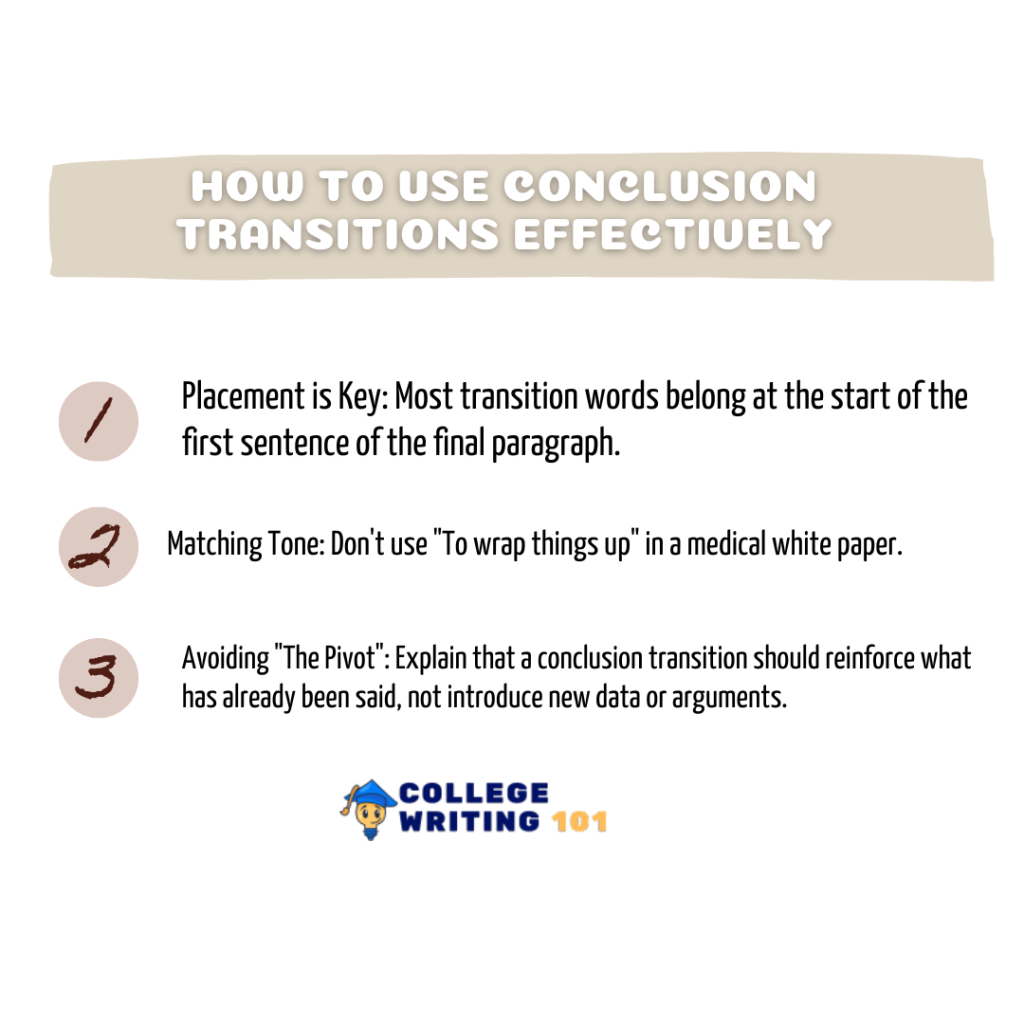
Begin your conclusion with a transitional phrase that tells readers you’re wrapping up. This could be “In conclusion,” “Ultimately,” or “To sum up.” However, don’t feel obligated to use one every time, especially in shorter pieces where the conclusion is obvious.
Use them sparingly
One or two transition words in a conclusion paragraph is usually enough. Overusing them makes your writing feel stiff and repetitive. You don’t need a transition word in every sentence.
Match the transition to your purpose
Choose transitions that fit what you’re actually doing. If you’re summarizing main points, use “in summary” or “overall.” If you’re showing a logical outcome, use “therefore” or “thus.” If you’re emphasizing significance, try “ultimately” or “clearly.”
Vary your choices
If you write multiple conclusions (like in essays with several sections), avoid starting each one the same way. Mix it up between “In conclusion,” “Finally,” “Ultimately,” and others to keep your writing fresh.
Place them naturally
Transitions work at the beginning of sentences (“Therefore, we should act now”) or within them (“We should, therefore, act now”). Let the rhythm of your sentence guide you.
Connect, don’t just announce
The best conclusions use transitions to actually link ideas, not just announce you’re done. Compare “In conclusion, recycling is important” with “Given these environmental benefits, recycling clearly deserves our commitment.” The second feels more purposeful.
FAQs
What word signals the conclusion of something?
Words like finally, overall, ultimately, and phrases such as in summary or to sum up signal a conclusion.
What can I write instead of conclusion?
You can use in summary, overall, to wrap up, in the end, or ultimately.
How to transition into a conclusion?
Restate the main idea briefly, then use a transition like overall or as a result to guide readers into the final thoughts.