
Validity in research is a key principle that determines whether a study truly measures what it claims to measure. Without validity, research findings lose credibility and cannot be relied upon to inform decisions, shape policies, or guide future studies. In both academic and professional fields, ensuring validity is what separates strong, trustworthy research from weak or misleading results. Researchers must carefully design their studies, select appropriate tools, and control for errors or biases that may influence outcomes. Validity takes different forms—such as internal, external, construct, and content validity—each addressing a specific aspect of accuracy and consistency. Understanding these forms helps researchers strengthen the quality of their work and avoid drawing false conclusions.
Importance of Validity in Research
Ensures Accurate Measurement Validity guarantees that research instruments and methods actually measure what they claim to measure, preventing researchers from drawing conclusions about the wrong variables or phenomena.
Establishes Credible Causal Relationships Valid research design allows researchers to confidently establish cause-and-effect relationships between variables while ruling out alternative explanations and confounding factors.
Enables Reliable Generalization Validity ensures that research findings can be appropriately applied to broader populations, settings, and contexts beyond the specific study sample.
Prevents Wasted Resources Invalid research leads to squandered time, money, and effort on studies that produce meaningless or misleading results, while valid research maximizes the value of invested resources.
Protects Against Harmful Consequences In applied fields like medicine, education, and psychology, invalid research can lead to ineffective or dangerous treatments, policies, and interventions that harm individuals and communities.
Builds Scientific Knowledge Valid studies contribute to the cumulative advancement of scientific understanding by providing reliable building blocks that other researchers can build upon confidently.
Maintains Public Trust Research validity preserves public confidence in scientific institutions and findings, which is essential for evidence-based decision-making in society.
Supports Evidence-Based Practice Valid research provides practitioners and policymakers with reliable evidence to guide their decisions and interventions in real-world settings.
Reduces Research Bias Validity safeguards help identify and minimize various forms of bias that can distort research findings and lead to incorrect conclusions.
Facilitates Replication and Verification Valid research designs enable other scientists to replicate studies and verify findings, which is fundamental to the self-correcting nature of science.
Ensures Ethical Research Standards Validity requirements help ensure that research participants’ time and contributions are used meaningfully and that studies meet ethical obligations to produce valuable knowledge.
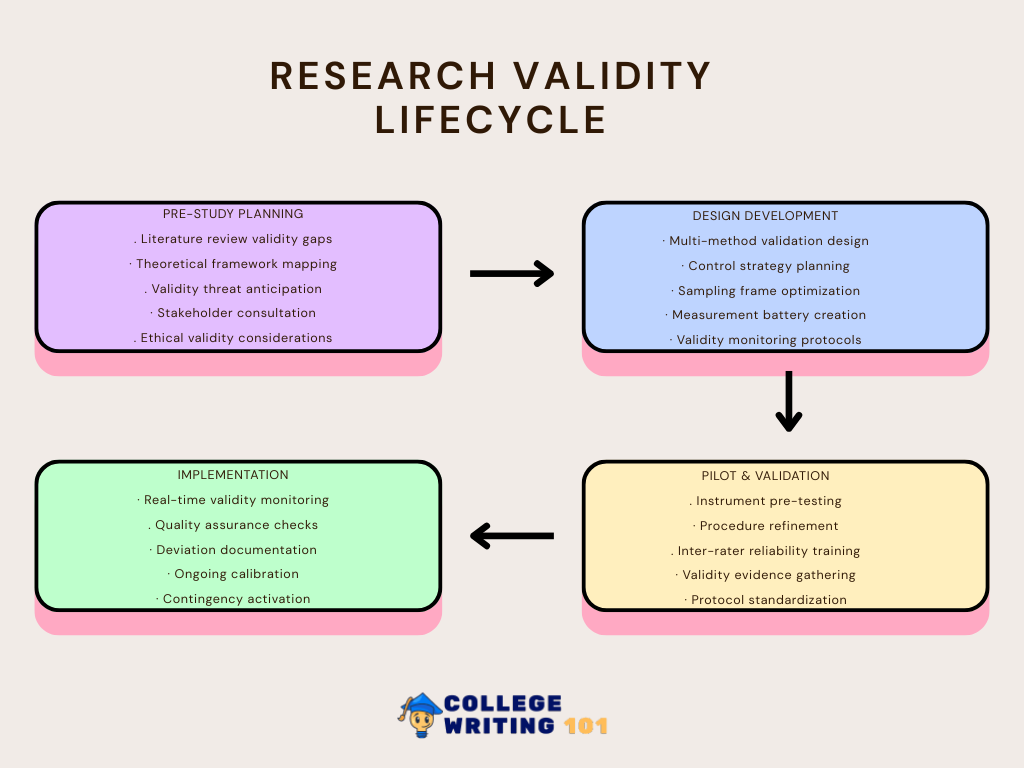
Types of Validity
Internal Validity
Definition: The extent to which a study establishes a trustworthy cause-and-effect relationship between the treatment and outcome, free from confounding variables.
Key Aspects: Controls for alternative explanations, eliminates threats like selection bias, history effects, maturation, testing effects, instrumentation changes, and regression to the mean.
Example: A study testing a new teaching method ensures that student improvement is due to the method itself, not differences in student ability, teacher experience, or external factors.
External Validity
Definition: The degree to which research findings can be generalized beyond the specific study context to other populations, settings, times, and conditions.
Key Aspects: Population validity (generalizing to other groups), ecological validity (generalizing to other settings), and temporal validity (generalizing across time periods).
Example: Results from a stress reduction program tested on college students can be applied to working adults in corporate environments.
Construct Validity
Definition: The extent to which a test or measurement tool accurately measures the theoretical construct or concept it claims to measure.
Key Aspects: Includes convergent validity (correlates with related measures), discriminant validity (doesn’t correlate with unrelated measures), and face validity (appears to measure what it should).
Example: An intelligence test actually measures cognitive ability rather than cultural knowledge or test-taking skills.
Content Validity
Definition: The degree to which a measurement instrument covers all aspects and dimensions of the construct being measured.
Key Aspects: Ensures comprehensive coverage of the concept, typically evaluated by expert judgment and systematic content analysis.
Example: A mathematics achievement test covers all required curriculum topics in appropriate proportions.
Criterion Validity
Definition: The extent to which a measure correlates with an external criterion or outcome it should theoretically predict or relate to.
Subtypes:
- Concurrent Validity: Correlation with a criterion measured at the same time
- Predictive Validity: Correlation with a future criterion or outcome
Example: SAT scores correlating with first-year college GPA (predictive validity) or with other standardized tests (concurrent validity).
Face Validity
Definition: The extent to which a test appears to measure what it claims to measure based on superficial examination.
Key Aspects: Focuses on surface-level appearance rather than statistical evidence, important for participant acceptance and cooperation.
Example: A depression inventory that includes questions about sadness, hopelessness, and loss of interest appears to measure depression.
Statistical Conclusion Validity
Definition: The degree to which conclusions about relationships between variables are justified based on the statistical evidence.
Key Aspects: Involves appropriate statistical power, correct use of statistical tests, meeting assumptions, and avoiding Type I and Type II errors.
Example: Using adequate sample sizes and appropriate statistical tests to detect true relationships between variables.
Ecological Validity
Definition: The extent to which research findings can be generalized to real-world settings and everyday situations.
Key Aspects: Considers whether artificial laboratory conditions reflect natural environments where the phenomenon typically occurs.
Example: Memory research conducted in realistic classroom settings rather than sterile laboratory environments.
Convergent Validity
Definition: The degree to which a measure correlates positively with other measures that theoretically should be related to the same construct.
Key Aspects: Demonstrates that different methods of measuring the same construct yield similar results.
Example: Multiple anxiety measures (self-report, physiological, behavioral) showing strong correlations with each other.
Discriminant Validity
Definition: The extent to which a measure does not correlate with measures of theoretically unrelated constructs.
Key Aspects: Proves that a test measures a distinct construct rather than overlapping with irrelevant variables.
Example: A creativity test not correlating highly with measures of intelligence or academic achievement, showing it measures something unique.
How to Improve Validity in Research
Enhancing Internal Validity
Use Randomization Randomly assign participants to treatment and control groups to eliminate selection bias and ensure groups are equivalent at baseline.
Control Confounding Variables Identify and control for variables that might influence the outcome through statistical control, matching, or experimental manipulation.
Implement Blinding Use single-blind or double-blind procedures to prevent participant and researcher expectations from influencing results.
Establish Control Groups Include appropriate comparison groups to isolate the effect of the treatment from other factors.
Use Pre-Post Designs Measure outcomes before and after intervention to control for initial differences between groups.
Minimize Attrition Reduce participant dropout through incentives, follow-up procedures, and making participation convenient to prevent biased sample loss.
Improving External Validity
Use Representative Sampling Select participants who accurately represent the target population through probability sampling methods when feasible.
Diversify Study Settings Conduct research across multiple locations, contexts, and environments to increase generalizability.
Include Diverse Populations Recruit participants from different demographic groups, cultures, and socioeconomic backgrounds.
Replicate Across Conditions Test findings under various conditions, time periods, and with different populations to establish broader applicability.
Use Field Studies Conduct research in natural, real-world settings rather than exclusively in controlled laboratory environments.
Strengthening Construct Validity
Develop Clear Operational Definitions Define constructs precisely and specify exactly how they will be measured and manipulated in the study.
Use Validated Instruments Employ measurement tools that have established reliability and validity evidence rather than creating new, untested measures.
Conduct Pilot Testing Test instruments and procedures with small samples before full implementation to identify potential problems.
Use Multiple Measures Assess constructs using different methods (self-report, observation, physiological measures) to triangulate findings.
Expert Review Have subject matter experts evaluate whether measures and procedures appropriately capture the intended constructs.
Enhancing Content Validity
Systematic Literature Review Thoroughly review existing research to ensure comprehensive understanding of the construct and its dimensions.
Expert Panel Evaluation Convene panels of experts to evaluate whether measures adequately cover all aspects of the construct.
Content Analysis Systematically analyze and categorize content to ensure representative coverage of the domain.
Use Established Frameworks Base measures on well-established theoretical frameworks and taxonomies in the field.
Improving Criterion Validity
Select Appropriate Criteria Choose external criteria that are theoretically relevant and practically important for validation purposes.
Use Gold Standard Measures Validate new instruments against established, widely-accepted measures when available.
Test Predictive Power Conduct longitudinal studies to assess how well measures predict future outcomes of interest.
Cross-Validation Test criterion validity across different samples and contexts to ensure stability of relationships.
Statistical and Methodological Improvements
Ensure Adequate Sample Size Conduct power analyses to determine minimum sample sizes needed to detect meaningful effects and avoid Type II errors.
Meet Statistical Assumptions Check and satisfy assumptions underlying statistical tests, using appropriate transformations or alternative analyses when needed.
Use Appropriate Statistical Methods Select statistical techniques that match the research design, data type, and research questions.
Control for Multiple Comparisons Apply appropriate corrections when conducting multiple statistical tests to avoid inflated Type I error rates.
Report Effect Sizes Include effect size measures alongside significance tests to indicate practical importance of findings.
Design and Planning Strategies
Develop Detailed Protocols Create comprehensive, standardized procedures for data collection, measurement, and analysis to ensure consistency.
Train Research Personnel Provide thorough training to data collectors and interviewers to minimize measurement error and bias.
Use Standardized Procedures Implement consistent protocols across all participants, settings, and time points to reduce variability.
Pilot Test Procedures Conduct small-scale preliminary studies to identify and resolve methodological problems before full implementation.
Plan for Threats to Validity Anticipate potential validity threats during the design phase and build in safeguards to address them proactively.
Quality Assurance Measures
Inter-Rater Reliability Use multiple raters for subjective measures and assess agreement to ensure consistent scoring and interpretation.
Regular Calibration Periodically retrain personnel and recalibrate instruments to maintain consistency throughout data collection.
Data Quality Checks Implement systematic procedures to identify and address missing data, outliers, and inconsistencies.
Transparency and Documentation Maintain detailed records of all procedures, decisions, and modifications to enable replication and evaluation.
Peer Review Subject research designs and findings to rigorous peer review before publication to identify potential validity issues.
Common Challenges to Validity
Threats to Internal Validity
Selection Bias Systematic differences between groups that exist before treatment begins, leading to false conclusions about causation. Occurs when participants self-select into groups or when assignment is not random.
History Effects External events occurring during the study period that affect outcomes independent of the treatment. These events can confound results by providing alternative explanations for observed changes.
Maturation Natural changes in participants over time (physical, psychological, or developmental) that are unrelated to the treatment but influence the dependent variable.
Testing Effects Changes in participant performance due to repeated exposure to the same measurement instrument, including practice effects or increased test sophistication.
Instrumentation Changes Variations in measurement tools, procedures, or observers over time that create artificial changes in recorded outcomes rather than true changes in the phenomenon being studied.
Regression to the Mean The statistical tendency for extreme scores to move toward the average on subsequent measurements, which can be mistaken for treatment effects.
Mortality/Attrition Systematic loss of participants during the study that creates biased samples and threatens the equivalence of comparison groups.
Challenges to External Validity
Population Restrictions Using narrow, unrepresentative samples that limit generalization to broader populations. Common issues include convenience sampling and volunteer bias.
Setting Limitations Conducting research in artificial or highly controlled environments that don’t reflect real-world conditions where findings would be applied.
Temporal Constraints Findings may not generalize across different time periods due to changing social, cultural, or technological contexts.
Treatment Variations Differences between research treatments and real-world implementations that limit the applicability of findings to practical settings.
Hawthorne Effect Participants changing their behavior simply because they know they’re being observed, leading to results that don’t reflect natural behavior patterns.
Construct Validity Challenges
Construct Underrepresentation Measures that fail to capture important dimensions of the construct, leading to incomplete or narrow assessment of the phenomenon of interest.
Construct-Irrelevant Variance Systematic measurement error where instruments assess factors unrelated to the intended construct, contaminating results with irrelevant information.
Mono-Operation Bias Relying on single measures or methods to assess constructs, which may not capture the full complexity of the phenomenon being studied.
Demand Characteristics Participants guessing the study’s purpose and altering their responses to meet perceived expectations rather than responding naturally.
Social Desirability Bias Participants providing responses they believe are socially acceptable rather than truthful, particularly problematic for sensitive topics.
Measurement and Statistical Challenges
Poor Reliability Inconsistent or unreliable measurements that introduce random error and reduce the ability to detect true relationships between variables.
Scale Limitations Using inappropriate measurement scales (nominal, ordinal, interval, ratio) that don’t match the statistical analyses being performed.
Range Restriction Limited variability in measured variables that artificially reduces correlations and effect sizes, leading to underestimation of relationships.
Ceiling and Floor Effects Measurement instruments that are too easy (ceiling) or too difficult (floor), preventing detection of true differences between participants.
Multiple Comparisons Problem Conducting numerous statistical tests without appropriate corrections, increasing the probability of finding false positive results.
Sampling and Recruitment Issues
Convenience Sampling Using easily accessible participants rather than representative samples, limiting generalizability of findings to broader populations.
Volunteer Bias Systematic differences between people who volunteer for research and those who don’t, creating unrepresentative samples.
Response Bias Systematic patterns in how participants respond to surveys or interviews that don’t reflect their true attitudes or behaviors.
Non-Response Bias Systematic differences between participants who complete the study and those who don’t respond or drop out.
Design and Implementation Problems
Confounding Variables Unmeasured variables that correlate with both the independent and dependent variables, providing alternative explanations for observed relationships.
Inadequate Control Groups Using inappropriate or poorly matched comparison groups that don’t provide valid baselines for evaluating treatment effects.
Insufficient Statistical Power Sample sizes too small to reliably detect meaningful effects, leading to Type II errors and inconclusive results.
Implementation Fidelity Issues Inconsistent delivery of treatments or interventions across participants, sites, or time periods that introduces unwanted variability.
Researcher and Observer Bias
Expectancy Effects Researcher expectations unconsciously influencing participant behavior or data interpretation in ways that confirm hypotheses.
Observer Bias Systematic errors in data collection or coding due to observer preconceptions or expectations about study outcomes.
Confirmation Bias Tendency to selectively attend to, collect, or interpret data in ways that confirm preexisting beliefs or hypotheses.
Allegiance Effects Researchers’ preferences for particular treatments or theories influencing study design, implementation, or interpretation of results.
Contextual and Environmental Factors
Situational Variables Uncontrolled environmental factors (noise, temperature, time of day) that systematically affect participant performance or responses.
Cultural and Social Context Failure to account for cultural differences or social contexts that may moderate the relationships being studied.
Reactivity Participants altering their natural behavior in response to being studied, creating artificial results that don’t reflect typical patterns.
Novelty Effects Temporary changes in behavior due to the newness of treatments or interventions that may not persist over time.
Ethical and Practical Constraints
Ethical Limitations Inability to use optimal research designs due to ethical constraints, forcing researchers to use less rigorous quasi-experimental approaches.
Resource Constraints Limited funding, time, or personnel that force compromises in study design, sample size, or measurement quality.
Access Restrictions Difficulty obtaining access to target populations or settings, leading to convenience samples or modified procedures.
Institutional Barriers Organizational policies or procedures that interfere with optimal research implementation or data collection protocols.
FAQs
What is validity and reliability?
Validity is the extent to which a test or research measures what it is supposed to measure.
Reliability is the consistency of results when a test or research is repeated under the same conditions.
What is validity and example?
Validity means accuracy of measurement.
Example: A math test is valid if it truly measures math skills, not reading ability.
What are the 3 C’s of validity?
Content validity – covers all aspects of the concept.
Criterion validity – compares results with an external standard.
Construct validity – measures the intended theoretical concept.
How is validity measured?
By using statistical tests (e.g., correlation, factor analysis), expert judgment, pilot studies, and comparison with established measures.