A thematic statement is a clear and concise expression of the central message or lesson conveyed by a piece of writing, film, or other form of storytelling. Unlike a plot summary, which explains what happens, a thematic statement focuses on the deeper meaning behind the events and characters. It communicates what the work says about life, society, or human nature, often in a universal way that can apply beyond the specific story.
For example, a novel might tell a story about friendship, but the thematic statement could be “True friendship withstands adversity.” Developing a strong thematic statement is important for both writers and readers because it provides direction, clarity, and purpose. Writers use it to stay focused on their message, while readers use it to interpret and analyze the work more meaningfully. In academic and creative contexts, mastering thematic statements enhances critical thinking and communication skills.
Theme vs. Thematic Statement
Theme is the broad, universal concept or topic that a work explores (like love, betrayal, or coming of age), while a thematic statement is a complete sentence that expresses the author’s specific perspective or message about that theme.
Think of theme as the “what” and thematic statement as the “what the author believes about it.”
Key Characteristics of a Thematic Statement
A strong thematic statement should be:
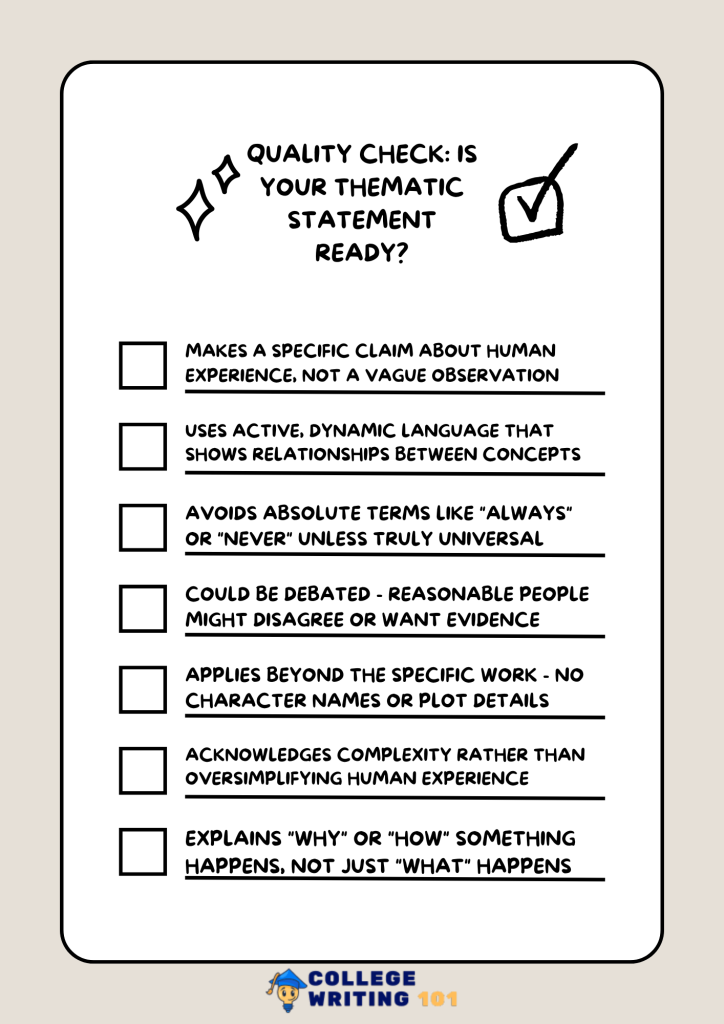
Complete and specific – It goes beyond naming a topic to make a clear assertion about human nature, society, or life. Rather than just saying “friendship,” it might state “True friendship requires mutual sacrifice and understanding.”
Universal yet nuanced – It addresses experiences or truths that resonate across different contexts while avoiding oversimplification. It shouldn’t be so broad as to be meaningless or so narrow as to apply only to the specific story.
Arguable and complex – The best thematic statements present ideas that could be debated or explored from multiple angles. They often acknowledge the complexity of human experience rather than offering simple moral lessons.
Free of plot specifics – A thematic statement shouldn’t reference specific characters, events, or details from the work. Instead, it should capture a broader truth that the story illustrates.
Stated positively – Rather than focusing on what something is not, effective thematic statements assert what something is or does.
Examples: Common Themes vs. Thematic Statements
Love
- Theme: Love
- Thematic statement: “Love requires individuals to be vulnerable and accept the risk of pain in order to experience genuine connection.”
Power and corruption
- Theme: Power and corruption
- Thematic statement: “Absolute power inevitably corrupts even those who initially possess noble intentions.”
Coming of age
- Theme: Coming of age
- Thematic statement: “The transition to adulthood requires letting go of childhood innocence while learning to navigate moral complexity.”
Social inequality
- Theme: Social inequality
- Thematic statement: “Economic disparity creates systemic barriers that perpetuate cycles of poverty across generations.”
Identity
- Theme: Identity
- Thematic statement: “Personal identity is shaped more by individual choices and actions than by circumstances of birth or social expectations.”
The key difference is that themes are topics for discussion, while thematic statements are the author’s specific conclusions or insights about those topics.
How to Write a Thematic Statement
1. Identify the Central Theme Start by determining what broad topic or concept the work explores. Ask yourself: What is this story really about beyond the plot? Common themes include identity, justice, family, sacrifice, or the nature of good and evil.
2. Analyze the Author’s Perspective Consider what specific message or insight the author conveys about this theme. Look at how characters develop, what conflicts arise, and how the story resolves. What does the author seem to believe about this topic?
3. Make it Universal Transform your observation into a statement that applies beyond the specific story. Remove character names, plot details, and setting-specific elements. Focus on the broader human truth being illustrated.
4. Ensure Completeness Write a full sentence that makes a clear assertion. Avoid fragments or questions. Your statement should be declarative and confident.
5. Test for Specificity Make sure your statement is detailed enough to be meaningful. “Love is important” is too vague, while “Love requires sacrifice and compromise to survive life’s challenges” is more specific and insightful.
Examples of Thematic Statements
From Literature
“To Kill a Mockingbird” by Harper Lee
- Theme: Moral courage and prejudice
- Thematic statement: “True integrity requires defending what is right even when society pressures you to conform to unjust norms.”
“The Great Gatsby” by F. Scott Fitzgerald
- Theme: The American Dream and social class
- Thematic statement: “The pursuit of wealth and status often corrupts genuine human connections and leads to moral emptiness.”
“Romeo and Juliet” by William Shakespeare
- Theme: Love and fate
- Thematic statement: “Intense passion can transcend social barriers but may ultimately destroy those who pursue it recklessly.”
- Theme: Power and totalitarianism
- Thematic statement: “Absolute governmental control destroys individual thought and human dignity through systematic manipulation of truth.”
“The Catcher in the Rye” by J.D. Salinger
- Theme: Coming of age and authenticity
- Thematic statement: “The transition to adulthood involves confronting the gap between idealistic expectations and disappointing realities.”
“Macbeth” by William Shakespeare
- Theme: Ambition and corruption
- Thematic statement: “Unchecked ambition corrupts moral judgment and ultimately leads to self-destruction.”
From Films and TV Shows
- Theme: Order versus chaos
- Thematic statement: “Maintaining moral principles becomes most difficult when facing adversaries who reject all ethical boundaries.”
- Theme: Moral transformation and consequences
- Thematic statement: “Small moral compromises can escalate into complete ethical collapse when justified by noble intentions.”
- Theme: Family loyalty and corruption
- Thematic statement: “Fierce loyalty to family can lead individuals to betray their own moral principles and perpetuate cycles of violence.”
- Theme: Environmental responsibility and human connection
- Thematic statement: “Technological convenience can isolate people from meaningful relationships and responsibility for their environment.”
“The Pursuit of Happyness” (2006)
- Theme: Perseverance and parental sacrifice
- Thematic statement: “Determination and sacrifice can overcome seemingly impossible circumstances, but often at great personal cost.”
- Theme: Technology and human nature
- Thematic statement: “Advanced technology amplifies both human potential and human flaws, often creating unintended social consequences.”
- Theme: Finding meaning in ordinary life
- Thematic statement: “Genuine human connections can transform mundane work environments into sources of purpose and joy.”
From Everyday Life Situations
Social Media and Relationships
- Theme: Digital connection versus authentic intimacy
- Thematic statement: “Social media creates the illusion of connection while often preventing the vulnerability necessary for genuine relationships.”
Work-Life Balance
- Theme: Career ambition versus personal fulfillment
- Thematic statement: “Professional success without personal relationships often leads to a sense of emptiness despite external achievements.”
Parenting and Independence
- Theme: Protection versus growth
- Thematic statement: “Overprotecting children can prevent them from developing the resilience necessary to handle life’s challenges.”
Friendship and Time
- Theme: Maintaining relationships through life changes
- Thematic statement: “Lasting friendships require intentional effort and adaptation as people grow and circumstances change.”
Money and Happiness
- Theme: Material wealth versus contentment
- Thematic statement: “Financial security can provide peace of mind, but the endless pursuit of wealth often diminishes appreciation for life’s simple pleasures.”
Education and Success
- Theme: Formal learning versus life experience
- Thematic statement: “True wisdom comes from combining academic knowledge with practical experience and emotional intelligence.”
Community and Individual Rights
- Theme: Personal freedom versus collective responsibility
- Thematic statement: “Individual liberty thrives best within communities that balance personal freedom with mutual obligation and respect.”
Aging and Legacy
- Theme: Time and mortality
- Thematic statement: “The awareness of mortality can either paralyze people with fear or motivate them to live more purposefully and authentically.”
Competition and Cooperation
- Theme: Achievement versus collaboration
- Thematic statement: “Sustainable success often requires balancing competitive drive with the ability to work effectively with others.”
Change and Tradition
Thematic statement: “Healthy societies honor their traditions while remaining open to necessary change and growth.”
Theme: Progress versus heritage
Why Thematic Statements are Important
In Literary Analysis and Education
Develops Critical Thinking Skills Crafting thematic statements requires students to move beyond plot summary to deeper analysis. They must synthesize evidence, recognize patterns, and draw meaningful conclusions about complex ideas. This process strengthens analytical reasoning that applies across disciplines.
Enhances Reading Comprehension Understanding themes helps readers connect with literature on multiple levels. Instead of simply following events, readers learn to recognize underlying meanings, symbolic elements, and authorial intent. This deeper engagement makes reading more rewarding and memorable.
Improves Writing and Communication Learning to articulate thematic statements teaches students to express complex ideas clearly and persuasively. This skill translates directly to academic writing, professional communication, and everyday discourse about important topics.
Builds Cultural Literacy Thematic analysis helps students understand how literature reflects and shapes cultural values across different time periods and societies. This knowledge creates informed citizens who can engage meaningfully with diverse perspectives.
Prepares for Standardized Testing Many academic assessments require students to identify themes and support interpretations with textual evidence. Strong thematic analysis skills directly improve performance on these evaluations.
In Personal Development
Promotes Self-Reflection Identifying themes in literature often mirrors the process of understanding patterns in one’s own life. Readers learn to recognize recurring challenges, relationships, and personal growth opportunities through thematic thinking.
Develops Empathy and Perspective Exploring universal themes helps people understand experiences different from their own. When readers recognize that themes like loss, identity, or moral conflict transcend individual circumstances, they develop greater compassion for others.
Provides Framework for Decision-Making Understanding thematic patterns in stories can illuminate similar patterns in real life. People who recognize themes like “power corrupts” or “sacrifice leads to growth” can apply these insights to their own choices and relationships.
Enhances Emotional Intelligence Thematic analysis requires recognizing complex emotional and psychological patterns. This skill helps people better understand their own motivations and responses as well as those of others.
In Communication and Discussion
Creates Common Ground Thematic statements provide a shared vocabulary for discussing complex ideas. When people can articulate universal themes, they can have more meaningful conversations about literature, films, current events, and personal experiences.
Facilitates Cross-Cultural Understanding While specific cultural expressions vary, many themes are universal. Recognizing shared thematic concerns helps bridge cultural divides and promotes mutual understanding across different backgrounds.
Improves Persuasive Communication Understanding how themes resonate with audiences makes speakers and writers more effective. Politicians, marketers, and advocates who understand thematic appeal can craft more compelling messages.
Encourages Nuanced Thinking Thematic statements require acknowledging complexity rather than oversimplifying issues. This skill is crucial for navigating polarized discussions and finding constructive solutions to social problems.
In Creative and Professional Work
Guides Creative Decision-Making Writers, filmmakers, and other artists use thematic statements to maintain focus and coherence in their work. A clear thematic vision helps creators make consistent choices about plot, character development, and artistic elements.
Enhances Leadership Skills Effective leaders often communicate through stories and examples that illustrate larger principles. Understanding how to identify and articulate themes helps leaders inspire others and create shared vision.
Improves Problem-Solving Thematic thinking helps people recognize patterns and underlying principles in complex situations. This skill is valuable in business, science, and any field requiring systematic analysis.
Supports Professional Development Many careers require the ability to analyze information, identify patterns, and communicate insights effectively. Thematic analysis develops all of these transferable skills.
In Social and Cultural Context
Promotes Democratic Engagement Citizens who can identify and analyze themes in political discourse are better equipped to evaluate candidates, policies, and media messages critically. This skill is essential for maintaining healthy democratic institutions.
Encourages Social Justice Awareness Many important social issues are fundamentally thematic in nature—examining patterns of inequality, discrimination, or systemic problems. Thematic analysis helps people recognize and address these broader patterns.
Preserves Cultural Memory They help preserve and transmit important cultural wisdom across generations. By articulating the enduring themes in classic works, societies maintain connection to their values and heritage.
Facilitates Meaningful Dialogue In an age of superficial communication, the ability to engage with deeper themes creates opportunities for more substantial conversations about what matters most in human experience.
Mistakes to Avoid
Confusing a theme with a topic – A topic is a subject like “love” or “war,” while a thematic statement expresses a complete idea, such as “Love has the power to heal even deep wounds.”
Summarizing the plot instead of the theme – It should not retell what happens in the story and explain the underlying message.
Being too specific – Avoid mentioning character names, places, or events. A good thematic statement should apply universally, not just to one story.
Writing moral lessons as commands – Instead of saying “You should never give up,” phrase it universally: “Perseverance helps people overcome challenges.”
Making it too vague – A statement like “Life is hard” is too broad. Instead, aim for depth, such as “Life’s challenges help people grow stronger.”
FAQs
What words should be used in a thematic statement?
Use universal words that express ideas about life, society, or human nature (e.g., love, hope, courage, freedom, friendship, loss). Avoid character names or plot details.
What is an example of a thematic statement for hope?
“Hope gives people the strength to overcome challenges and keep moving forward.”
What is a theme statement for friendship?
“True friendship provides support and loyalty during both good and difficult times.”