
An empirical article is a formal, research-based paper that presents original findings. Unlike theoretical essays or opinion pieces, its core purpose is to share new knowledge acquired through direct observation or experimentation. This foundational format of scientific reporting follows a standardized structure, typically including distinct sections for an introduction, methodology, results, and discussion.
The process begins with a specific research question. The authors then detail their methods, explaining exactly how they collected measurable data, whether through surveys, experiments, or other systematic techniques. The results section presents the raw data and analysis, often using statistics and visuals. Finally, the discussion interprets these findings, explaining their significance and how they connect to existing knowledge. In essence, an empirical article provides verifiable evidence to support its conclusions, forming the bedrock of academic progress across numerous disciplines.
Key Features of an Empirical Article
Structured Format
Empirical articles follow a standardized organization that ensures clarity and reproducibility. The typical structure includes:
- Abstract: A concise summary of the study’s purpose, methods, findings, and conclusions
- Introduction: Background information, literature review, and research questions or hypotheses
- Methodology: Detailed description of research design, participants, materials, and procedures
- Results: Presentation of findings through data analysis, often including tables and figures
- Discussion: Interpretation of results, implications, limitations, and suggestions for future research
- References: Complete citations of all sources used
Research Questions and Hypotheses
Every empirical article begins with clearly defined research questions or testable hypotheses. These statements guide the entire study and provide a framework for data collection and analysis. Well-formulated hypotheses are specific, measurable, and based on existing theoretical foundations or previous research findings.
Systematic Data Collection
The methodology section describes precisely how data was gathered, ensuring transparency and replicability. This includes:
- Sample selection: How participants or subjects were chosen
- Data collection instruments: Surveys, tests, observation protocols, or measuring devices
- Procedures: Step-by-step process followed during data gathering
- Ethical considerations: Informed consent, privacy protection, and institutional review
Quantitative or Qualitative Analysis
Empirical articles employ rigorous analytical methods appropriate to their research design:
- Quantitative analysis: Statistical tests, correlation analysis, regression models, or experimental comparisons
- Qualitative analysis: Thematic coding, content analysis, or interpretive frameworks
- Mixed methods: Combination of both approaches for comprehensive understanding
Objective Reporting
Results are presented objectively, separating findings from interpretation. Authors report what the data shows without bias, including unexpected or contradictory results. Statistical significance, effect sizes, and confidence intervals are commonly reported in quantitative studies.
Peer Review Process
Empirical articles undergo rigorous peer review before publication, where experts in the field evaluate the study’s methodology, analysis, and conclusions. This quality control ensures that published research meets academic standards and contributes meaningfully to scientific knowledge.
Replicability and Transparency
A hallmark of empirical research is that other researchers should be able to replicate the study using the provided methodology. This requires detailed documentation of all procedures, materials, and analytical approaches used in the investigation.
Evidence-Based Conclusions
Conclusions are directly supported by the collected data and analysis. Authors acknowledge limitations of their findings and avoid overgeneralization beyond what the evidence supports. Recommendations for future research often emerge from identified gaps or unexpected findings.
Contribution to Knowledge
Empirical articles advance understanding within their field by either confirming existing theories, challenging established assumptions, or revealing new patterns and relationships. They build upon previous research while opening new avenues for investigation.
Ethical Standards
All empirical research adheres to established ethical guidelines, protecting participant welfare and ensuring data integrity. This includes obtaining proper approvals, maintaining confidentiality, and reporting results honestly without manipulation or selective reporting.
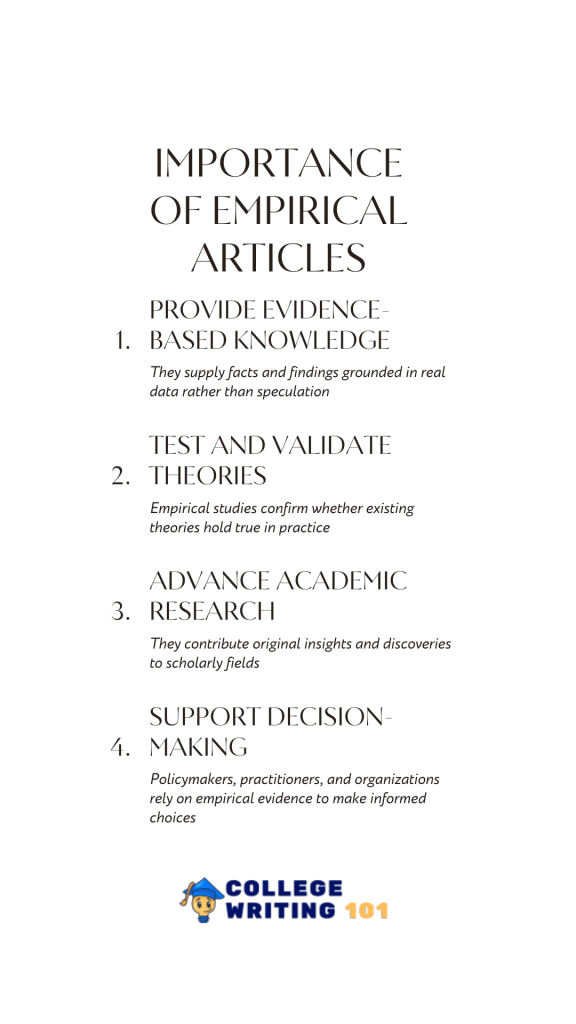
How to Identify an Empirical Article
Key Structural Components to Look For
Abstract Characteristics The abstract of an empirical article typically includes four main elements: the purpose or research question, the methodology used, key findings, and conclusions or implications. Look for phrases like “this study examined,” “data were collected from,” “results indicate,” or “findings suggest.” The abstract should clearly indicate that original research was conducted.
Introduction and Literature Review Empirical articles begin with a comprehensive literature review that establishes the theoretical foundation and identifies gaps in existing knowledge. The introduction concludes with specific research questions, hypotheses, or objectives that the study aims to address. This section demonstrates how the current study builds upon previous research while contributing something new to the field.
Methodology Section This is perhaps the most distinctive feature of an empirical article. The methodology section provides detailed information about how the research was conducted, including:
- Research design (experimental, correlational, qualitative, etc.)
- Participants or subjects (sample size, demographics, selection criteria)
- Data collection procedures and instruments
- Variables measured or manipulated
- Ethical considerations and approvals
- Data analysis techniques
The level of detail should be sufficient for other researchers to replicate the study.
Results Section The results section presents the findings from data analysis without interpretation. It typically includes:
- Statistical analyses and their outcomes
- Tables, figures, and graphs displaying data
- Descriptive statistics
- Tests of hypotheses or research questions
- Raw findings before discussion of their meaning
Discussion and Conclusion This section interprets the results, relates findings back to the literature review, discusses limitations, and suggests implications for theory and practice. Authors often propose directions for future research based on their findings.
Language and Terminology Indicators
Empirical articles use specific language that signals original research was conducted. Look for terms and phrases such as:
- “We conducted,” “we examined,” “we investigated”
- “Participants were recruited,” “subjects completed”
- “Data were collected,” “measures included”
- “Statistical analyses revealed,” “results showed”
- “The experiment demonstrated,” “our findings indicate”
- References to specific statistical tests (t-tests, ANOVA, regression analysis, etc.)
Types of Empirical Research to Recognize
Quantitative Studies These involve numerical data and statistical analysis. They often test hypotheses and look for relationships between variables. Common types include experiments, surveys, and correlational studies.
Qualitative Studies These focus on understanding experiences, behaviors, or phenomena through non-numerical data like interviews, observations, or textual analysis. Methods include ethnography, case studies, and phenomenological research.
Mixed Methods Studies These combine both quantitative and qualitative approaches within a single study to provide a more comprehensive understanding of the research question.
What Empirical Articles Are Not
To better identify empirical articles, it’s helpful to understand what they’re not:
Literature Reviews or Meta-Analyses While these may analyze existing research systematically, they don’t present new original data collection. They synthesize findings from multiple existing studies rather than conducting new research.
Theoretical Articles These propose new theories or frameworks but don’t test them with original data. They rely on logical argument and existing literature rather than empirical evidence.
Opinion Pieces or Editorials These express viewpoints or arguments but aren’t based on systematic data collection and analysis.
Case Reports While these may describe real situations, they typically don’t involve systematic data collection or statistical analysis across multiple cases.
Practical Tips for Quick Identification
Check the Journal Certain journals are more likely to publish empirical research. Look at the journal’s scope and typical content to get a sense of whether it primarily publishes original research.
Scan the Reference List Empirical articles typically cite methodological sources, measurement instruments, and statistical techniques alongside theoretical references.
Look for IRB Approval Many empirical studies involving human subjects will mention Institutional Review Board (IRB) approval or ethical clearance.
Examine Tables and Figures Empirical articles often contain data tables, statistical outputs, graphs, and charts that present original findings rather than just illustrative examples from other sources.
Check Author Affiliations Research-intensive institutions and authors with methodological expertise are more likely to produce empirical work.
Empirical vs. Review/Theoretical Articles
When reading academic journals, it is important to know the difference between empirical articles and review/theoretical articles. Both types of writing contribute to scholarly knowledge, but they serve different purposes and are written in distinct formats.
1. Empirical Articles
- Definition: Reports of original research based on direct observation, experiments, surveys, or other forms of data collection.
- Content: They typically follow the structure of Abstract, Introduction, Methodology, Results, Discussion, and References.
- Purpose: To provide evidence, test hypotheses, or generate new knowledge.
- Example: A study testing the effect of a new medication on patient recovery.
2. Review/Theoretical Articles
- Definition: Articles that summarize, compare, or discuss existing research without presenting new data from an experiment or study.
- Content: They synthesize findings from multiple empirical studies, build theories, or provide critical discussions.
- Purpose: To analyze trends in a research field, identify gaps, or propose new frameworks.
- Example: A literature review analyzing previous studies on climate change adaptation strategies.
Comparison Table: Empirical vs. Review/Theoretical Articles
| Feature | Empirical Articles | Review/Theoretical Articles |
|---|---|---|
| Definition | Original research based on data collection and analysis | Summarizes or critiques existing studies without new data |
| Structure | Abstract, Introduction, Methodology, Results, Discussion, References | Abstract, Introduction, Thematic/Topical Sections, Conclusion, References |
| Source of Information | Data collected through experiments, surveys, interviews, or observations | Published empirical studies, books, and previous reviews |
| Purpose | To present new findings and test hypotheses | To summarize knowledge, identify gaps, or propose new theories |
| Example | A psychology experiment testing memory performance | A literature review of studies on human memory research |
| Contribution | Provides direct evidence and original insights | Provides context, synthesis, and theoretical foundations |
Examples of Empirical Research
Psychology and Behavioral Sciences
Cognitive Psychology Studies
- Cognitive Behavioral Therapy: Strategies for Enhancing Treatment Engagement – This empirical study examines the relationship between homework and symptom reduction in CBT, highlighting the role of patient beliefs and collaborative approaches in homework design.
Clinical Psychology Research
- Effects of Cognitive Behavioral Therapy on Anxiety and Depressive Symptoms in Advanced Cancer Patients: A Meta-Analysis – This meta-analysis found that cognitive behavioral therapy lasting 2-8 weeks is moderately effective for anxiety and depressive symptoms in advanced cancer patients.
Meta-Analysis Studies
- The Empirical Status of Cognitive-Behavioral Therapy: A Review of Meta-Analyses – This comprehensive review summarizes 16 methodologically rigorous meta-analyses examining CBT treatment outcomes for various psychiatric disorders.
Education Research
Medical Education Technology
- Medical Education Trends for Future Physicians in the Era of Advanced Technology and Artificial Intelligence: An Integrative Review – This integrative review examines how medical education must adapt to digitalized healthcare systems and identifies values that medical educators need to implement in curricula.
Learning and Pedagogy Studies
- How Cognitive Psychology Changed Medical Education Research – This research investigates how cognitive psychology principles have transformed medical education practices and student learning outcomes.
Cognitive Neuroscience Methods
- Method Matters: An Empirical Study of Impact in Cognitive Neuroscience – This study compares functional neuroimaging and lesion studies, examining their relative impact in elucidating brain structure-function relationships.
Health and Medical Research
Digital Health and Well-being
- Health Status in the Era of Digital Transformation and Sustainable Economic Development – This empirical study uses structural equation modeling to examine the complex relationship among healthcare expenditure, digital transformation, health status, and well-being within the European Union framework.
Depression Research
- Empirical Status of Cognitive Theory of Depression – This study reviews empirical evidence testing Beck’s cognitive theory of depression, finding support for increased negativity of cognitions in depressive thinking patterns.
FAQs
Where do I find empirical articles?
You can find empirical articles in academic databases such as Google Scholar, JSTOR, PubMed, PsycINFO, ScienceDirect, and ProQuest. Many universities also provide access to these databases through their libraries. When searching, use keywords along with filters like “empirical study” or “peer-reviewed” to narrow your results.
How to write an empirical article?
Writing an empirical article typically follows this structure:
Abstract – A brief summary of the study.
Introduction – Explanation of the research question and background.
Methodology – Details about participants, data collection, and procedures.
Results – Presentation of data and findings.
Discussion – Interpretation of results, limitations, and implications.
References – Sources cited.
Clarity, accuracy, and adherence to academic writing standards (such as APA style) are essential.
What are three types of empirical evidence?
Experimental Evidence – Data collected through controlled experiments.
Observational Evidence – Information gathered through watching and recording behavior/events.
Survey/Interview Evidence – Responses collected directly from participants.
Is empirical the same as quantitative?
Not exactly. Quantitative research is one form of empirical research, but not the only one. Empirical research also includes qualitative methods, which rely on observations, interviews, and case studies rather than numerical data. In short:
All quantitative studies are empirical.
Not all empirical studies are quantitative (some are qualitative)